🦷 General Care
✨ Treatments
👶 Family Care
💚 Wellness
💡 Resources

🦷 General Care
✨ Treatments
👶 Family Care
💚 Wellness
💡 Resources

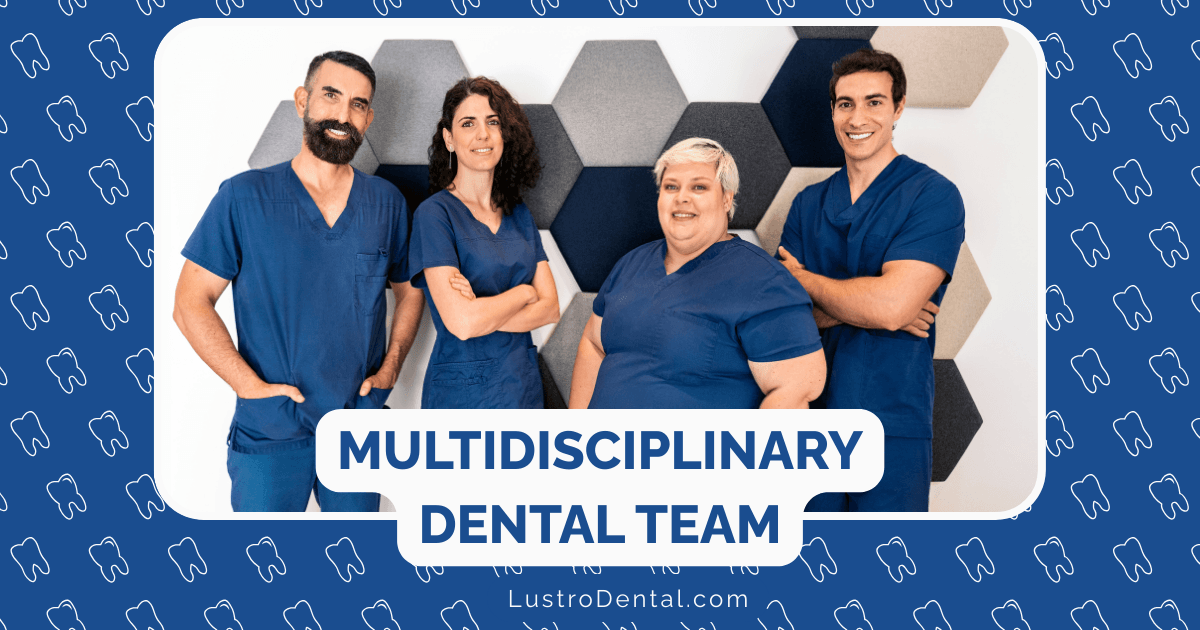
When it comes to your oral health, the days of the lone dentist handling everything from cleanings to complex surgeries are largely behind us. Modern dentistry has evolved into a collaborative field where specialists with advanced training work together to deliver truly comprehensive care.
This team-based approach isn’t just a trendy healthcare model—it’s revolutionizing patient outcomes. According to the Journal of the American Dental Association, multidisciplinary dental teams can improve treatment success rates by up to 30% for complex cases.
Let’s explore how these dental dream teams work together and why having access to multiple specialists under one roof might be the key to optimal oral health.
The human mouth is surprisingly complex. Your oral health connects to virtually every system in your body, from cardiovascular to digestive to immune function. This complexity means that comprehensive care often requires multiple perspectives and skill sets.
Dr. Sarah Chen, Director of the Multidisciplinary Dental Institute, explains: “No single dental provider, no matter how talented, can master every technique and stay current in every subspecialty. The collaborative model allows each specialist to focus deeply on their area of expertise while contributing to a cohesive treatment plan.”
Research published in the International Journal of Dentistry shows that patients treated by multidisciplinary teams report higher satisfaction, better functional outcomes, and fewer complications than those treated by isolated practitioners.
The general dentist serves as the primary oral healthcare provider and often the coordinator of your overall treatment plan. Think of them as your dental home base.
Responsibilities include:
Dr. James Wilson, a practicing general dentist, notes: “We’re like primary care physicians for the mouth. We see the big picture, coordinate care, and handle most routine needs, but we also know when to bring in specialists for the best patient outcomes.”
While not a dentist, the hygienist plays a crucial role in maintaining oral health and preventing disease.
Responsibilities include:
Endodontists focus on treating the dental pulp—the inner tissues containing nerves and blood vessels.
Responsibilities include:
According to the American Association of Endodontists, these specialists perform an average of 25 root canal treatments weekly, compared to general dentists who typically do two. This volume translates to greater expertise and higher success rates.
Periodontists focus on the prevention, diagnosis, and treatment of periodontal (gum) disease and the placement of dental implants.
Responsibilities include:
The American Academy of Periodontology notes that nearly half of Americans over 30 have some form of periodontal disease, making this specialty crucial for comprehensive oral health.
Orthodontists diagnose and treat malocclusions (improper bites) and other irregularities in tooth position.
Responsibilities include:
Dr. Emily Rodriguez, an orthodontist with 15 years of experience, explains: “We don’t just straighten teeth for aesthetics. Proper alignment is fundamental to function, comfort, and the longevity of your dentition.”
These specialists handle the surgical aspects of dental care, including complex extractions and reconstructive procedures.
Responsibilities include:
Oral surgeons complete 4-6 years of additional training after dental school, often including medical school, making them uniquely qualified for complex cases.
Prosthodontists focus on the restoration and replacement of missing teeth and oral structures.
Responsibilities include:
The American College of Prosthodontists points out that these specialists are the architects of dental reconstruction, combining functional needs with aesthetic considerations.
Pediatric dentists specialize in treating children from infancy through adolescence, including those with special healthcare needs.
Responsibilities include:
According to the American Academy of Pediatric Dentistry, these specialists complete 2-3 years of additional training focused on child psychology, growth, and development.
Consider Sarah, a 45-year-old patient with multiple missing teeth, severe gum disease, misaligned remaining teeth, and chronic jaw pain. In a traditional model, she might bounce between different practices, facing communication gaps and potentially conflicting treatment plans.
In a multidisciplinary practice, her care might unfold like this:
Dr. Michael Roberts, who leads a multidisciplinary practice, explains: “Each specialist contributes their expertise at the right moment in the treatment sequence. The result is more predictable, more efficient, and ultimately more successful than what any single provider could achieve.”
Multiple perspectives lead to more thorough assessment. A study in the Journal of Prosthodontic Research found that multidisciplinary evaluation identified an average of 3.2 more significant findings per patient than single-provider assessment.
When specialists collaborate from the beginning, treatment sequences can be optimized. For example, the orthodontist and oral surgeon can coordinate on exactly how teeth should be moved before implant placement.
Receiving care from multiple specialists within one practice means:
In a multidisciplinary practice, specialists communicate directly rather than through referral letters or patient messages. This immediate feedback loop reduces misunderstandings and improves care coordination.
Research published in the International Journal of Prosthodontics demonstrates that complex cases treated by multidisciplinary teams have higher success rates, fewer complications, and better long-term stability.
While not every dental practice offers comprehensive specialist care under one roof, this model is becoming increasingly common. Here’s how to find a practice that offers team-based care:
Many larger dental groups now house several specialists alongside general dentists.
Even if specialists aren’t in the same physical location, ask how your general dentist coordinates care with specialists. Do they have regular case conferences? Do they share digital records seamlessly?
Modern practices should have systems for sharing images, treatment notes, and plans between providers. Ask about their digital integration.
Academic dental centers and hospital dental departments typically offer multidisciplinary care and often feature the latest techniques and technologies.
The team approach to dentistry continues to evolve with technology playing an increasingly important role. Dr. Lisa Chen, a dental futurist, predicts: “We’re moving toward virtual collaboration platforms where specialists can consult on cases in real-time, regardless of physical location. This will make multidisciplinary care accessible even in rural areas.”
Other emerging trends include:
The complexity of oral health demands a team approach for truly comprehensive care. While a skilled general dentist remains the foundation of your dental care, having access to specialists working in coordination can elevate your treatment outcomes to new levels.
As you evaluate your dental care options, consider the advantages of practices that embrace the multidisciplinary model. Your smile—and your overall health—may benefit significantly from the combined expertise of dental specialists working together toward your optimal oral health.
Have you experienced multidisciplinary dental care? Share your experience in the comments below.