🦷 General Care
✨ Treatments
👶 Family Care
💚 Wellness
💡 Resources

🦷 General Care
✨ Treatments
👶 Family Care
💚 Wellness
💡 Resources

When I talk to patients about their dental health concerns, I often hear worries about cavities, gum disease, or even the dreaded root canal. Rarely does someone mention oral cancer screening—yet this simple 5-minute exam could literally be the difference between life and death.
Here’s a sobering statistic: According to the American Cancer Society, approximately 59,660 Americans will be diagnosed with oral or oropharyngeal cancer in 2025, and nearly 12,770 will die from these cancers—that’s roughly one person every hour of every day.
What makes these numbers even more heartbreaking is that when caught early, oral cancer has an 86.3% five-year survival rate. Yet when discovered in later stages, that rate plummets to just 40.4%. The difference? Often just a simple screening that takes less time than brewing your morning coffee.
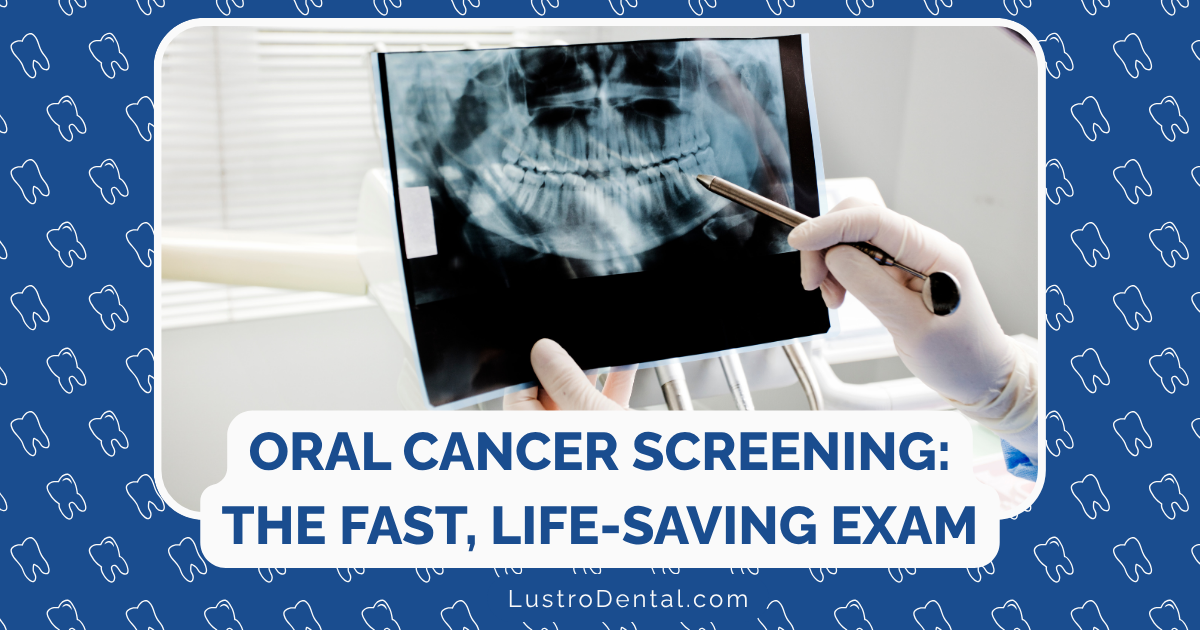
An oral cancer screening is a quick, painless examination performed by your dentist or doctor to look for signs of cancer or precancerous conditions in your mouth. Despite what many believe, it’s not a separate procedure requiring a special appointment—it’s typically part of your regular dental check-up.
Dr. Lisa Thompson, an oral pathologist at the University of California San Francisco, explains: “Many patients don’t realize they’re actually receiving an oral cancer screening during their routine dental visits. When we examine the teeth and gums, we’re simultaneously evaluating all the soft tissues for any suspicious changes.”
The screening process typically involves two main components:
Your dentist will look at your:
They’re looking for:
Using gloved hands, your dentist will feel the tissues in your mouth, your jaw, and the lymph nodes in your neck to detect any abnormalities that might not be visible to the naked eye.
Some dental practices also use additional screening tools to enhance detection:
The entire process typically takes about five minutes—possibly the most valuable five minutes of your dental appointment.
The Oral Cancer Foundation recommends that everyone receive an oral cancer screening at least once a year. However, certain groups should consider more frequent screenings:
Dr. James Morrison of the National Institute of Dental and Craniofacial Research notes, “We’re seeing a disturbing trend of oral cancers in younger patients who don’t have the traditional risk factors of tobacco and alcohol use. Many of these cases are HPV-related, which makes regular screening even more critical for everyone.”
While professional screenings are irreplaceable, monthly self-examinations can help catch changes early. Here’s a simple process you can follow at home:
Remember: Any sore, discoloration, or lump that persists for more than two weeks should be evaluated by a professional.
Statistics tell one story, but personal experiences reveal the true impact of early detection. Take Sarah, a 42-year-old teacher and non-smoker who shared her story with me:
“During a routine dental cleaning, my dentist noticed a small white patch under my tongue. I hadn’t seen it—who looks under their tongue regularly? It didn’t hurt, and I felt completely healthy. She recommended a biopsy, which revealed early-stage oral cancer. After treatment, I’m cancer-free five years later. That five-minute screening literally saved my life.”
Stories like Sarah’s aren’t rare. Dr. Robert Haddad at Dana-Farber Cancer Institute points out that “Many oral cancer survivors can trace their successful outcomes back to a routine dental visit where an attentive provider noticed something suspicious.”
Despite the clear benefits, many people don’t receive regular oral cancer screenings. The reasons vary:
Community health initiatives like Free Oral Cancer Screening Events are working to bridge this gap, but more awareness is needed.
First, don’t panic. The majority of abnormalities discovered during screenings are not cancerous. If your dentist finds something concerning, they may:
Remember that early detection is the key to successful treatment. According to the National Cancer Institute, when oral cancer is diagnosed before it has spread, the 5-year relative survival rate is nearly 86%—significantly better than many other cancers.
As someone deeply committed to preventive health, I believe oral cancer screening represents one of the most undervalued yet potentially life-saving procedures in healthcare today. Consider this:
Dr. Caitlin Hoffman of Memorial Sloan Kettering Cancer Center puts it perfectly: “If I told you that five minutes of your time once or twice a year could potentially save your life, wouldn’t you make that time? That’s exactly what oral cancer screening offers.”
Remember, the most dangerous phrase in healthcare might be “it’s probably nothing.” When it comes to unusual changes in your mouth, professional evaluation is always the right choice.
The five minutes you spend getting screened for oral cancer might just be the most important five minutes of your year. Isn’t your life worth that time?
Have you ever had an oral cancer screening? Did you know it was part of your regular dental check-up? Share your experiences in the comments below.