🦷 General Care
✨ Treatments
👶 Family Care
💚 Wellness
💡 Resources

🦷 General Care
✨ Treatments
👶 Family Care
💚 Wellness
💡 Resources

If you’ve been exploring tooth replacement options, you’ve likely encountered the classic dilemma: traditional dentures are affordable but problematic, while full dental implants provide amazing results but at a premium price. What if there was a middle ground that combines the best aspects of both?
Enter implant-supported dentures—a revolutionary solution that marries the comprehensive coverage of dentures with the stability and functionality of dental implants. As someone who’s guided countless patients through this decision, I’ve seen firsthand how this hybrid approach can be life-changing.
Let’s explore why implant-supported dentures might be the “just right” solution you’ve been searching for.
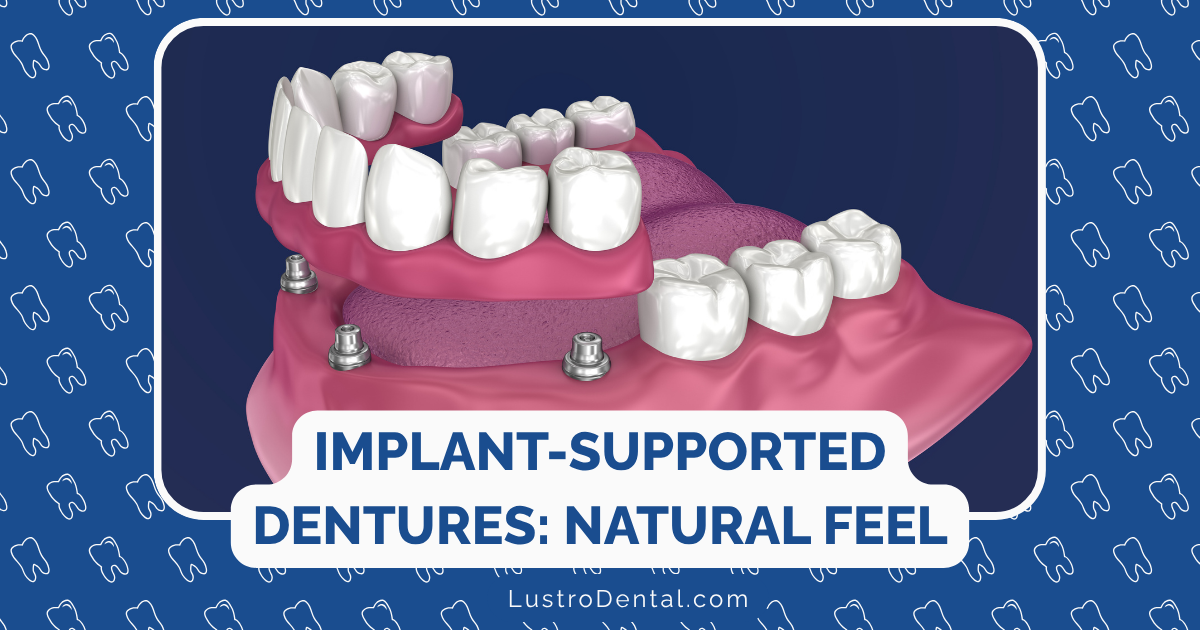
Implant-supported dentures are exactly what they sound like—dentures that are secured to dental implants rather than simply resting on your gums. These specialized prosthetics use a variety of attachment methods to connect to titanium implants that are surgically placed in your jawbone.
Unlike traditional dentures that rely on suction and adhesives to stay in place, implant-supported dentures are anchored directly to your jaw, creating a secure foundation that prevents shifting, slipping, and the embarrassing moments that often accompany conventional dentures.
According to the American College of Prosthodontists, more than 36 million Americans are missing all their teeth. For many of these individuals, implant-supported dentures offer a middle path between budget-friendly traditional dentures and the higher investment of full implant restorations.
Not all implant-supported dentures are created equal. There are several varieties, each with its own advantages:
A thin metal bar follows the curve of your jaw and attaches to 2-5 implants. The denture features clips or attachments that secure to this bar, providing stability while allowing removal for cleaning.
Each implant in your jaw holds a metal attachment that fits into a corresponding socket on the denture. Often called “snap-in” or “snap-on” dentures, these use a ball-and-socket mechanism for security and easy removal.
According to research from the Journal of Prosthetic Dentistry, patients with removable implant-supported dentures report 89% higher satisfaction rates compared to traditional dentures, primarily due to improved stability and chewing ability.
These permanent dentures are secured to 4-8 implants and can only be removed by a dentist. They provide maximum stability and function most like natural teeth.
This innovative approach uses just four strategically placed implants (or six for All-on-6) to support an entire arch of teeth. The posterior implants are angled to maximize contact with available bone, often eliminating the need for bone grafting.
Dr. Sarah Johnson, a prosthodontist at Advanced Dental Solutions, explains: “The All-on-4 technique has revolutionized implant dentistry by making full-arch restoration accessible to patients who previously weren’t candidates due to bone loss. It’s truly a game-changer.”
Understanding the journey to implant-supported dentures helps set realistic expectations. While the specific timeline varies based on your oral health and the type of restoration, here’s a general overview:
Your journey begins with a comprehensive evaluation that typically includes:
Modern dental practices like Digital Smile Design now use advanced imaging and software to create a virtual preview of your results before treatment begins.
Some patients require preparatory procedures before implant placement:
According to the American Academy of Implant Dentistry, approximately 40% of implant patients require some form of bone augmentation prior to implant placement.
The foundation of your new smile is established during implant surgery:
With computer-guided implant placement, this procedure is more precise and comfortable than ever before. A 2023 study in the International Journal of Oral & Maxillofacial Implants found that guided surgery reduced implant placement error by up to 70% compared to freehand techniques.
This critical healing phase allows the implants to fuse with your jawbone:
“Osseointegration is the biological process that makes dental implants so successful,” explains Dr. Michael Chen of the Institute for Dental Implant Awareness. “It’s worth the wait to ensure your implants have a rock-solid foundation.”
Once healing is complete, the connection between your implants and denture is established:
The culmination of your treatment brings your new smile to life:
With digital denture technology, this process is becoming increasingly precise. CAD/CAM systems can create dentures with accuracy within 0.01mm, ensuring exceptional fit and comfort.
Perhaps the most immediate benefit is the end of denture movement. No more worrying about your teeth shifting while speaking or eating. A clinical study published in the Journal of Oral Rehabilitation found that implant-supported dentures provide up to 90% of the stability of natural teeth, compared to just 20-30% for traditional dentures.
When teeth are lost, the jawbone begins to deteriorate—a process called resorption. Traditional dentures can actually accelerate this bone loss by placing pressure on the gums and underlying bone.
Implant-supported dentures change this equation entirely. The implants stimulate the jawbone just like natural tooth roots, maintaining bone volume and density. This preservation helps maintain your facial structure and prevents the “sunken” appearance often associated with long-term denture wear.
According to research from the International Journal of Oral & Maxillofacial Implants, patients with implant-supported dentures experience 75% less bone loss over five years compared to those with conventional dentures.
Traditional denture wearers often struggle with dietary limitations, avoiding foods that are difficult to chew. This can lead to nutritional deficiencies and diminished quality of life.
Implant-supported dentures restore near-natural chewing ability. A study in the Journal of Dentistry demonstrated that patients with implant-supported dentures can generate up to 85% of the chewing force of natural teeth, compared to just 20-25% with conventional dentures.
This improved function means you can enjoy a wider variety of foods, including fresh fruits, vegetables, and proteins essential for good health.
The psychological impact of secure, comfortable teeth shouldn’t be underestimated. Many traditional denture wearers develop anxiety about social situations, fearing embarrassing slippage or difficulty speaking.
Implant-supported dentures eliminate these concerns, allowing you to laugh, speak, and smile with confidence. A 2024 quality-of-life study found that 94% of patients reported significant improvements in social confidence within three months of receiving implant-supported dentures.
Say goodbye to denture pastes, powders, and strips. Implant-supported dentures stay securely in place without adhesives, simplifying your daily routine and eliminating the unpleasant taste and texture of these products.
While the initial investment is higher than traditional dentures, implant-supported dentures often provide better long-term value. According to the American Academy of Implant Dentistry, implant-supported restorations have a success rate exceeding 95% at 10 years, with many lasting 20+ years or even a lifetime with proper care.
In contrast, traditional dentures typically need replacement every 5-7 years due to changes in the jawbone and wear on the denture itself.
To help you understand how implant-supported dentures compare to other tooth replacement options, consider this comparison:
| Feature | Traditional Dentures | Implant-Supported Dentures | Full Implant Bridges |
| Initial Cost | $1,000-$3,000 per arch | $8,000-$20,000 per arch | $20,000-$50,000 per arch |
| Longevity | 5-7 years | 10-20+ years | 20+ years to lifetime |
| Stability | Poor to moderate | Excellent | Excellent |
| Bone Preservation | None (accelerates bone loss) | Good | Excellent |
| Chewing Efficiency | 20-25% of natural teeth | 75-85% of natural teeth | 90-100% of natural teeth |
| Maintenance | Daily removal, cleaning, adhesives | Depends on type (removable or fixed) | Professional cleaning, similar to natural teeth |
| Impact on Speech | May affect speech | Natural speech | Natural speech |
| Number of Implants | None | 2-6 per arch | 6-8 per arch |
| Candidacy Requirements | Minimal | Moderate bone requirements | Significant bone requirements |
While implant-supported dentures are suitable for many patients, certain factors affect candidacy:
Dr. Lisa Rodriguez of the Center for Implant Dentistry notes: “Thanks to advances like bone grafting, guided surgery, and the All-on-4 technique, we can now help many patients who previously weren’t candidates for implant treatment. It’s worth consulting with a specialist to explore your options.”
Implant-supported dentures represent a significant investment in your health and quality of life. In 2025, you can expect costs in these ranges:
These figures typically include:
However, they may not include:
Several options can help make implant-supported dentures more accessible:
While coverage varies significantly, more insurance plans are beginning to cover portions of implant treatment. According to the National Association of Dental Plans, approximately 35% of dental plans now offer some implant coverage, typically 50% up to an annual maximum.
These tax-advantaged accounts can be used for qualified dental procedures, including implants.
Many practices partner with third-party financing companies like CareCredit or LendingClub to offer payment plans, often with 0% interest for qualified patients.
Some patients opt to complete their implant treatment in stages, spreading the cost over time while still benefiting from improved denture stability.
Proper maintenance ensures the longevity of your investment:
Research from the Journal of Clinical Periodontology indicates that proper maintenance can increase implant success rates from 90% to over 98% at the 10-year mark.
Statistics tell part of the story, but patient experiences reveal the true impact of implant-supported dentures:
“After years of struggling with traditional dentures that slipped constantly, my implant-supported dentures have given me back my confidence. I can eat anything I want, and I never worry about embarrassing moments during conversations. It’s like having my natural teeth back.” – Margaret, 67
“As someone who lost my teeth at a relatively young age due to an accident, I was devastated by how traditional dentures limited my life. My implant-supported dentures have been transformative—I can eat, speak, and smile without a second thought. They’re as close to natural teeth as possible without the full implant price tag.” – James, 52
Implant-supported dentures truly represent the best of both worlds—combining the comprehensive coverage of dentures with the stability and function of dental implants at a price point between the two options.
While they require a greater initial investment than traditional dentures, the improvements in quality of life, oral health, and long-term value make them worth considering for anyone facing extensive tooth loss.
The best way to determine if implant-supported dentures are right for you is to consult with a dentist experienced in implant dentistry. They can evaluate your specific situation, discuss your goals, and help you understand all your options.
Remember that your smile is an investment in yourself—in your health, confidence, and daily quality of life. Choosing the right solution is about finding what works best for your unique needs and circumstances.