🦷 General Care
✨ Treatments
👶 Family Care
💚 Wellness
💡 Resources

🦷 General Care
✨ Treatments
👶 Family Care
💚 Wellness
💡 Resources

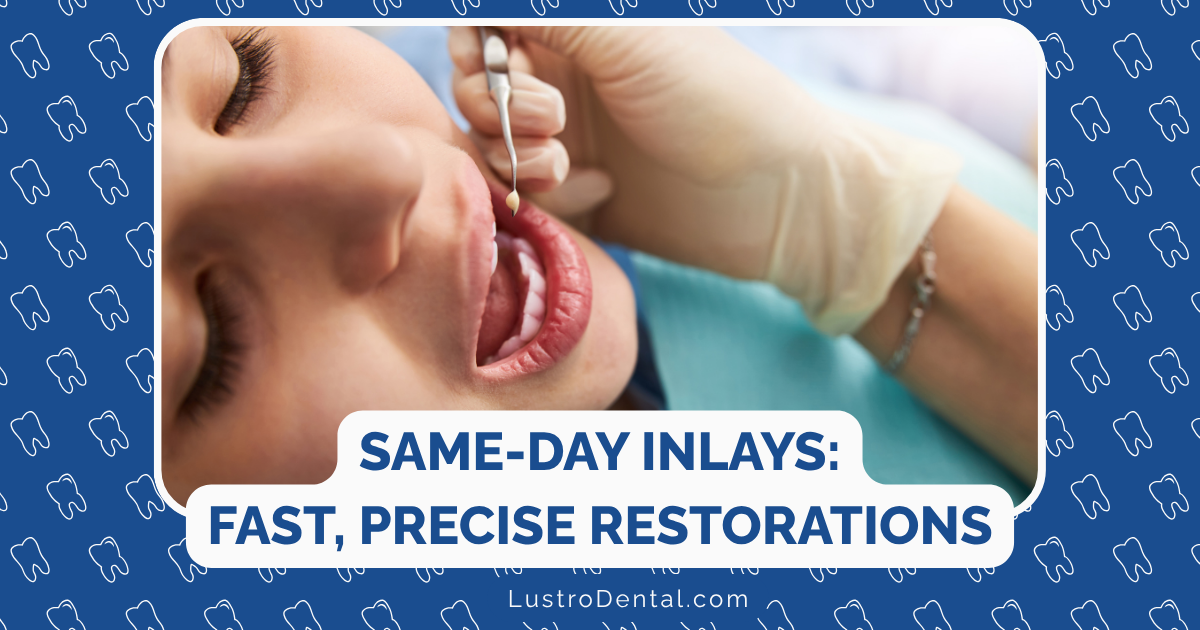
Remember when getting a dental inlay meant at least two appointments, a temporary restoration, and weeks of waiting? Those days are rapidly becoming history thanks to revolutionary advances in digital dentistry. Today, CAD/CAM technology is transforming the patient experience by enabling dentists to design, create, and place high-quality ceramic inlays in a single visit—often in less than two hours.
As someone who’s witnessed this digital revolution firsthand, I can tell you it’s changing more than just convenience factors. It’s improving precision, enhancing outcomes, and making quality dental care more accessible than ever before. Let’s explore how digital dentistry is eliminating the wait for inlays and what this means for your dental experience.
To appreciate how revolutionary same-day inlays are, it helps to understand the traditional process they’re replacing:
This process typically took 2-3 weeks from start to finish and required multiple appointments, temporary restorations (which could fall out or cause discomfort), and coordination between the dental office and external lab.
The game-changer in modern dentistry is CAD/CAM technology—Computer-Aided Design and Computer-Aided Manufacturing. This technology enables dentists to create precise, custom dental restorations right in the office.
The most popular CAD/CAM system for dental offices is CEREC (Chairside Economical Restoration of Esthetic Ceramics), though other systems like E4D and Planmeca also offer similar capabilities. These systems typically include:
Dr. Sarah Johnson, a prosthodontist at the University of Michigan School of Dentistry, explains: “CAD/CAM technology has revolutionized how we approach restorative dentistry. The precision we can achieve with digital scanning often exceeds what was possible with traditional impressions, and the ability to complete the entire process in one visit is transformative for patients.”
The digital workflow for creating same-day inlays is remarkably streamlined:
Instead of goopy impression materials that can trigger gag reflexes and discomfort, digital impressions use a small intraoral scanner—about the size of an electric toothbrush—to capture thousands of images of the prepared tooth and surrounding structures.
“Digital scanning is not only more comfortable for patients, but it’s also incredibly precise,” notes Dr. Michael Chen of the American Academy of Digital Dentistry. “Modern scanners can capture details down to 50 microns—about half the width of a human hair.”
Research published in the Journal of Prosthodontics found that digital impressions demonstrated accuracy comparable to or better than traditional impressions, with significantly higher patient comfort ratings.
Once the scan is complete, specialized software transforms the digital impression into a 3D model that the dentist can manipulate on screen. The dentist then designs the inlay with precision, ensuring perfect fit, proper contours, and ideal contact with adjacent teeth.
The software can automatically suggest optimal designs based on the patient’s unique anatomy, which the dentist can then refine. This combines the efficiency of automation with the expertise of the clinician.
With the design complete, the information is sent to an in-office milling machine. This precision instrument carves the inlay from a solid block of ceramic or composite material. The milling process typically takes 15-20 minutes, during which the dentist can see other patients or prepare for the final placement.
Modern milling units can achieve remarkable precision, with marginal discrepancies averaging just 50-100 microns—well within the clinically acceptable range of 120 microns.
Once milled, the inlay may undergo some final adjustments, polishing, and in some cases, staining and glazing to match the patient’s natural tooth color perfectly. The inlay is then bonded to the tooth using strong dental adhesives.
“The entire process—from scanning to final placement—typically takes 60-90 minutes of actual working time,” explains Dr. Lisa Rodriguez, a digital dentistry specialist at Advanced Dental Solutions. “This means patients can often receive their permanent inlay in a single 2-hour appointment.”
Same-day inlays aren’t just about speed—they’re also about advanced materials that offer exceptional durability and aesthetics:
Most CAD/CAM inlays are milled from high-strength ceramic materials like:
According to research published in the International Journal of Computerized Dentistry, ceramic inlays created using CAD/CAM technology demonstrate survival rates of over 90% at 10 years—comparable to or better than laboratory-fabricated restorations.
For certain situations, high-density composite blocks offer advantages:
“The materials available for CAD/CAM restorations have evolved dramatically,” notes Dr. James Wilson of the Academy of CAD/CAM Dentistry. “Today’s ceramic and composite blocks offer physical properties that often exceed those of traditionally fabricated restorations.”
One of the most significant benefits of digital dentistry is the precision it enables:
The margin—where the restoration meets the tooth—is critical for long-term success. Poor marginal fit can lead to bacterial infiltration, recurrent decay, and restoration failure.
A 2023 systematic review in the Journal of Prosthetic Dentistry analyzed 15 studies comparing the marginal fit of CAD/CAM inlays versus traditional laboratory-fabricated inlays. The findings showed that CAD/CAM inlays demonstrated mean marginal gaps of 50-100 μm, compared to 70-160 μm for traditional inlays.
Digital workflows reduce the variability inherent in manual processes. With traditional methods, the quality of an inlay depends heavily on the skill of the laboratory technician. Digital design and manufacturing introduce consistency that helps ensure predictable results.
“The standardization that digital dentistry brings to restorative procedures is perhaps its greatest unsung benefit,” explains Dr. Jennifer Martinez of Digital Dental Solutions. “We see much less variation in quality from one restoration to the next.”
While the time savings of same-day inlays are obvious, patients experience numerous other benefits:
The digital process allows patients to see their teeth and the proposed restoration on screen, fostering better understanding and involvement in treatment decisions.
According to a patient satisfaction study published in the Journal of Dentistry, patients who received same-day CAD/CAM restorations reported 92% higher satisfaction scores compared to those who underwent traditional multi-visit procedures.
For dental practices, the investment in digital technology offers several advantages:
While the initial investment for CAD/CAM technology is significant—typically $100,000-$150,000 for a complete system—many practices find the return on investment compelling.
Dr. Robert Wilson, a practice management consultant at Dental Economics Institute, notes: “Practices performing just 3-5 restorations per week can typically recoup their investment within 2-3 years, while improving patient satisfaction and clinical outcomes.”
Despite their many advantages, same-day inlays aren’t the perfect solution for every situation:
While CAD/CAM materials are excellent, they don’t yet cover the full spectrum of traditional options. For example, gold inlays—still considered the gold standard for durability—require traditional fabrication methods.
Implementing digital dentistry requires training and practice. Some dentists may produce better results with familiar traditional methods while they’re still mastering digital techniques.
The technology continues to evolve rapidly, with several exciting developments on the horizon:
Artificial intelligence is beginning to play a role in restoration design, analyzing thousands of successful cases to suggest optimal contours and occlusal relationships.
New ceramic and composite formulations continue to emerge, offering better aesthetics, strength, and milling properties.
Digital workflows are increasingly integrated with other dental technologies, such as cone beam CT imaging and digital smile design, for comprehensive treatment planning.
According to projections from the American Dental Association, by 2030, more than 80% of dental practices in the United States are expected to incorporate some form of CAD/CAM technology, up from approximately 40% in 2025.
If you need an inlay, consider these factors when deciding between same-day and traditional options:
The days of waiting weeks for a dental inlay are rapidly becoming a thing of the past. Digital dentistry—through CAD/CAM technology—is revolutionizing the patient experience by enabling same-day treatment that’s precise, comfortable, and convenient.
As Dr. Lisa Nguyen of the Digital Dentistry Society puts it: “Same-day inlays represent more than just a time-saving convenience—they’re a fundamental shift in how we deliver restorative care. By eliminating the wait, we’re not just saving time; we’re improving outcomes, enhancing patient satisfaction, and making quality dental care more accessible.”
For patients, this means less time in the dental chair, fewer appointments, and faster resolution of dental issues. For dentists, it means greater control over the final result, improved efficiency, and the satisfaction of providing state-of-the-art care.
The digital revolution in dentistry is here, and when it comes to inlays, the wait is over.