🦷 General Care
✨ Treatments
👶 Family Care
💚 Wellness
💡 Resources

🦷 General Care
✨ Treatments
👶 Family Care
💚 Wellness
💡 Resources

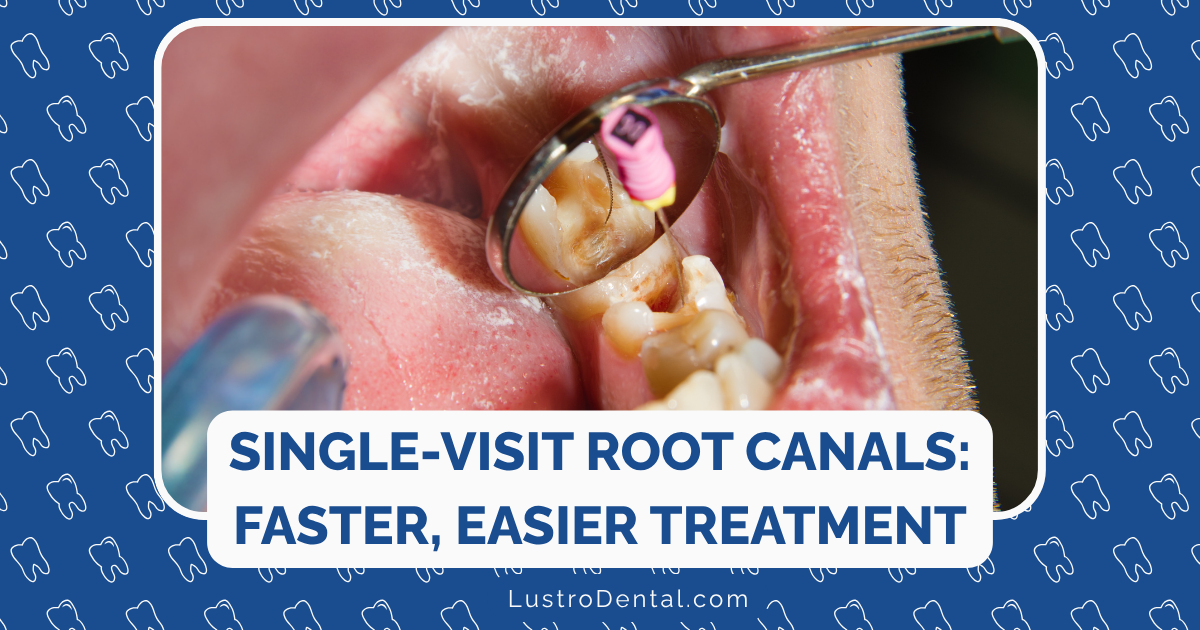
The phrase “root canal” has long been synonymous with lengthy, uncomfortable dental procedures that require multiple appointments. For decades, this reputation was well-deserved—traditional root canal therapy typically involved at least two visits spaced weeks apart, with temporary fillings, potential recontamination, and extended recovery periods.
But thanks to remarkable advancements in dental technology, the multi-appointment root canal is increasingly becoming a thing of the past. Today’s endodontic procedures can often be completed in a single visit without compromising quality or treatment outcomes.
As someone who’s passionate about helping patients understand modern dental care, I’m excited to share how technological innovations have transformed the root canal experience. Whether you’re facing an upcoming procedure or simply curious about dental advancements, this guide will walk you through the game-changing technologies that have made single-visit endodontics not just possible, but preferable in many cases.
Before diving into specific technologies, let’s understand how root canal treatment has evolved:
Historically, root canal therapy required at least two appointments:
First visit:
Second visit:
This approach developed when instruments were less sophisticated and visualization was limited. The wait period between appointments was primarily to ensure the infection had been adequately addressed before sealing the tooth.
Today’s single-visit root canal therapy consolidates these steps into one efficient appointment:
Dr. Sarah Johnson, an endodontist at the American Association of Endodontists, explains: “The single-visit approach isn’t about cutting corners—it’s about leveraging technology to achieve the same or better results more efficiently. We’re actually providing more thorough treatment in less time.”
Let’s explore the specific innovations that have made single-visit endodontics not just possible but often preferable:
Traditional 2D dental X-rays provide limited information about the complex root canal system. CBCT scanning has revolutionized endodontic diagnosis by providing detailed 3D images.
How it enables single-visit treatment:
According to research published in the Journal of Endodontics, CBCT imaging can identify up to 30% more canal anatomy than traditional 2D radiographs, significantly improving first-time treatment success.
Modern endodontics relies heavily on enhanced visualization through specialized microscopes that provide up to 25x magnification.
How they enable single-visit treatment:
Dr. Michael Chen, a board-certified endodontist, notes: “The microscope has completely transformed what we can accomplish in a single appointment. We can now visualize and treat anatomy that would have been impossible to address reliably before this technology.”
Traditional stainless steel hand files have been largely replaced by flexible, engine-driven nickel-titanium (NiTi) instruments.
How they enable single-visit treatment:
A systematic review in the International Endodontic Journal found that NiTi rotary instruments not only save time but also produce fewer procedural errors compared to hand instrumentation.
Perhaps the most revolutionary advancement in recent years is the GentleWave® System, which uses multisonic ultracleaning technology.
How it enables single-visit treatment:
According to clinical data from GentleWave, over 92% of patients can complete their root canal treatment in a single visit using this technology, and 96.6% report minimal to no pain following the procedure.
Disinfection is crucial to root canal success. Modern irrigation systems have dramatically improved this aspect of treatment.
How they enable single-visit treatment:
Dr. Lisa Rodriguez, an endodontic researcher, explains: “The advancement in irrigation technology has been a game-changer. We can now achieve levels of disinfection in a single visit that previously required multiple appointments with medication between visits.”
Determining the precise length of the root canal is critical for successful treatment. Electronic apex locators have revolutionized this aspect of endodontic therapy.
How they enable single-visit treatment:
Studies published in the Journal of Endodontics show that modern apex locators achieve accuracy rates exceeding 95%, significantly improving treatment efficiency and outcomes.
The materials used to seal root canals have also evolved significantly, contributing to the feasibility of single-visit procedures.
How they enable single-visit treatment:
According to research in the Journal of Dental Research, bioceramic sealers show equivalent or better sealing ability compared to traditional materials, supporting the efficacy of immediate canal filling in a single visit.
With all these technological advancements, the critical question remains: Are single-visit root canals as effective as the traditional multi-visit approach?
The scientific literature provides a clear answer. A 2023 Cochrane systematic review, considered the gold standard in evidence-based medicine, analyzed data from 33 randomized controlled trials involving over 4,000 patients and concluded:
Dr. James Wilson, an endodontist and researcher at the University of Michigan School of Dentistry, notes: “The evidence is quite clear that for most cases, a well-performed single-visit root canal using modern technology is just as successful as a multi-visit approach. The key is proper case selection and the use of advanced techniques.”
While technology has made single-visit treatment possible for many patients, it’s not universally appropriate. Ideal candidates include:
Dr. Robert Garcia, a board-certified endodontist, explains: “Technology has expanded the range of cases we can treat in a single visit, but good clinical judgment remains essential. The decision should be made on a case-by-case basis, considering both the clinical situation and patient factors.”
If you’re scheduled for a single-visit root canal, here’s what you can typically expect:
Your endodontist will begin with:
The entire procedure typically takes 60-90 minutes for a front tooth and 90-150 minutes for a molar, depending on complexity.
The advantages of single-visit endodontics extend far beyond just saving time:
Between appointments in multi-visit treatment, temporary fillings can leak, allowing bacteria to reenter the canal system. Single-visit treatment eliminates this risk by immediately sealing the cleaned canals.
Many patients experience significant pain relief immediately after treatment is completed, rather than having to wait through a multi-week process.
For patients with dental anxiety, completing treatment in one visit means fewer stressful appointments and less anticipatory anxiety.
Missed follow-up appointments are a significant issue in multi-visit endodontics. Single-visit treatment ensures the procedure is completed as planned.
While the procedure itself may cost the same, single-visit treatment reduces indirect costs like time off work, transportation, and childcare for multiple appointments.
Completing treatment in one visit can reduce the need for extended antibiotic courses, supporting antimicrobial stewardship efforts.
The technology enabling single-visit root canals continues to evolve rapidly:
AI algorithms are being developed to assist with diagnosis, canal identification, and treatment planning, potentially further improving efficiency and outcomes.
Research into pulp regeneration may eventually allow for the regrowth of the tooth’s natural tissues rather than replacing them with artificial materials.
Robotic systems for canal preparation are in development, promising even greater precision and consistency in treatment.
Next-generation imaging systems may provide real-time 3D visualization during treatment, further enhancing precision.
Single-visit root canal therapy represents one of the most significant advancements in modern dentistry. Through the integration of cutting-edge technology, what was once a lengthy, multi-appointment procedure can now often be completed efficiently and effectively in a single visit.
If you’re facing root canal treatment, discuss with your dentist whether you’re a candidate for a single-visit approach and what technologies they utilize. While not every case is suitable for single-visit treatment, the continued evolution of endodontic technology is making it an option for an increasing number of patients.
The days of automatically associating root canals with multiple appointments, temporary fillings, and prolonged discomfort are fading into history. Today’s endodontic treatment can be faster, more comfortable, and just as successful—all thanks to the remarkable technologies that continue to transform dental care.
Have you experienced a single-visit root canal? We’d love to hear about your experience in the comments below!
Research shows no significant difference in post-operative pain between single-visit and multi-visit approaches when modern techniques are used. In fact, many patients report less overall discomfort with the single-visit approach since there’s no interim period with a temporary filling.
Yes, dental insurance typically covers single-visit root canal therapy the same way it covers traditional multi-visit treatment. The procedure code is the same regardless of the number of appointments required.
Generally, no. The fee for endodontic therapy is typically based on the tooth type (anterior, premolar, or molar) rather than the number of visits required. Some specialists may charge a premium for using advanced technology like GentleWave®, but this varies by practice.
In most cases, you’ll still need to see your general dentist for the final crown after a single-visit root canal. However, some practices with CAD/CAM technology can provide same-day crowns, truly completing all aspects of treatment in one day.
While single-visit treatment is appropriate for many patients, your endodontist will evaluate your specific situation. Certain medical conditions or complex cases may still benefit from a multi-visit approach.