🦷 General Care
✨ Treatments
👶 Family Care
💚 Wellness
💡 Resources

🦷 General Care
✨ Treatments
👶 Family Care
💚 Wellness
💡 Resources

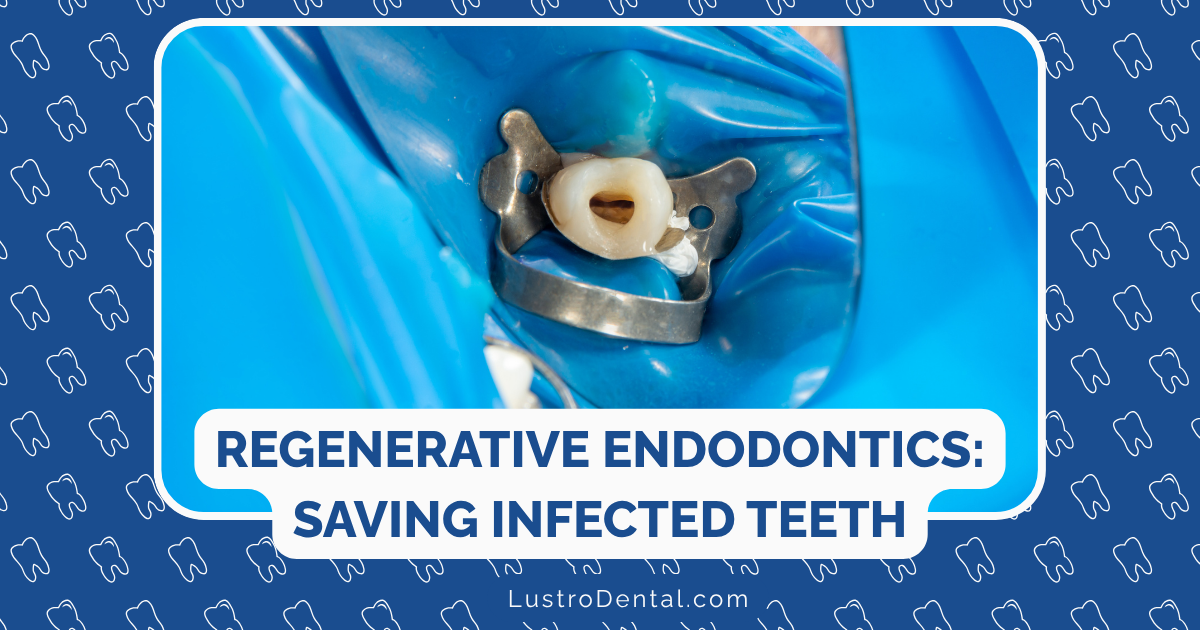
For decades, the standard approach to treating infected or necrotic dental pulp has been relatively straightforward: remove the damaged tissue, clean and shape the canal, and fill it with an inert material. While this traditional root canal therapy effectively eliminates infection, it leaves behind a technically “dead” tooth—one without the living pulp tissue that provides sensation, immune defense, and continued development in younger patients.
But what if there was another way? What if we could not just remove the infection but actually regenerate the living tissues that were lost?
This is the promise of regenerative endodontics, an exciting frontier that’s transforming how we approach pulp damage and offering new hope for maintaining truly vital teeth throughout our lives.
Traditional root canal therapy has been remarkably successful at saving teeth that would otherwise require extraction. However, it comes with limitations. Teeth without vital pulp become more brittle over time, lose their ability to sense temperature changes, and in young patients with immature roots, may remain structurally compromised.
Regenerative endodontics takes a fundamentally different approach. Rather than simply removing damaged tissue and replacing it with synthetic materials, it aims to stimulate the body’s own healing mechanisms to regenerate the pulp-dentin complex.
Dr. Sonali Shah, endodontic researcher at the University of Pennsylvania School of Dental Medicine, explains: “We’re shifting from a paradigm of replacement to one of regeneration. Instead of asking ‘How can we fill this space?’ we’re asking ‘How can we help the body rebuild what was lost?'”
To understand regenerative endodontics, we need to appreciate the remarkable healing potential of dental tissues. The tooth pulp contains a diverse population of cells, including:
According to a 2024 review in the Journal of Cellular and Molecular Medicine, successful pulp regeneration requires three key elements working in harmony:
When these elements come together in the right environment, they can recreate the complex structure and function of the dental pulp.
The field of regenerative endodontics uses several terms that are important to distinguish:
Dr. Martin Trope, a pioneer in the field, clarifies: “True regeneration means recreating the exact tissue that was lost, with all its components and functions. What we often achieve clinically is revitalization—the ingrowth of vital tissue that may not be identical to the original pulp but restores many of its functions.”
While complete regeneration remains the ultimate goal, even partial revitalization represents a significant advancement over conventional root canal treatment.
The most widely used regenerative procedure today involves a protocol that has evolved significantly since its introduction in the early 2000s. According to the American Association of Endodontists (AAE), the current approach typically includes:
This approach has shown promising results, particularly in immature permanent teeth, with success rates of 70-80% reported in terms of continued root development and restoration of some pulp vitality.
Regenerative endodontic procedures are evaluated based on several criteria:
A 2023 systematic review published in the Journal of Endodontics found that while most cases achieve the primary goals, the secondary and tertiary outcomes show more variability. This highlights the need for continued refinement of techniques.
While the current revitalization protocol relies on resident stem cells and the body’s natural healing capacity, the next generation of treatments involves direct stem cell therapy.
Several sources of stem cells show promise for endodontic regeneration:
One of the most exciting developments came in early 2025, when RD Dental Clinic in Japan began the first clinical trial using allogeneic (donor-derived) dental pulp stem cells for pulp regeneration. This represents a significant advance because:
The Japanese trial aims to treat 10 patients with irreversible pulpitis or apical periodontitis, with results expected by late 2025.
Beyond stem cells themselves, researchers are developing sophisticated scaffolds to support cell growth and differentiation:
Dr. Sarah Chen, biomaterials researcher at Harvard School of Dental Medicine, notes: “The ideal scaffold isn’t just a passive structure—it actively participates in the regeneration process by releasing signals at the right time and place to guide cell behavior.”
Despite its promise, regenerative endodontics faces several challenges:
For patients considering regenerative endodontic procedures, the experience differs from traditional root canal therapy in several ways:
As one patient from a clinical trial shared: “The process took longer than a regular root canal, but knowing there was a chance my tooth could actually heal itself made it worth it. Six months later, tests showed my tooth was responding to cold again—something I was told would never happen after a traditional root canal.”
While regenerative approaches continue to evolve, current evidence suggests they are most successful in:
However, as techniques advance, these criteria are expanding. The recent Japanese clinical trial is specifically targeting adult patients with mature teeth suffering from irreversible pulpitis or apical periodontitis—conditions previously considered beyond the reach of regenerative approaches.
The field of regenerative endodontics is advancing rapidly, with several exciting developments on the horizon:
According to Dr. Anthony Smith, Director of the Center for Dental Regeneration: “Within the next decade, I believe regenerative approaches will become the standard of care for many endodontic conditions. The question will shift from ‘Can we regenerate this pulp?’ to ‘Why would we not try to regenerate it?'”
If you’re interested in regenerative endodontic options, consider these steps:
Regenerative endodontics represents more than just a new treatment technique—it embodies a fundamental shift in how we think about dental disease and healing. Rather than simply managing damage, we’re learning to harness and enhance the body’s natural regenerative capacity.
While challenges remain and many approaches are still evolving, the progress in this field offers hope that in the future, a diagnosis of pulp necrosis won’t necessarily mean the end of a tooth’s vitality. Instead, it could mark the beginning of a regenerative journey, resulting in a tooth that continues to function, develop, and maintain its natural defenses.
As we continue to refine these techniques and expand their applications, regenerative endodontics promises to transform our approach to dental care, preserving not just the structure of teeth but their full, living vitality for years to come.