🦷 General Care
✨ Treatments
👶 Family Care
💚 Wellness
💡 Resources

🦷 General Care
✨ Treatments
👶 Family Care
💚 Wellness
💡 Resources

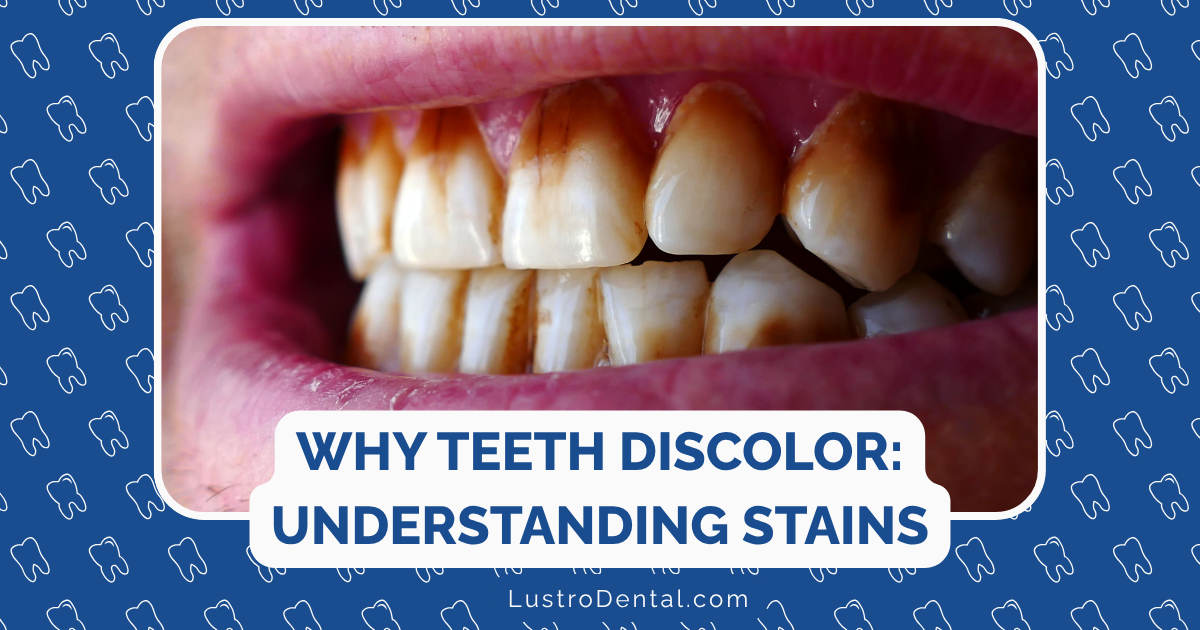
Have you ever wondered why some people can drink coffee daily with minimal tooth discoloration, while others develop noticeable stains after just a few cups? Or why certain family members seem to maintain whiter teeth with minimal effort, while others struggle despite diligent care? The answer lies in the fascinating science of tooth discoloration—a complex interplay of genetics, biology, behavior, and chemistry.
As someone who’s spent years studying dental health, I can tell you that tooth staining isn’t simply a matter of oral hygiene (though that certainly plays a role). Multiple factors determine how quickly your teeth discolor, many of which are beyond your control. Let’s explore the science behind why some teeth stain faster than others and what you can do about it.
To comprehend why teeth discolor differently, we first need to understand tooth structure:
Dental enamel—the outermost layer of your teeth—is the hardest substance in the human body. Composed of approximately 96% mineral content (primarily hydroxyapatite crystals), enamel serves as both protector and potential canvas for stains.
Key enamel characteristics that affect staining include:
Dr. Sarah Johnson, a researcher at the American Academy of Enamel Biology, explains: “Enamel is essentially a crystal lattice with microscopic spaces between the crystals. The size and arrangement of these spaces—what we call porosity—significantly impacts how quickly staining agents can penetrate the tooth surface.”
Beneath the enamel lies dentin—a yellower, more porous tissue that makes up the bulk of your tooth. As enamel thins or becomes more translucent, the natural yellow color of dentin becomes more visible, contributing to what we perceive as discoloration.
Within minutes of brushing, a thin protein film called the acquired pellicle begins forming on your teeth. This natural film derived from saliva serves as the attachment site for many staining compounds. The composition and thickness of your pellicle—which varies between individuals—can significantly impact staining susceptibility.
Your genetic makeup plays a substantial role in determining how quickly your teeth discolor:
Research published in the Journal of Dental Research has identified over 115 genetic conditions that affect enamel formation, including:
Even without these specific conditions, genetic variations influence:
Dr. Michael Chen of the International Association of Dental Genetics notes: “Some people simply hit the genetic lottery when it comes to tooth color and stain resistance. Their enamel might be naturally thicker, less porous, or structured in a way that reflects light more effectively, giving the appearance of whiter teeth.”
Your baseline tooth color is genetically determined and exists on a spectrum from yellowish to bluish-white. This natural variation is due to differences in:
A 2023 twin study published in the Journal of Clinical Dentistry found that approximately 60-80% of variation in natural tooth color can be attributed to genetic factors.
Genetically determined variations in saliva significantly impact staining susceptibility:
Tooth discoloration isn’t random—it follows specific chemical processes:
Extrinsic stains occur on the tooth surface and involve several mechanisms:
Chromogens—intensely pigmented molecules found in foods, beverages, and tobacco—are the primary culprits in extrinsic staining. They bind to the acquired pellicle or directly to the enamel surface through various mechanisms:
Tannins—plant compounds found in coffee, tea, and wine—act as “binding agents” that enhance staining by:
“Tannins are particularly interesting because they don’t necessarily cause stains themselves,” explains Dr. Lisa Rodriguez of the Institute for Dental Biomaterials. “Instead, they act as mordants—substances that help other compounds bind more effectively to surfaces, similar to how mordants are used in fabric dyeing.”
Acidic foods and beverages contribute to staining through:
Research from the University of Rochester Dental School found that exposure to acidic beverages (pH < 4.0) for just 30 seconds can create microscopic enamel erosion, making teeth more susceptible to staining for up to 30 minutes afterward.
Intrinsic stains occur within the tooth structure itself and are typically more difficult to address:
Some substances become incorporated into tooth structure during tooth formation:
As we age, several processes contribute to intrinsic discoloration:
Physical trauma can trigger internal bleeding within the tooth, leading to:
With this foundation, we can now understand why some individuals experience more rapid tooth discoloration:
Enamel porosity—the microscopic spaces between enamel crystals—varies significantly between individuals:
A landmark study in the Journal of Dental Research found that high-porosity enamel can absorb up to 7 times more chromogenic material than low-porosity enamel exposed to the same staining agents.
The acquired pellicle—that protein film that forms on teeth—varies between individuals:
Your oral microbiome—the ecosystem of bacteria in your mouth—influences staining:
Dr. James Wilson, microbiologist at the Center for Oral Microbiome Studies, explains: “The specific composition of your oral microbiome is as unique as a fingerprint and significantly influences how quickly chromogens attach to your teeth. Some bacterial communities actually produce protective factors that resist staining, while others facilitate it.”
While genetically determined, saliva characteristics are also influenced by:
Certain behaviors can amplify genetic predispositions to staining:
Not all potential staining agents are created equal. Based on research from the Journal of Clinical Dentistry, here’s how common food and beverages rank in staining potential:
Understanding the science of tooth staining empowers you to make informed choices:
If you have genetically stain-prone teeth, your children might too. Consider:
Emerging research is opening new frontiers in understanding and addressing tooth discoloration:
Scientists are developing saliva tests to identify individual staining susceptibility based on:
New protective coatings mimic natural enamel properties while providing enhanced stain resistance:
Emerging probiotic approaches aim to:
The science of tooth staining reveals that much of your susceptibility to discoloration is determined by factors beyond your control. Your genetic makeup, enamel structure, and natural biological variations play major roles in how quickly your teeth stain.
This knowledge shouldn’t be discouraging but liberating. Understanding why your teeth behave the way they do allows you to develop targeted strategies rather than feeling frustrated by comparisons to others with different dental biology.
Whether you’re blessed with naturally stain-resistant teeth or face an uphill battle against rapid discoloration, the key is developing an individualized approach based on your unique oral environment. By combining this scientific understanding with appropriate preventive measures and treatments, you can maintain your healthiest, brightest smile—whatever that means for your unique dental makeup.