🦷 General Care
✨ Treatments
👶 Family Care
💚 Wellness
💡 Resources

🦷 General Care
✨ Treatments
👶 Family Care
💚 Wellness
💡 Resources

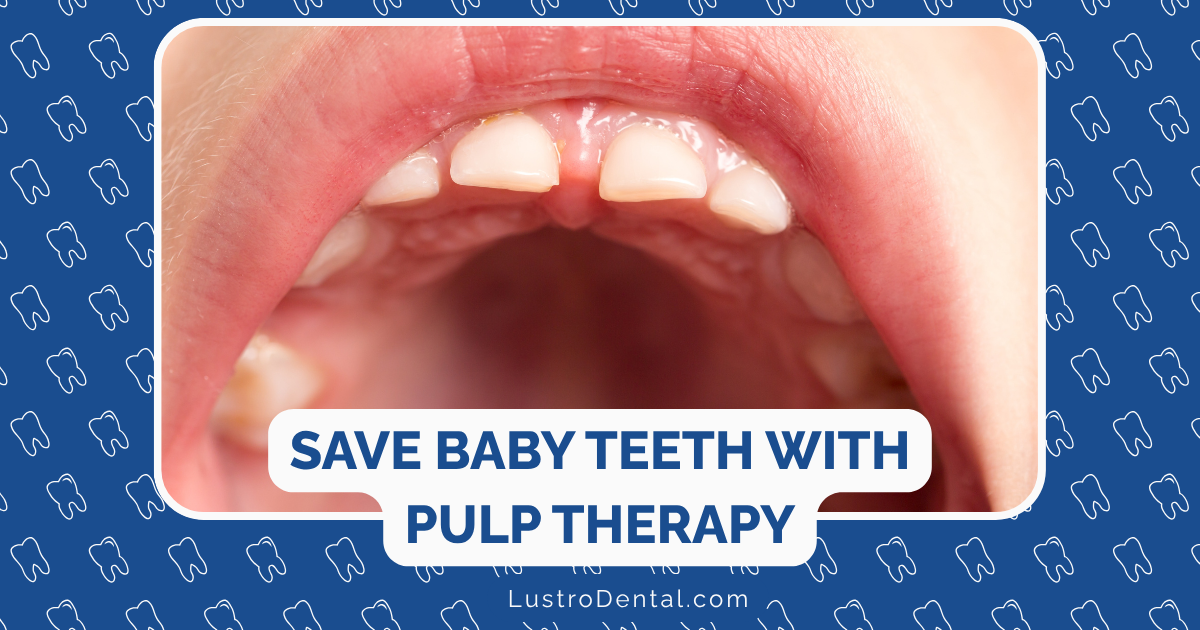
“But they’re just baby teeth—don’t they fall out anyway?”
As a dental health advocate, I hear this question often from well-meaning parents. And while it’s true that primary (baby) teeth will eventually be replaced by permanent teeth, the idea that they’re somehow disposable couldn’t be further from the truth.
Primary teeth play crucial roles in your child’s development: they help with proper speech, enable effective chewing, maintain space for permanent teeth, and contribute to facial aesthetics and self-confidence. Losing them too early can lead to a cascade of issues that might affect your child for years to come.
That’s why, when a baby tooth suffers from deep decay or trauma that reaches the dental pulp (the living tissue inside the tooth), modern pediatric dentistry focuses on preservation rather than extraction whenever possible. The key to save baby teeth? Pulp therapy.
Before we dive into treatment options, let’s understand what we’re trying to save.
The dental pulp is the soft tissue at the center of each tooth, containing blood vessels, nerves, and connective tissue. It’s essentially the living heart of the tooth, responsible for:
In children’s teeth, the pulp is proportionally larger than in adult teeth, with pulp horns (extensions of the pulp) that reach closer to the tooth surface. This means decay can reach the pulp more quickly in primary teeth, often before parents notice any symptoms.
Children aren’t always able to articulate dental pain clearly, so it’s important to watch for these indicators:
If you notice any of these signs, it’s important to see a pediatric dentist promptly. Early intervention often means simpler, less invasive treatment.
According to the American Academy of Pediatric Dentistry, there are several approaches to treating pulp issues in baby teeth, depending on the extent of the damage:
When it’s used: For deep cavities approaching the pulp, but without actual pulp exposure or symptoms of irreversible pulpitis (severe inflammation).
What happens: The dentist removes most of the decay but leaves a thin layer of affected dentin to avoid exposing the pulp. This area is then covered with a biocompatible material that promotes healing and prevents bacterial invasion.
Success rate: Recent systematic reviews show that IPT has an excellent success rate of over 90% at 24 months, making it the preferred choice when appropriate.
Materials used: Traditionally, calcium hydroxide was used, but newer materials like glass ionomer cement (GIC) and Biodentine have shown excellent results.
Dr. Maria Chen, a pediatric dentist at Children’s Dental Health Center, explains: “Indirect pulp treatment is often our first choice when we can preserve the vitality of the pulp. It’s minimally invasive and has excellent outcomes when case selection is appropriate.”
When it’s used: When there’s a tiny exposure of the pulp in an otherwise healthy tooth, typically due to trauma rather than decay.
What happens: The exposed pulp is covered directly with a biocompatible material to promote healing and dentin bridge formation.
Success rate: In primary teeth, direct pulp capping has historically shown lower success rates than in permanent teeth, but newer materials are improving outcomes.
Materials used: Mineral Trioxide Aggregate (MTA) and Biodentine have largely replaced calcium hydroxide for this procedure due to their superior biocompatibility and sealing ability.
It’s worth noting that direct pulp capping in primary teeth due to carious exposure (rather than traumatic exposure) is generally not recommended due to lower success rates compared to pulpotomy.
When it’s used: When decay or trauma has exposed the pulp, but the infection is limited to the crown portion of the tooth, with the root pulp remaining healthy.
What happens: The dentist removes the infected coronal (top) portion of the pulp while leaving the healthy root pulp intact. The remaining pulp is treated with a medicament to promote healing, then sealed with a restoration.
Success rate: With modern materials like MTA or Biodentine, success rates exceed 90% at 24 months.
Materials used: While formocresol was traditionally used, calcium silicate cements like MTA and Biodentine are now strongly recommended by the latest research due to their excellent biocompatibility and high success rates.
When it’s used: When the entire pulp, including the root portion, is irreversibly infected or necrotic (dead).
What happens: Similar to a traditional root canal in adults, the entire pulp is removed from both the crown and roots. The canals are cleaned, shaped, and filled with a resorbable material that will disappear as the primary tooth’s roots naturally resorb before exfoliation.
Success rate: Success rates range from 70-90%, depending on the extent of infection and the restorability of the tooth.
Materials used: Zinc oxide eugenol, iodoform-based pastes (like Metapex or Vitapex), or a combination material like Endoflas are commonly used as filling materials.
Pediatric pulp therapy has seen significant advancements in recent years, making treatments more effective, biocompatible, and comfortable for children:
Calcium silicate-based materials like MTA and Biodentine have revolutionized pulp therapy. These materials:
According to a 2024 systematic review, pulpotomies performed with calcium silicate cements showed significantly better outcomes than those using traditional materials like formocresol or ferric sulfate.
The trend toward tissue preservation has led to more conservative approaches:
Dr. James Wilson, researcher at Pediatric Dental Innovations, notes: “Our approach has shifted dramatically toward preservation rather than replacement. With modern materials and techniques, we can save teeth that would have been extracted just a decade ago.”
Parents sometimes wonder if these procedures are worth it when the tooth will eventually fall out anyway. Here’s why preserving primary teeth matters:
Primary teeth hold space for permanent teeth. Losing them too early can lead to:
Many primary teeth remain until ages 10-12, during critical speech development years. Missing front teeth can affect pronunciation of certain sounds, potentially leading to speech issues.
Effective chewing is important for nutrition and digestive health. Missing teeth can limit food choices or lead to inadequate chewing.
Visible missing teeth can affect a child’s self-confidence, potentially impacting social interactions during formative years.
Preserving a tooth through pulp therapy is generally less traumatic than extraction, helping maintain a positive attitude toward dental care.
If your child needs pulp therapy, here’s what you can typically expect:
Eight-year-old Emma came to our office with a severely decayed lower primary molar. Her mother was concerned about the pain Emma was experiencing but hesitant about extensive treatment for a “tooth that would fall out anyway.”
After discussing the importance of the tooth for proper development and the options available, Emma’s mother agreed to a pulpotomy with MTA, followed by a stainless steel crown. Two years later, the tooth is still functioning perfectly, maintaining space for the permanent tooth that will eventually replace it. Emma’s mother later shared that the treatment helped her daughter return to normal eating and eliminated the pain that had been affecting her sleep and school performance.
Stories like Emma’s are common in pediatric dental practices, where modern pulp therapy techniques are saving thousands of primary teeth each year.
When considering treatment options for your child’s damaged primary tooth, discuss these factors with your dentist:
Remember that each child and situation is unique. A pediatric dentist can help you weigh these factors to make the best decision for your child’s specific needs.
Pulp therapy for primary teeth requires specialized knowledge and skills. Consider these factors when seeking treatment:
Many dental schools and community health centers also offer pediatric dental services at reduced rates if cost is a concern.
While it might seem easier to simply extract a problematic primary tooth, the long-term consequences of premature tooth loss often outweigh the short-term convenience. Modern pulp therapy techniques offer safe, effective ways to preserve these important teeth until they’re ready to be naturally replaced by their permanent successors.
By understanding the options available and working with a skilled pediatric dental provider, you can make informed decisions that support your child’s oral health, development, and well-being for years to come.
Remember: Those little teeth have big jobs to do—and they’re worth saving.
Have questions about pulp therapy for primary teeth? Share them in the comments below, and we’ll address them in a future post!