🦷 General Care
✨ Treatments
👶 Family Care
💚 Wellness
💡 Resources

🦷 General Care
✨ Treatments
👶 Family Care
💚 Wellness
💡 Resources

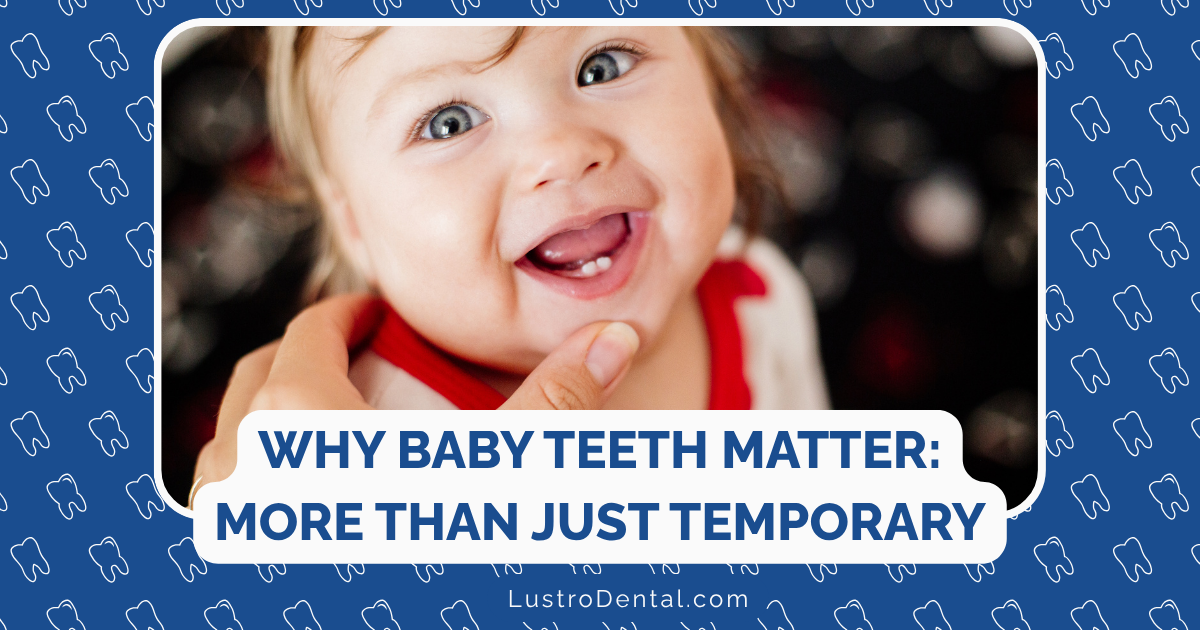
As someone passionate about dental health education, I’ve heard this sentiment countless times from well-meaning parents. It’s an understandable perspective. After all, primary teeth (also called baby teeth or deciduous teeth) do eventually make way for permanent ones.
But dismissing baby teeth as merely temporary placeholders overlooks their crucial role in your child’s development. These first teeth are far more important than many realize, influencing everything from your child’s ability to speak clearly to the long-term alignment of their adult smile.
Let’s explore why these seemingly “temporary” teeth deserve serious attention and care.
Those tiny teeth play an enormous role in how your child learns to speak. Primary teeth, particularly the front ones, help children form many sounds correctly by providing surfaces for the tongue to press against when making sounds like “th,” “s,” and “l.”
Dr. Sarah Johnson, a pediatric speech pathologist at Children’s Communication Center, explains: “When children lose their front teeth naturally around age 6-7, you’ll often notice a temporary lisp. This demonstrates how crucial teeth are for proper speech. Now imagine those teeth were lost years earlier due to decay—the speech impacts would be much more significant and long-lasting.”
Children who lose baby teeth prematurely often develop compensatory speech patterns that can be difficult to correct later, potentially requiring speech therapy.
Baby teeth allow children to transition from soft foods to a varied diet that includes fruits, vegetables, and proteins requiring proper chewing. This dietary diversity is essential for:
Research published in the Journal of Pediatric Nutrition found that children with untreated dental decay or missing teeth often have lower body weights and nutritional deficiencies compared to children with healthy dentition, highlighting the connection between dental health and overall nutrition.
Perhaps the most critical function of baby teeth is serving as space maintainers for permanent teeth developing beneath the gums. Each primary tooth holds a specific amount of space in the jaw, ensuring that when permanent teeth begin to emerge, they have the proper room to erupt into position.
When a baby tooth is lost prematurely due to decay or injury, neighboring teeth can drift into the empty space. This drift can:
Dr. Michael Chen of the American Academy of Pediatric Dentistry notes: “Nature designed this two-phase dentition system for a reason. Primary teeth serve as the perfect guides for permanent teeth, creating a roadmap for proper eruption. When we disrupt this system through early tooth loss, we often see significant orthodontic issues develop.”
Baby teeth play a significant role in proper jaw development. The presence and function of these teeth stimulate bone growth and help shape the arches of the jaw.
When children use their teeth for chewing, the forces applied help:
Early loss of baby teeth can alter these developmental processes, potentially affecting facial aesthetics and function.
While perhaps less physiological than other functions, the psychological impact of healthy baby teeth shouldn’t be underestimated. Children with decayed, damaged, or missing front teeth may become self-conscious about smiling or speaking in social situations.
A study published in the International Journal of Paediatric Dentistry found that children with visible dental problems reported higher levels of social anxiety and lower self-esteem compared to peers with healthy smiles.
Understanding what happens when baby teeth are lost prematurely helps illustrate why preserving them is so important.
When a baby tooth is lost years before its permanent successor is ready to emerge, adjacent teeth begin shifting into the empty space within just weeks. This shifting can:
If a baby tooth is lost prematurely, pediatric dentists often recommend space maintainers—devices designed to hold open the space until the permanent tooth is ready to erupt. These can be:
While space maintainers are effective, they’re a reactive solution. Preserving baby teeth whenever possible is always preferable.
Given their significance, how should parents care for baby teeth?
Dental care should begin before the first tooth even appears:
The American Academy of Pediatric Dentistry and the American Dental Association recommend a child’s first dental visit by age 1 or within 6 months after the first tooth erupts.
These early visits:
One of the most common threats to baby teeth is Early Childhood Caries (ECC), sometimes called “baby bottle tooth decay.” This condition can rapidly destroy primary teeth, particularly the upper front teeth.
Prevention includes:
Maintain regular dental visits every 6 months, or as recommended by your child’s dentist. These visits allow for:
Primary teeth also serve an important educational purpose. They provide children with their first opportunity to learn about:
These early lessons establish habits and attitudes that often persist throughout life, influencing not just dental health but overall health behaviors.
When we view baby teeth not as temporary placeholders but as crucial developmental tools that influence speech, nutrition, dental alignment, and self-confidence, their importance becomes clear.
Dr. Lisa Williams, pediatric dentist at Children’s Dental Health Associates, puts it this way: “Primary teeth may be temporary in the sense that they eventually fall out, but their effects on development are permanent. The care we provide—or fail to provide—for these first teeth can impact a child’s health, appearance, and confidence for decades to come.”
By understanding and respecting the vital role of baby teeth, parents can help ensure their children develop healthy smiles, clear speech, proper nutrition, and the self-confidence that comes with them—benefits that last far beyond the temporary presence of those first tiny teeth.
What questions do you have about caring for your child’s baby teeth? Share in the comments below!