🦷 General Care
✨ Treatments
👶 Family Care
💚 Wellness
💡 Resources

🦷 General Care
✨ Treatments
👶 Family Care
💚 Wellness
💡 Resources

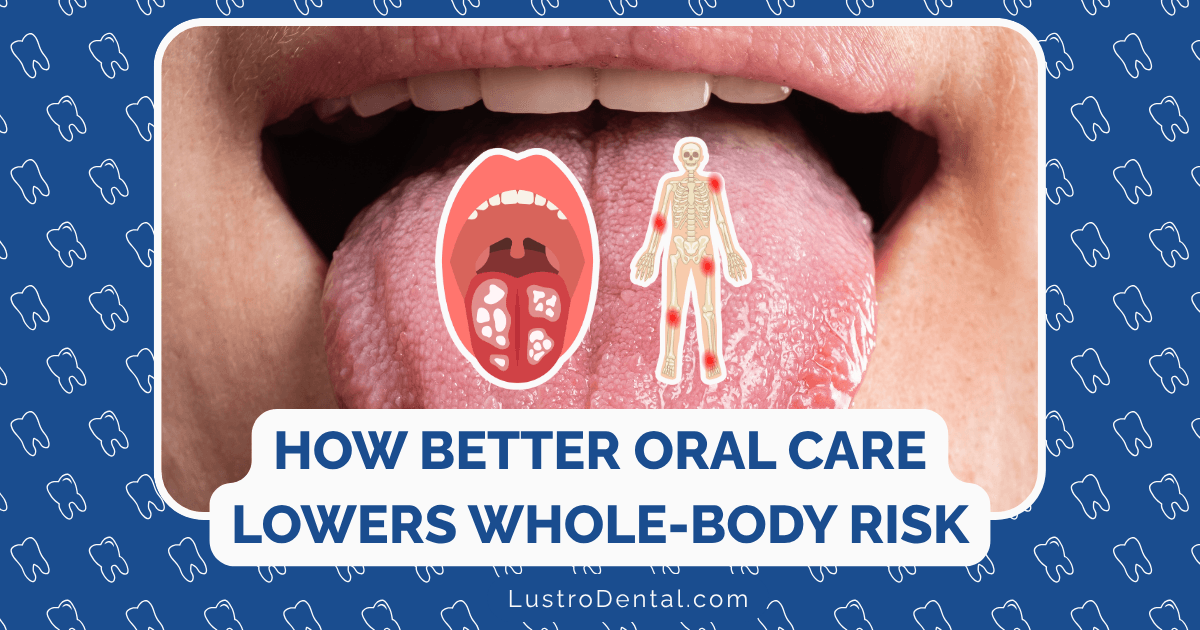
For decades, we’ve understood oral health primarily in terms of preventing cavities and maintaining a bright smile. However, emerging research reveals a far more profound connection: the state of your mouth may significantly impact inflammation throughout your entire body.
As a dental health advocate who has followed this research closely, I’ve observed how this paradigm shift is transforming both dentistry and medicine. The mouth is no longer viewed as an isolated system but rather as a gateway that can either protect or compromise your overall health.
In this comprehensive guide, I’ll explore the fascinating connection between oral health and systemic inflammation, and share evidence-based strategies for leveraging improved oral care to potentially reduce inflammation throughout your body.
Before diving into specific strategies, it’s essential to understand how oral health and systemic inflammation are interconnected.
Inflammation serves as the common denominator linking oral conditions to systemic health. According to research published in Science Direct, periodontal diseases—particularly periodontitis—are chronic inflammatory conditions that extend far beyond the oral cavity.
Dr. Sarah Chen, an immunologist specializing in inflammatory disorders, explains: “The mouth contains upward of 2,000 bacterial species. When these microbial communities become imbalanced, the resulting inflammation doesn’t remain confined to the oral cavity. It can trigger or exacerbate inflammatory processes throughout the body.”
This concept of “inflammatory burden” suggests that each source of inflammation in your body—including gum disease—contributes to your overall inflammatory load. Reducing inflammation in one area, such as your mouth, may help decrease total body inflammation.
Several pathways connect oral health to systemic inflammation:
Bacteria from periodontal infections can enter the bloodstream through inflamed and bleeding gums. Research from the National Center for Biotechnology Information highlights that specific oral bacteria, including Porphyromonas gingivalis and Fusobacterium nucleatum, have been detected in distant body sites and linked to various systemic conditions.
Periodontal disease triggers the release of pro-inflammatory cytokines such as interleukin-1 (IL-1), interleukin-6 (IL-6), and tumor necrosis factor-alpha (TNF-α). These inflammatory molecules enter the bloodstream and can promote inflammation in distant tissues and organs.
Chronic oral inflammation may alter immune function, potentially leading to dysregulated immune responses throughout the body. This can contribute to or exacerbate autoimmune and inflammatory conditions.
Many risk factors for periodontal disease—including smoking, poor diet, stress, and aging—also contribute to systemic inflammatory conditions, creating a compounding effect.
The impact of oral inflammation extends to numerous systemic conditions:
Dr. Michael Rodriguez, a periodontist with a focus on systemic health, notes: “What’s particularly concerning is that nearly half of American adults have some form of periodontal disease, and many are completely asymptomatic. This means millions of people have a significant source of inflammation that they’re entirely unaware of.”
Now that we understand the connection, let’s explore practical strategies for improving oral health to potentially reduce systemic inflammation.
Perhaps the most direct approach to reducing oral-related inflammation is through professional periodontal treatment.
Research published in PubMed indicates that non-surgical periodontal therapy (NSPT) can significantly reduce inflammatory markers. This typically involves:
Studies have demonstrated that periodontal treatment may improve markers of systemic inflammation and related conditions:
According to the University of Colorado School of Dental Medicine, addressing periodontal disease promptly can potentially reduce the risk of serious conditions like heart attack and stroke by eliminating this source of chronic inflammation.
Consistent, thorough oral hygiene is fundamental to reducing oral inflammation.
Dr. Jennifer Lee, a dental researcher specializing in preventive dentistry, advises: “The timing of oral hygiene is just as important as the technique. Brushing after meals helps remove food particles that feed bacteria, but wait 30-60 minutes after consuming acidic foods or beverages to avoid damaging softened enamel.”
Consider incorporating evidence-supported technologies:
Diet plays a dual role in oral and systemic inflammation, both directly affecting the oral environment and influencing systemic inflammatory processes.
According to Sola Dental Spa, the following nutrients and food sources can help combat inflammation:
Certain dietary elements can promote inflammation and should be minimized:
Dr. Rodriguez emphasizes: “Hydration is often overlooked but critically important for oral health. Water helps rinse away food particles and bacteria while supporting saliva production. Saliva contains enzymes that neutralize acids and proteins that fight bacteria.”
Several lifestyle factors significantly impact both oral inflammation and systemic inflammatory load.
Smoking and other tobacco use is perhaps the most significant modifiable risk factor for periodontal disease and is associated with:
Quitting tobacco can lead to notable improvements in gum health, often within weeks to months.
Chronic stress contributes to inflammation through several mechanisms:
Effective stress reduction techniques include mindfulness meditation, regular exercise, adequate sleep, and social connection.
According to Washington Perio, regular professional dental care is essential for:
For those with active periodontal disease or a history of gum problems, more frequent visits (every 3-4 months rather than every 6) may be recommended.
While a food-first approach is preferred, certain supplements may support oral health and reduce inflammation.
Dr. Lee cautions: “Supplements should complement, not replace, fundamental oral care practices. Always discuss supplements with your healthcare providers, as some may interact with medications or have unexpected effects.”
Certain groups may benefit particularly from focusing on the oral-systemic inflammation connection.
The bidirectional relationship between diabetes and periodontal disease is well-established:
For people with diabetes, meticulous oral hygiene and regular professional care are especially important for both oral and systemic health.
Given the links between periodontal disease and cardiovascular conditions:
For those with autoimmune conditions like rheumatoid arthritis:
Pregnant women experience hormonal changes that can exacerbate gingival inflammation:
The field of oral-systemic health continues to evolve rapidly, with several promising areas of investigation.
Research is exploring how to beneficially modify the oral microbiome:
Rather than simply suppressing inflammation, newer approaches focus on actively resolving it:
Advances in diagnostics are enabling more personalized approaches:
The evidence connecting oral health to systemic inflammation offers a compelling reason to prioritize dental care beyond aesthetics or even cavity prevention. By viewing oral health as an integral component of overall wellness, we gain a powerful lever for potentially reducing total body inflammation.
The strategies outlined here—professional periodontal treatment, enhanced daily oral hygiene, anti-inflammatory dietary choices, positive lifestyle modifications, and targeted supplementation—represent a comprehensive approach to leveraging the oral-systemic connection for better health.
As research continues to illuminate the intricate relationships between oral health and systemic inflammation, one thing becomes increasingly clear: the health of your mouth may be far more consequential than previously recognized. By taking steps to reduce oral inflammation, you may be benefiting not just your smile, but your entire body.
Have you noticed connections between your oral health and overall wellbeing? What strategies have you found most effective for maintaining optimal oral health? Share your experiences in the comments below.