🦷 General Care
✨ Treatments
👶 Family Care
💚 Wellness
💡 Resources

🦷 General Care
✨ Treatments
👶 Family Care
💚 Wellness
💡 Resources

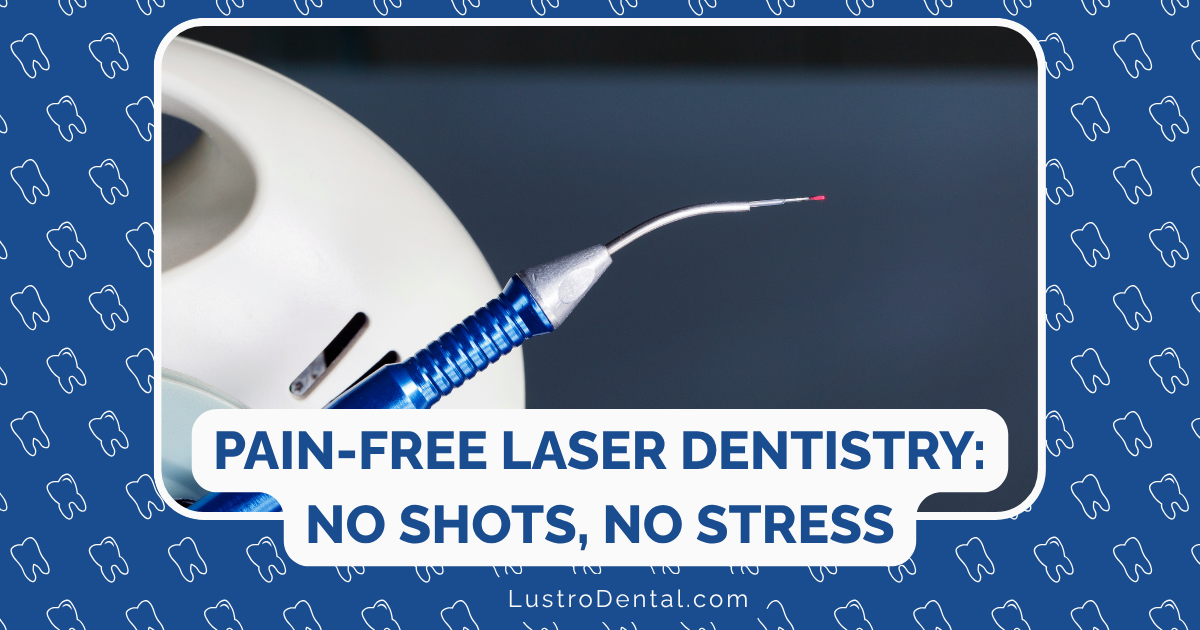
The whir of the drill. The pinch of the needle. The numb, swollen feeling that lingers for hours afterward. For many people, these sensations represent the primary reasons they avoid dental care. Dental anxiety affects an estimated 36% of the population, with 12% suffering from extreme dental fear, according to the Journal of Dental Research. But what if these fear-inducing elements could be eliminated from the dental experience?
Enter laser dentistry—a revolutionary approach that’s transforming the patient experience by reducing or even eliminating the need for anesthesia while providing pain-free treatment. This technology isn’t just changing procedures; it’s changing perceptions about dental care itself.
Before exploring the laser revolution, it’s worth understanding why traditional dental procedures can be uncomfortable:
Conventional dental tools like drills and scalers work through direct mechanical action—they physically contact and remove tooth structure or debris. This mechanical interaction creates:
Dr. Mark Schlesinger, clinical professor at the University of California School of Dentistry, explains: “The mechanical nature of traditional dental tools means they stimulate multiple sensory pathways simultaneously—pressure, temperature, and vibration. This creates a perfect storm for discomfort that requires anesthesia to manage.”
While local anesthesia effectively blocks pain during procedures, it comes with several drawbacks:
These challenges have driven the search for alternatives that can provide comfortable care without these limitations.
Laser dentistry represents a fundamentally different approach to dental procedures. Instead of mechanical action, lasers use light energy to interact with tissues in highly specific ways.
The word “LASER” stands for Light Amplification by Stimulated Emission of Radiation. In simple terms, a laser produces an intense, narrow beam of light at a specific wavelength. Different wavelengths interact with different tissues in unique ways.
When used in dentistry, lasers can:
Several types of lasers are used in dentistry, each with specific applications:
These lasers, like the Er:YAG (erbium-doped yttrium aluminum garnet) and Er,Cr:YSGG (erbium, chromium-doped yttrium scandium gallium garnet), are primarily used for procedures involving tooth structure:
The Er:YAG laser, for example, operates at a wavelength that’s highly absorbed by water and hydroxyapatite (a main component of tooth enamel). This allows it to effectively remove decay while minimizing the impact on surrounding healthy tissue.
Diode lasers and Nd:YAG (neodymium-doped yttrium aluminum garnet) lasers are absorbed by hemoglobin and melanin, making them ideal for soft tissue procedures:
The newest generation of dental lasers, like the Solea CO₂ laser, can effectively treat both hard and soft tissues, offering versatility across a wide range of procedures.
Research published in the Journal of the American Dental Association indicates that these advanced lasers can address approximately 80-90% of routine dental procedures with reduced or no anesthesia.
The pain-free nature of laser dentistry isn’t magic—it’s based on solid scientific principles that address the fundamental causes of dental pain.
Unlike traditional tools that affect large areas, lasers can target decay or diseased tissue with microscopic precision, often leaving healthy tissue completely untouched. This selective approach minimizes trauma and inflammatory responses that trigger pain.
Certain laser wavelengths temporarily disrupt nerve transmission, creating an analgesic (pain-reducing) effect in the treatment area. According to research in the International Journal of Laser Dentistry, this neural inhibition can reduce or eliminate the need for injectable anesthetics in many procedures.
Many modern dental lasers incorporate water, creating what’s called a hydro-photonic effect. Dr. Lisa Johnson, a laser dentistry specialist, explains how this works: “The water molecules are energized by the laser, creating microscopic water droplets that absorb heat and prevent temperature rise in the tooth. This eliminates the thermal stimulation that typically causes pain during dental procedures.”
Lasers operate without direct mechanical contact, eliminating the vibration and pressure associated with traditional drills. Since mechanical stimulation is a primary trigger for dental pain, its absence significantly enhances comfort.
The elimination of the drill noise and needle can dramatically reduce anxiety, which in turn lowers perceived pain. This psychological component shouldn’t be underestimated—studies in the Journal of Dental Anxiety have shown that anxiety reduction alone can significantly improve pain tolerance during dental procedures.
The applications of pain-free laser dentistry span virtually all aspects of dental care:
Traditional cavity preparation involves drilling, which typically requires anesthesia and removes significant healthy tooth structure along with decay. Laser preparation is fundamentally different:
A clinical study published in the Journal of Conservative Dentistry found that 93% of patients who experienced both traditional and laser cavity preparation preferred the laser approach, with 87% requiring no anesthesia during the laser procedure.
Periodontal disease treatment traditionally involves scaling and root planing—a process that can be uncomfortable and often requires numbing. Laser-assisted periodontal therapy offers a gentler alternative:
The LANAP (Laser-Assisted New Attachment Procedure) protocol, cleared by the FDA, has demonstrated remarkable success in treating periodontal disease with minimal discomfort. According to the Academy of Periodontology, laser protocols can achieve comparable or better results than traditional methods with significantly less patient discomfort.
Procedures involving gum tissue—like crown lengthening, gingival recontouring, or frenectomies—traditionally required scalpels, sutures, and significant recovery time. Laser alternatives offer:
Dr. Samuel Chen, director of the Institute for Advanced Laser Dentistry, notes: “The ability to perform soft tissue procedures without anesthesia, bleeding, or sutures has transformed our approach. Patients who previously would have been referred to specialists can now have these procedures completed comfortably in a general practice setting.”
Perhaps no group benefits more from pain-free dentistry than children. Dental experiences during childhood can shape attitudes toward oral healthcare for life. Laser dentistry offers particular advantages for young patients:
Research in the Journal of Pediatric Dentistry found that children treated with dental lasers showed significantly lower anxiety scores and better treatment acceptance compared to those receiving traditional care.
For those considering laser dentistry, understanding the experience can help manage expectations:
Sarah M., a patient who recently experienced laser dentistry for the first time, shares: “After years of dreading dental visits, my laser treatment was nothing short of revolutionary. No needle, no drilling sound, and I was able to eat lunch immediately afterward. I didn’t even realize the procedure was finished until my dentist told me!”
While laser dentistry offers remarkable benefits, it’s important to understand its limitations:
Some dental situations still require traditional approaches:
Laser technology represents a significant investment for dental practices, which can affect treatment costs. However, many patients find the improved experience worth the potential premium, and as the technology becomes more widespread, costs continue to decrease.
The effectiveness of laser dentistry depends heavily on the practitioner’s training and experience. The Academy of Laser Dentistry recommends seeking dentists with specific certification in laser procedures.
Coverage for laser procedures varies by provider. Many insurance companies now recognize laser alternatives, though some may still classify certain procedures as “premium” options.
If you’re interested in experiencing pain-free laser dentistry, consider these questions when searching for a provider:
The field of laser dentistry continues to evolve rapidly. Current developments suggest several exciting directions:
Artificial intelligence is being incorporated into laser systems to optimize settings for individual patients and specific procedures, further enhancing precision and comfort.
Researchers are developing new protocols for using lasers in increasingly complex procedures, potentially expanding the range of treatments that can be performed without anesthesia.
As more dentists adopt laser technology and manufacturing scales up, these tools are becoming more affordable and accessible to a wider range of practices and patients.
The integration of lasers with other advanced technologies, such as 3D imaging and CAD/CAM systems, is creating comprehensive digital workflows that further enhance the patient experience.
The elimination of anesthesia through laser dentistry represents more than just a technological advancement—it’s a paradigm shift in how we approach oral health. By removing the primary sources of fear and discomfort from dental procedures, lasers are helping millions of people overcome dental anxiety and access the care they need.
For the estimated 9-15% of Americans who avoid dental care entirely due to fear—a statistic reported by the American Dental Association—this technology offers a compelling reason to reconsider. Pain-free dentistry isn’t just more comfortable; it’s opening doors to improved oral health for those who have long avoided traditional care.
As laser technology continues to advance and become more widespread, the days of the dreaded dental drill and needle may soon be nothing but a memory—replaced by gentler, more precise approaches that prioritize patient comfort without compromising clinical outcomes.
Have you experienced laser dentistry? Share your experience in the comments below!