🦷 General Care
✨ Treatments
👶 Family Care
💚 Wellness
💡 Resources

🦷 General Care
✨ Treatments
👶 Family Care
💚 Wellness
💡 Resources

For decades, the standard approach to treating severely damaged or infected dental pulp has been root canal therapy—a procedure that, while effective at eliminating infection, leaves the tooth essentially “dead” by removing its vital inner tissues. This conventional treatment has served dentistry well, but it comes with limitations: treated teeth become more brittle over time, lack the ability to sense temperature or pressure, and in young patients with immature roots, may remain structurally compromised.
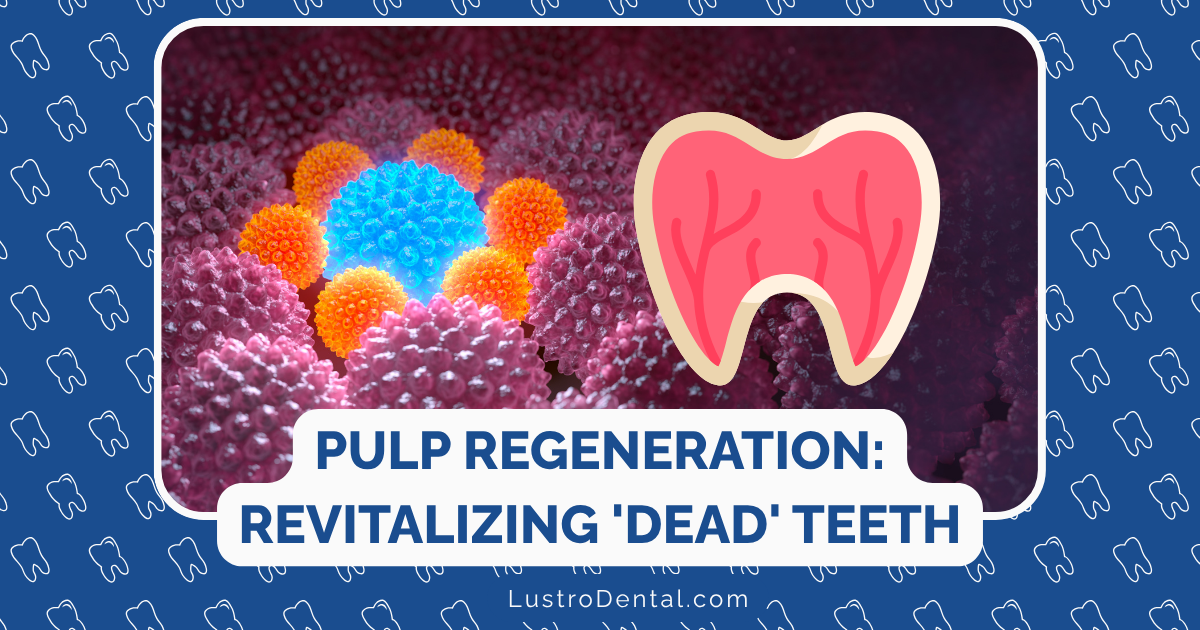
But what if there was another way? What if, instead of simply removing damaged tissue, we could actually regenerate it? This is the promise of regenerative endodontics—a revolutionary approach that aims to restore the vitality and functionality of damaged dental pulp and continue root development in immature teeth.
Regenerative endodontics represents a fundamental shift in endodontic treatment philosophy—moving from a focus on tissue removal and replacement with synthetic materials to the biological regeneration of the pulp-dentin complex.
Dr. Sarah Johnson, Director of the American Association of Endodontists’ Regenerative Endodontics Committee, explains: “Traditional endodontics is about removing diseased tissue and filling the space. Regenerative endodontics is about harnessing the body’s natural healing capacity to restore living tissue. It’s the difference between replacing a part and healing an organ.”
At its core, regenerative endodontics is built on three fundamental components of tissue engineering:
By manipulating these elements within the controlled environment of the root canal system, endodontists can create conditions conducive to tissue regeneration rather than simply filling the space with inert materials.
While some aspects of regenerative endodontics remain in research phases, several applications have already transitioned to clinical practice:
The most established application of regenerative endodontics is the treatment of immature permanent teeth with pulp necrosis—a condition that traditionally presented significant challenges:
The Traditional Approach: Apexification
The Regenerative Approach: Revitalization
According to research published by the American Association of Endodontists, regenerative procedures result in approximately 15% increase in root length and 29% increase in root width compared to traditional apexification procedures—substantial improvements that significantly enhance the tooth’s long-term prognosis.
Dr. Michael Chen, an endodontist specializing in regenerative procedures, notes: “The difference in outcomes can be dramatic. With apexification, the root remains thin and fragile. With revitalization, we often see remarkable continued root development, with thickening of the walls and maturation of the apex. These teeth are much stronger and have a better long-term prognosis.”
Another area where regenerative approaches are gaining traction is in the treatment of pulp exposures:
Traditional Approach: Complete Pulpectomy
Regenerative Approach: Partial Pulpotomy
A systematic review published in the Journal of Endodontics found success rates exceeding 90% for partial pulpotomy procedures using bioactive materials—comparable to conventional root canal therapy but with the significant advantage of maintaining pulp vitality.
The growing body of clinical evidence supports the efficacy of regenerative endodontic procedures:
According to a comprehensive analysis of 250 successful cases of regenerative endodontic treatment from 18 different studies published in Dental and Medical Problems:
The American Association of Endodontists reports overall success and survival rates ranging from 90-100% for regenerative endodontic procedures.
Several key factors have been identified as critical for successful outcomes:
Dr. Lisa Rodriguez, who has conducted clinical research on regenerative endodontics, emphasizes: “Case selection is critical. The ideal candidate is a younger patient with an immature tooth that has a wide-open apex, minimal root wall destruction, and good overall health. As our techniques improve, we’re seeing success in a broader range of cases, but these factors remain important predictors of outcome.”
For patients considering regenerative endodontic treatment, understanding the procedure can help set appropriate expectations:
First Appointment:
Second Appointment (2-4 weeks later):
Follow-up:
James, a 12-year-old patient who underwent regenerative endodontic treatment for a necrotic immature premolar following trauma, shares his experience: “I was nervous at first, but it wasn’t much different from getting a filling. I had two appointments, and after the second one, I just had regular check-ups. Three years later, my dentist says the tooth is doing great—the root has grown more, and the tooth feels normal.”
While current regenerative endodontic procedures primarily rely on the patient’s own stem cells recruited from periapical tissues, research is advancing rapidly toward more sophisticated approaches:
The next generation of regenerative endodontics involves the direct transplantation of stem cells into the root canal space:
A recent systematic review published in Science Direct analyzed various stem cell-based approaches and found promising results across multiple studies, particularly with dental pulp stem cells and umbilical cord mesenchymal stem cells for pulpal regeneration.
The American Association of Endodontists Foundation has invested $2.5 million in research grants to investigate stem cell regeneration in endodontics, including a study on “Cell Based Approaches to Endodontic Regeneration” that aims to test whether autologous dental pulp stem cell transplantation can regenerate the pulp-dentin complex in teeth with necrotic pulp.
Beyond the simple blood clot currently used in clinical procedures, researchers are developing sophisticated scaffolds:
Perhaps most exciting is the emerging evidence that regenerative approaches may be applicable to fully developed teeth with closed apices—a population far larger than immature teeth:
Dr. Robert Thompson, a researcher in regenerative endodontics, explains: “The application of regenerative procedures to mature teeth would revolutionize endodontics. While we’re still in early stages, the preliminary results are encouraging. The key challenges are creating sufficient space for new tissue growth and ensuring adequate blood supply through the narrow apical foramen.”
Despite the promising results, several challenges must be addressed before regenerative endodontics can fully replace conventional endodontic therapy:
For patients considering treatment options, several factors should be considered:
Regenerative endodontic procedures are currently most appropriate for:
If you’re considering regenerative endodontic treatment, consider asking:
Dr. Emily Martinez, who specializes in pediatric endodontics, advises: “Regenerative endodontics offers tremendous benefits for the right cases, particularly in young patients with immature teeth. However, it’s not a universal solution. The decision should be made collaboratively between the patient, parents if applicable, and the endodontist, considering the specific circumstances of each case.”
Regenerative endodontics represents one of the most exciting frontiers in dental medicine—a shift from simply managing disease to actually regenerating healthy tissue. While current clinical applications are primarily focused on immature teeth with necrotic pulps, ongoing research continues to expand the possibilities, potentially transforming how we approach pulpal disease across all age groups.
The American Association of Endodontists has recognized the significance of this field by investing millions in research, incorporating regenerative endodontics into endodontic specialty program requirements, and developing clinical guidelines to standardize procedures.
As the field continues to evolve, patients can expect more predictable outcomes, broader applications, and potentially the ability to restore vitality to teeth that would otherwise remain devitalized after conventional treatment. This progress not only advances the technical aspects of dental care but also aligns with the fundamental goal of preserving natural dentition in its most functional state.
For patients facing endodontic treatment, particularly children and adolescents with immature teeth, discussing regenerative options with an endodontist may open the door to treatments that not only address immediate concerns but set the stage for better long-term outcomes and dental health.
Have you or your child experienced regenerative endodontic treatment? We’d love to hear about your experience in the comments below!