🦷 General Care
✨ Treatments
👶 Family Care
💚 Wellness
💡 Resources

🦷 General Care
✨ Treatments
👶 Family Care
💚 Wellness
💡 Resources

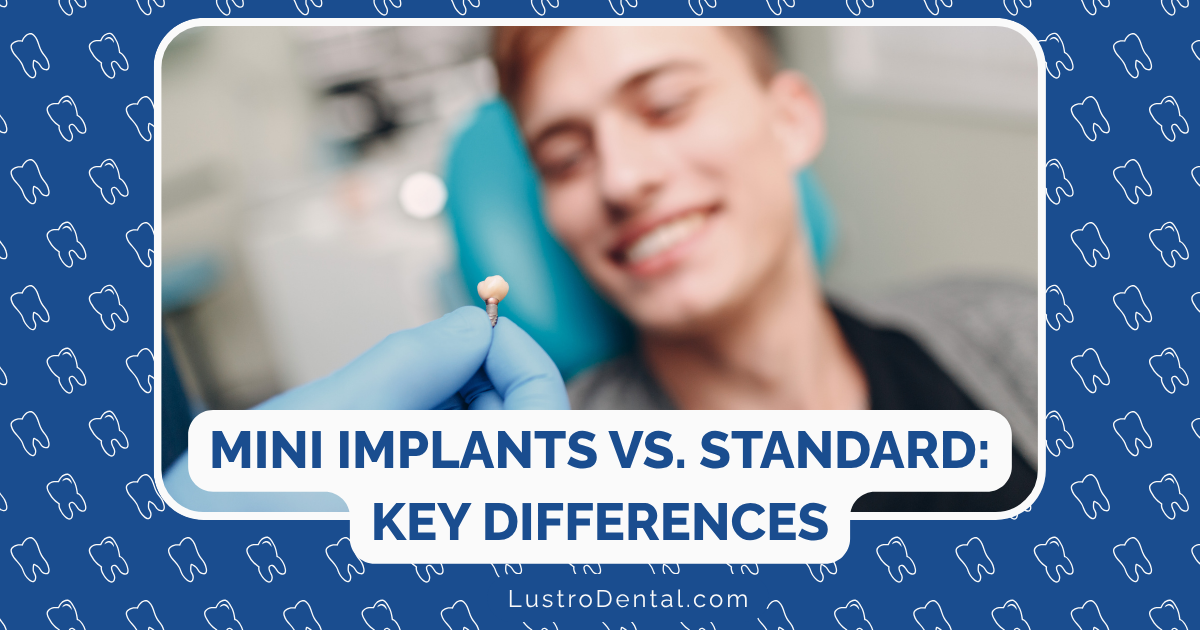
When it comes to replacing missing teeth, dental implants have revolutionized restorative dentistry by providing solutions that closely mimic natural teeth in both function and appearance. However, not all dental implants are created equal. The two main categories—mini dental implants and standard (traditional) implants—offer distinct advantages and limitations that can significantly impact your treatment experience and outcomes.
As someone who’s passionate about helping patients understand their dental options, I’ve seen firsthand how important it is to match the right implant type to each person’s unique needs. In this comprehensive guide, I’ll break down the key differences between mini and standard implants, explore their pros and cons, and help you understand which option might be better suited for your specific situation.
Before diving into the details, let’s clarify what distinguishes these two implant types:
Standard implants are the traditional option that has been widely used for decades:
Mini implants, as the name suggests, are smaller in size:
Dr. Sarah Johnson, a prosthodontist at the American College of Prosthodontists, explains: “The primary difference between mini and standard implants is their diameter. This seemingly small distinction has significant implications for surgical placement, healing, load-bearing capacity, and appropriate applications.”
The size difference between these implant types leads to several important distinctions in how they’re used and what they can accomplish:
Standard Implants:
Mini Implants:
According to a study published in the Journal of Oral Implantology, mini implant placement typically causes less trauma to surrounding tissues, resulting in reduced swelling and faster recovery.
Standard Implants:
Mini Implants:
Dr. Michael Chen, an oral surgeon, notes: “The reduced bone width requirement is perhaps the most significant advantage of mini implants. They’ve opened up implant treatment to many patients who would otherwise require extensive bone grafting or be considered poor candidates for implants altogether.”
Standard Implants:
Mini Implants:
Research from the International Journal of Oral & Maxillofacial Implants indicates that standard implants can withstand significantly higher occlusal forces, making them more suitable for posterior teeth where chewing forces are greatest.
Standard Implants:
Mini Implants:
Standard Implants:
Mini Implants:
According to the American Academy of Implant Dentistry, the total treatment cost for mini implants can be 50-70% less than standard implants, making them a more accessible option for budget-conscious patients.
One of the most important considerations when choosing between implant types is their long-term success and durability:
A 2024 systematic review in the Journal of Dental Research confirmed the excellent long-term prognosis of standard implants, with survival rates exceeding 95% at the 10-year mark.
Research published in the Journal of Oral Implantology indicates that mini implants can achieve success rates comparable to standard implants in the short to medium term, particularly when used for denture stabilization.
Dr. Lisa Rodriguez, a specialist in implant dentistry, explains: “While mini implants have shown promising results, we simply don’t have the same depth of long-term data that we have for standard implants. This doesn’t mean they’re inferior—just that we should be somewhat more cautious in our expectations for their longevity, especially in high-stress applications.”
Understanding which patients are best suited for each implant type can help guide your decision:
Dr. Robert Garcia, a prosthodontist with 20 years of experience, observes: “I’ve found mini implants to be particularly valuable for elderly patients with dentures who aren’t good candidates for extensive surgery. The ability to stabilize their dentures with a minimally invasive procedure can dramatically improve their quality of life.”
Let’s summarize the advantages and limitations of each option:
Pros:
Cons:
Pros:
Cons:
Several myths about mini implants persist that deserve clarification:
Reality: While mini implants are less invasive, they aren’t appropriate for all situations. Their reduced diameter limits their strength and applications, making standard implants a better choice for many patients, particularly for posterior teeth.
Reality: Physics doesn’t lie—the smaller diameter of mini implants inherently reduces their strength and resistance to fracture. Laboratory studies have shown that mini implants can fracture after approximately 480,000 cycles of a 300 Newton load, which is significantly lower than the average adult bite force of 720 to 900 Newtons in the molar region.
Reality: While mini implants can often be placed without bone grafting, they still require a minimum amount of bone. Severely atrophied ridges may still need some augmentation, though typically less than would be required for standard implants.
Reality: When properly placed in appropriate situations, mini implants can provide long-term service. However, they are not simply “temporary” versions of standard implants but rather different tools with specific indications.
Sometimes hearing from patients who have experienced these options provides valuable perspective:
“After being told I needed extensive bone grafting for standard implants, I opted for mini implants to stabilize my lower denture. The procedure was quick, virtually painless, and transformed my experience with dentures. Five years later, they’re still working perfectly.” — Margaret, 72
“I initially chose mini implants for my two missing molars due to the lower cost. Within two years, one fractured and had to be replaced with a standard implant. I wish I’d gone with the standard option from the beginning for those high-pressure chewing teeth.” — David, 58
“As someone with severe dental anxiety, the less invasive mini implant procedure was much less intimidating. I was able to have my front tooth replaced without the extensive surgery that standard implants would have required.” — Jennifer, 45
If you’re trying to decide between mini and standard implants, consider these key factors:
Front teeth experience less bite force than back teeth. Mini implants may be suitable for anterior replacements but are generally not recommended for molars.
Have your dentist evaluate your bone dimensions. If you have adequate width, standard implants typically offer better long-term results. If your ridge is narrow, mini implants may help you avoid bone grafting.
Consider how you’ll use the implants. For denture stabilization, mini implants can work excellently. For individual tooth replacements that need to withstand significant chewing forces, standard implants are usually preferable.
While cost shouldn’t be the only factor, it’s a practical consideration. Mini implants can make implant treatment accessible to patients who couldn’t otherwise afford it.
Consider your age, health, and how long you need the solution to last. Younger patients generally benefit from the proven longevity of standard implants.
Before making your decision, discuss these questions with your implant provider:
In some cases, a combination of mini and standard implants provides the optimal solution:
Dr. James Wilson, an implantologist, shares: “I’ve had great success with hybrid approaches that leverage the strengths of both implant types. This personalized approach often provides the best balance of function, aesthetics, and value for complex cases.”
Both mini and standard dental implants have their place in modern dentistry. Rather than viewing them as competing options where one is universally “better” than the other, it’s more accurate to see them as different tools designed for different situations.
Standard implants remain the gold standard for most tooth replacement scenarios, particularly for posterior teeth and when bone dimensions permit. Their proven track record, superior strength, and excellent longevity make them the preferred choice when conditions are favorable.
Mini implants offer a valuable alternative for specific situations—stabilizing dentures, replacing small anterior teeth, and providing solutions for patients with narrow ridges who wish to avoid bone grafting. Their less invasive nature and lower cost have made implant treatment accessible to many patients who would otherwise go without.
The best approach is a personalized one that considers your specific oral condition, functional needs, budget, and long-term goals. By working closely with a qualified implant dentist who offers both options, you can develop a treatment plan that provides the optimal balance of benefits for your unique situation.
Remember that the “best” dental implant isn’t necessarily the largest, the smallest, or the most expensive—it’s the one that most effectively restores your function, preserves your oral health, fits your budget, and meets your long-term needs.
Have you had experience with either mini or standard dental implants? We’d love to hear about your experience in the comments below!