🦷 General Care
✨ Treatments
👶 Family Care
💚 Wellness
💡 Resources

🦷 General Care
✨ Treatments
👶 Family Care
💚 Wellness
💡 Resources

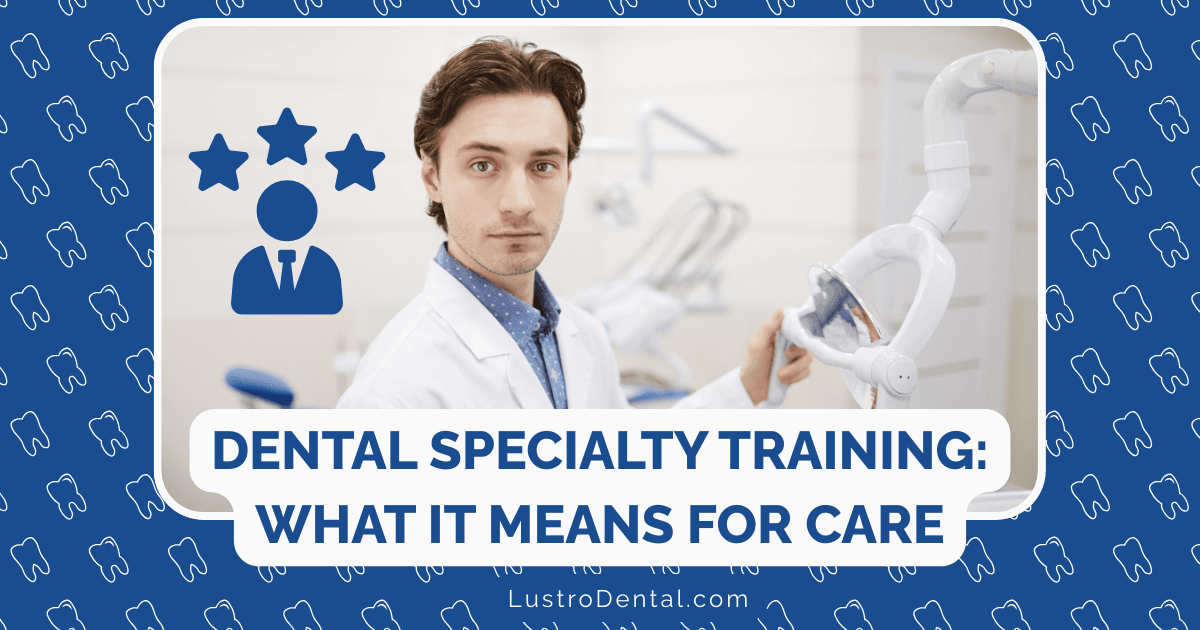
When seeking dental care, you may have noticed an array of credentials following your provider’s name—DDS, DMD, FAGD, Diplomate, or Board Certified—but what do these designations actually signify? More importantly, how do they impact the quality of care you receive?
In the complex landscape of dental credentials, understanding the difference between basic qualifications and advanced specialty training can help you make more informed decisions about your oral healthcare. This comprehensive guide will demystify dental specialty training and certifications, explaining what they mean and why they matter to you as a patient.
Before exploring specialized training, it’s important to understand the baseline education all dentists receive:
These are the primary professional degrees in dentistry, and despite the different names, they represent equivalent education and training. Both require:
According to the American Dental Association (ADA), “The DDS and DMD degrees are equivalent in terms of rigor and curriculum. The difference in terminology is simply a matter of institutional preference.”
This foundational education qualifies a dentist to perform general procedures such as:
While this training is comprehensive, it represents just the beginning of a dentist’s potential educational journey.
For dentists who wish to focus on a specific area of practice, post-doctoral specialty education provides advanced training. As of 2025, the National Commission on Recognition of Dental Specialties and Certifying Boards (NCRDSCB) recognizes 12 dental specialties:
Focus: Advanced pain and anxiety management during dental procedures
Training: Minimum 3-year residency after dental school
Patient Benefits:
When You Might Need One: If you experience severe dental anxiety, require complex surgical procedures, or have medical conditions that complicate pain management.
Focus: Prevention and control of dental diseases on a community-wide basis
Training: Minimum 2-year residency after dental school
Patient Benefits:
When You Might Need One: You may not directly seek treatment from these specialists, but their work influences public health initiatives, school-based dental programs, and community water fluoridation that benefit everyone.
Focus: Diagnosis and treatment of diseases and injuries affecting dental pulp and periradicular tissues
Training: Minimum 2-year residency after dental school
Patient Benefits:
When You Might Need One: If you require a root canal on a tooth with complex anatomy, need retreatment of a failed root canal, or experience dental trauma affecting the pulp.
Focus: Diagnosis and management of diseases affecting the oral and maxillofacial regions
Training: Minimum 3-year residency after dental school
Patient Benefits:
When You Might Need One: If you have an unusual growth, persistent sore, or suspicious lesion in your mouth that requires biopsy and diagnosis.
Focus: Production and interpretation of images for diagnosing diseases in the oral and maxillofacial region
Training: Minimum 2-year residency after dental school
Patient Benefits:
When You Might Need One: If you require specialized imaging such as cone-beam CT scans, MRI, or ultrasound for complex dental or facial conditions.
Focus: Surgical treatment of diseases, injuries, and defects of the oral and maxillofacial regions
Training: Minimum 4-6 year residency after dental school (may include medical school)
Patient Benefits:
When You Might Need One: If you require wisdom tooth removal, dental implants, jaw surgery, facial reconstruction, or treatment for facial pain disorders.
Focus: Diagnosis and management of oral conditions in medically complex patients
Training: Minimum 2-year residency after dental school
Patient Benefits:
When You Might Need One: If you have autoimmune disorders affecting the mouth, oral complications of cancer treatment, salivary gland disorders, or require dental care while managing multiple medical conditions.
Focus: Assessment, diagnosis, and management of pain disorders of the jaw, mouth, face, head, and neck
Training: Minimum 2-year residency after dental school
Patient Benefits:
When You Might Need One: If you experience chronic jaw pain, headaches related to oral structures, neuropathic facial pain, or sleep-related breathing disorders.
Focus: Diagnosis, prevention, and correction of malpositioned teeth and jaws
Training: Minimum 2-3 year residency after dental school
Patient Benefits:
When You Might Need One: If you require correction of crowded or misaligned teeth, have jaw growth abnormalities, or seek treatment for malocclusion (improper bite).
Focus: Comprehensive oral health care for infants, children, and adolescents, including those with special needs
Training: Minimum 2-year residency after dental school
Patient Benefits:
When You Might Need One: For children under 18, especially those with complex medical conditions, developmental disorders, or severe dental anxiety.
Focus: Prevention, diagnosis, and treatment of diseases affecting the supporting structures of teeth
Training: Minimum 3-year residency after dental school
Patient Benefits:
When You Might Need One: If you have moderate to severe gum disease, require gum grafting, need bone regeneration, or are considering dental implants.
Focus: Diagnosis, treatment planning, rehabilitation, and maintenance of oral function and aesthetics
Training: Minimum 3-year residency after dental school
Patient Benefits:
When You Might Need One: If you need multiple missing teeth replaced, require full-mouth reconstruction, have worn dentition requiring rehabilitation, or need maxillofacial prosthetics following cancer surgery or trauma.
While completing a specialty residency qualifies a dentist to practice in that specialty, board certification represents an additional, voluntary step that demonstrates exceptional knowledge and skill.
For each recognized specialty, a national certifying board establishes and maintains standards for certification. The process typically includes:
According to the American Board of Dental Specialties, “Board certification is a significant achievement beyond licensure and represents a dentist’s commitment to excellence in their specialty area.”
When your specialist is board-certified (often indicated by terms like “Diplomate” or “Board Certified”), you can expect:
Dr. James Wilson, past president of the American Board of Prosthodontics, notes: “Board certification represents a specialist’s commitment to providing the highest level of patient care. It’s a rigorous process that ensures the dentist has not only completed specialty training but has demonstrated mastery of that specialty’s knowledge and skills.”
In addition to the 12 recognized specialties, dentists may pursue other advanced credentials that demonstrate commitment to excellence in specific areas of practice.
These designations indicate significant continuing education beyond dental school for general dentists:
According to the Academy of General Dentistry, less than 2% of dentists in the United States have achieved MAGD status, making it a significant distinction for general practitioners.
For dentists focusing on implant dentistry, ICOI offers three levels of certification:
These credentials specifically indicate advanced training and experience in dental implant procedures.
Dentists may also hold:
As a patient, you have the right to know your provider’s qualifications. Here’s how to verify credentials:
Most dentists are proud of their educational achievements and will gladly discuss their training. Consider asking:
You can verify board certification through:
In the office, look for:
Understanding dental specialties helps you make informed decisions about your care. Consider seeking a specialist when:
If your condition is unusual, severe, or complicated, a specialist’s advanced training may be beneficial.
Ethical general dentists refer patients to specialists when cases exceed their training or comfort level.
If initial treatment hasn’t resolved your issue, a specialist may offer alternative approaches.
Certain medical conditions may require the expertise of specialists who have additional training in managing medically complex patients.
Modern dentistry often involves a team approach, with specialists and general dentists collaborating for comprehensive care.
Your general dentist typically serves as your primary dental provider, coordinating with specialists as needed. This collaboration ensures:
Dr. Sarah Johnson, a prosthodontist and educator, explains: “The relationship between general dentists and specialists is synergistic. General dentists provide essential ongoing care and identify when specialized expertise is needed, while specialists offer advanced training for specific complex procedures. Together, they provide patients with optimal outcomes.”
The field of dental specialization continues to evolve, with several notable trends:
Within recognized specialties, dentists are further subspecializing in areas like:
Advanced technologies are creating new areas of expertise:
The boundaries between specialties are becoming more fluid, with increasing collaboration on complex cases requiring multiple specialized skills.
Understanding dental specialty training and certifications empowers you to:
The extensive training and rigorous certification processes that dental specialists undergo translate directly to better patient outcomes. Whether you’re seeking routine care from a highly trained general dentist or specialized treatment for a complex condition, knowing what those credentials after your dentist’s name actually mean helps you make confident, informed decisions about your oral health care.
Remember, the best dental care often comes from providers who not only have appropriate credentials but also communicate clearly, listen to your concerns, and involve you in treatment decisions. Credentials matter, but the provider-patient relationship remains at the heart of quality dental care.