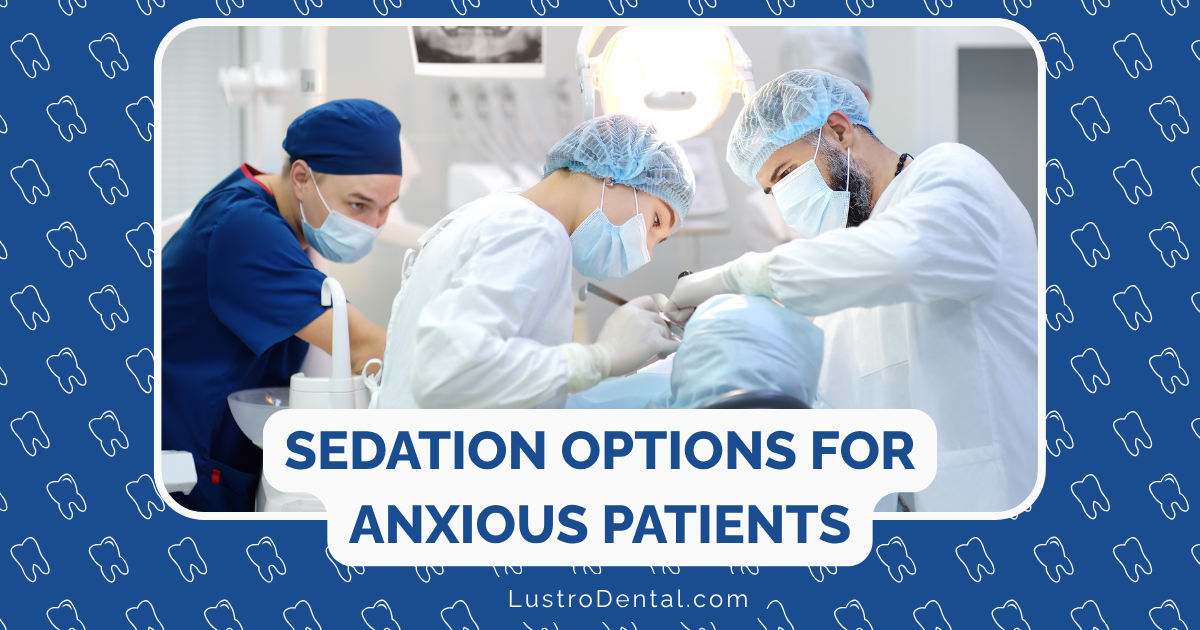
Sedation Options for Anxious Patients: Finding Your Comfort Level
Does the thought of sitting in a dental chair make your heart race? You’re not alone. Dental anxiety affects approximately 36% of the population, with another 12% suffering from extreme dental fear that can prevent them from seeking necessary care.
Fortunately, modern dentistry offers a range of sedation options designed to help anxious patients receive the dental care they need without the overwhelming stress. Whether you experience mild nervousness or paralyzing phobia, there’s a sedation approach that can work for you.
In this comprehensive guide, we’ll explore the spectrum of dental sedation options, helping you understand which approach might be right for your specific comfort needs and anxiety level.
Dental anxiety exists on a continuum—from mild uneasiness to severe phobia—and can stem from various sources:
Previous negative dental experiences
Fear of pain or needles
Concerns about loss of control
Embarrassment about oral health
Sensory triggers (sounds, smells, or sensations)
Generalized anxiety that manifests in dental settings
Sedation dentistry addresses these concerns by creating a more relaxed experience. According to the Cleveland Clinic, sedation can range from minimal relaxation where you remain fully conscious to deep sedation where you have little to no awareness of the procedure.
The Four Levels of Dental Sedation
Dental sedation is typically categorized into four distinct levels, each appropriate for different degrees of anxiety and procedure complexity:
1. Minimal Sedation
What it is: The lightest form of sedation, where you remain fully awake but feel relaxed.
Best for:
Mild dental anxiety
Routine procedures like cleanings, fillings, or simple extractions
Patients who want to remain fully alert but take the “edge” off
Common methods: Nitrous oxide (“laughing gas”) or a small dose of oral sedative
2. Moderate Sedation (Conscious Sedation)
What it is: A deeper state of relaxation where you remain conscious but may slur words and have limited memory of the procedure.
Best for:
Moderate anxiety
Longer procedures requiring more extensive work
Patients who prefer to be less aware of the details of treatment
Common methods: Oral sedatives (higher dosage) or sometimes nitrous oxide combined with oral medication
3. Deep Sedation
What it is: A state on the edge of consciousness where you can still be awakened but are largely unaware of the procedure.
Patients who require extensive work that would be difficult to complete in a single visit otherwise
Common methods: IV or inhaled medications administered by an anesthesiologist or specially trained dentist
Exploring Specific Sedation Methods
Now let’s look more closely at the specific methods used to achieve these sedation levels:
Nitrous Oxide (Laughing Gas)
How it works: Delivered through a small mask placed over your nose, nitrous oxide is mixed with oxygen to create a mild euphoric effect that reduces anxiety.
Anxiety level addressed: Mild to moderate
Procedure duration: Takes effect within 3-5 minutes and wears off quickly after the gas is turned off
Pros:
Fast-acting and quick to wear off
You can drive yourself home afterward
No lingering effects
Dosage can be adjusted throughout the procedure
Safe for most patients, including children
Cons:
May not be sufficient for severe anxiety
Some people experience nausea
Not as effective for longer, more complex procedures
According to Virginia Family Dentistry, nitrous oxide patients typically feel relaxed, slightly euphoric, and less aware of time passing—making dental procedures seem shorter than they actually are.
Oral Sedation
How it works: You take a prescribed anti-anxiety medication (typically a benzodiazepine like Halcion, Valium, or Ativan) before your appointment.
Anxiety level addressed: Moderate to moderately severe
Procedure duration: Usually taken about an hour before the procedure; effects can last several hours
Pros:
No needles required
Stronger anxiety relief than nitrous oxide alone
Can be used for longer procedures
Often creates partial amnesia of the procedure
Relatively inexpensive compared to IV sedation
Cons:
Cannot drive after taking medication (need someone to transport you)
Effects can be unpredictable based on individual metabolism
Cannot be adjusted during the procedure once taken
May cause drowsiness for remainder of the day
Dr. Isaac Davidson notes on his practice website that oral sedation can be combined with nitrous oxide for enhanced effect, making it versatile for patients with varying anxiety levels.
Intravenous (IV) Sedation
How it works: Sedative medications are delivered directly into your bloodstream through an IV line, creating a deeper level of sedation.
Anxiety level addressed: High anxiety to dental phobia
Procedure duration: Takes effect almost immediately; recovery varies but typically requires several hours
Pros:
Rapid onset of sedation
Dentist can adjust dosage in real-time based on your needs
Creates a deep state of relaxation
Often produces partial or complete amnesia of the procedure
Allows complex work to be completed in fewer visits
Cons:
Requires an IV insertion (needle)
More expensive than other sedation options
Requires specialized training for the dentist
Need someone to drive you home and monitor you after
Not available at all dental practices
The Center for Implant and Esthetic Dentistry describes IV sedation as creating a “twilight sleep” where patients are on the edge of consciousness—aware enough to respond to simple directions but deeply relaxed and largely unaware of the details of the procedure.
General Anesthesia
How it works: Medications administered intravenously or through inhalation render you completely unconscious.
Anxiety level addressed: Severe dental phobia or special circumstances
Procedure duration: Takes effect quickly; recovery can take several hours to a full day
Current medications that might interact with sedatives
Always provide your complete medical history to your dentist when discussing sedation options.
4. Consider Practical Factors
Recovery time: How quickly do you need to return to normal activities?
Transportation: Can someone drive you home if needed?
Cost considerations: What does your insurance cover?
Availability: Does your dentist offer your preferred sedation method?
What to Expect with Each Sedation Option
Before Your Appointment
Nitrous Oxide:
No special preparation needed
Eat normally before the appointment
Arrive at your regular appointment time
Oral Sedation:
Take prescribed medication 1-2 hours before appointment (follow dentist’s instructions exactly)
Arrange for someone to drive you to and from the appointment
Avoid eating for 6 hours before if recommended by your dentist
Wear comfortable clothing
IV Sedation/General Anesthesia:
Usually requires fasting for 6-8 hours before the procedure
Arrange for someone to drive you home and stay with you afterward
Wear loose, comfortable clothing with short sleeves for IV access
Follow all pre-operative instructions carefully
May require pre-sedation evaluation appointment
During Your Appointment
Nitrous Oxide:
Small mask placed over your nose
Initial flow of pure oxygen, followed by nitrous oxide
Feelings of relaxation, tingling, or warmth within minutes
Remain conscious and able to communicate throughout
Dentist can adjust levels based on your comfort
Oral Sedation:
Relaxed, drowsy feeling by appointment time
Remain conscious but may feel sleepy
May have limited memory of the procedure
Dentist monitors vital signs throughout
IV Sedation:
IV line placed in arm or hand
Rapid onset of deep relaxation
Reduced awareness of surroundings and procedure
May drift in and out of sleep
Continuous monitoring of vital signs
Can respond to verbal commands
General Anesthesia:
Complete unconsciousness
No awareness or memory of procedure
Continuous monitoring by anesthesia professional
Breathing may be assisted
After Your Appointment
Nitrous Oxide:
Effects wear off within minutes after oxygen is administered
Can drive yourself home and resume normal activities
No lingering grogginess
Oral Sedation:
Remain groggy for several hours
Should not drive, work, or make important decisions for 24 hours
May experience mild amnesia about the appointment
Rest at home for the remainder of the day
IV Sedation:
Need someone to drive you home and stay with you
Rest for the remainder of the day
Avoid alcohol, operating machinery, or making important decisions for 24 hours
May have little to no memory of the procedure
General Anesthesia:
Longer recovery period (several hours to a full day)
May experience nausea, dizziness, or disorientation
Need someone to drive you home and monitor you
Follow all post-operative instructions carefully
Safety Considerations and Risks
While dental sedation is generally very safe when administered by qualified professionals, it’s important to understand potential risks:
Nitrous Oxide:
Minimal risks
Nausea in some patients
Headache (rare)
Not recommended for patients with certain respiratory conditions or in first trimester of pregnancy
Oral Sedation:
Unpredictable absorption rates can make dosing less precise
Potential for respiratory depression (rare with proper dosing)
Drug interactions with other medications
Prolonged drowsiness
IV Sedation:
Bruising or pain at IV site
Respiratory depression (monitored continuously)
Blood pressure fluctuations
Rare allergic reactions
General Anesthesia:
Highest risk profile of all sedation options
Potential for more significant respiratory and cardiovascular effects
Longer recovery with potential for nausea and vomiting
Rare but serious complications possible
Finding a Qualified Sedation Dentist
Not all dentists offer all types of sedation. When seeking a sedation dentist:
Verify credentials: Ask about specific training in sedation techniques
Check experience: How many patients have they sedated using your preferred method?
Ask about emergency protocols: What safety measures are in place?
Discuss monitoring: What equipment is used to monitor vital signs?
Review facility: Is it properly equipped for the level of sedation offered?
Many dental specialists (oral surgeons, periodontists) have advanced training in sedation, as do dentists who have completed post-graduate programs in sedation dentistry.
Discussing Sedation with Your Dentist: Questions to Ask
When consulting with your dentist about sedation options, consider asking:
“Given my anxiety level and dental needs, which sedation option would you recommend?”
“What are the risks and benefits of each sedation option for my specific situation?”
“What is your experience with this type of sedation?”
“What should I expect before, during, and after the procedure?”
“What are the total costs involved, and what might my insurance cover?”
“What alternatives might be appropriate if my first choice isn’t suitable?”
“How should I prepare for my sedation appointment?”
Beyond Sedation: Complementary Approaches
While sedation is extremely effective, consider these complementary approaches to enhance your comfort:
Communication techniques: Establish hand signals with your dentist to indicate when you need a break
Distraction methods: Music, podcasts, or videos during treatment
Relaxation training: Deep breathing, progressive muscle relaxation, or guided imagery
Psychological approaches: Cognitive behavioral therapy specifically for dental anxiety
Gradual exposure: Starting with brief, simple appointments to build confidence
The Bottom Line: Finding Your Comfort Zone
The ideal sedation option balances your anxiety level, medical history, procedure requirements, and personal preferences. What works for one person may not be right for another.
Remember that the goal of sedation dentistry isn’t just to get through a single procedure—it’s to help you establish a comfortable relationship with dental care that supports your long-term oral health. Many patients find that with positive experiences under sedation, their dental anxiety gradually decreases over time.
If dental anxiety has kept you from seeking necessary care, know that modern sedation dentistry offers more options than ever before to help you find your comfort level and reclaim your oral health.
Have you had experience with dental sedation? What worked best for you? Share your experiences in the comments below to help others who might be considering their options.