🦷 General Care
✨ Treatments
👶 Family Care
💚 Wellness
💡 Resources

🦷 General Care
✨ Treatments
👶 Family Care
💚 Wellness
💡 Resources

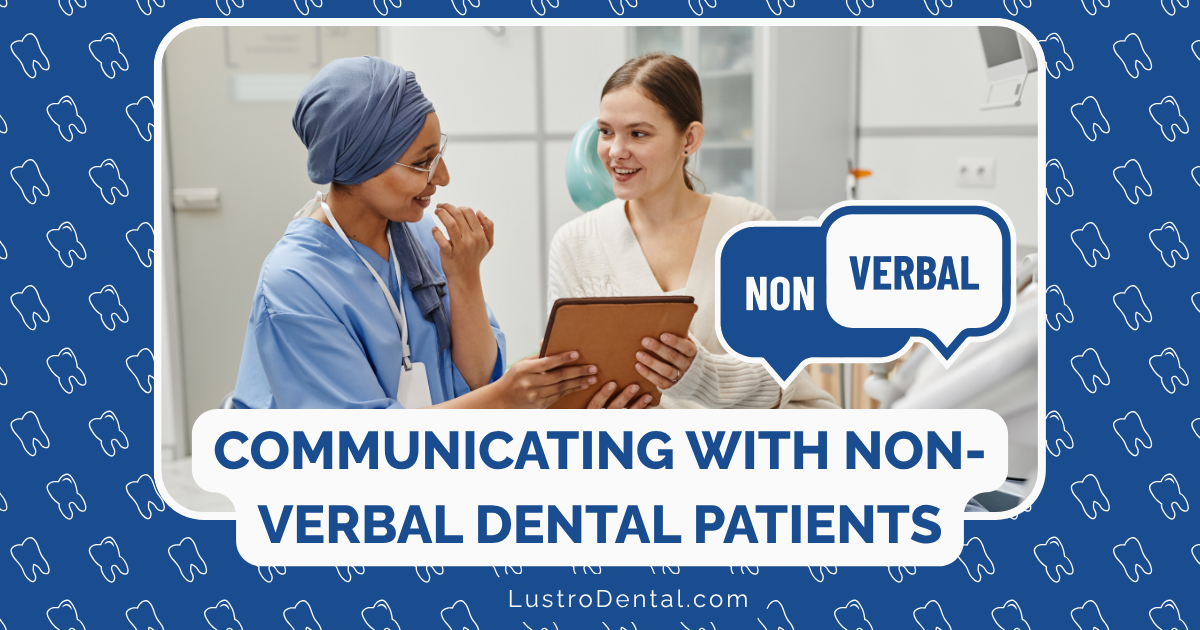
The dental chair can be an intimidating place for anyone. Now imagine sitting there unable to express your fears, ask questions, or tell the dentist when something hurts. This is the reality for many non-verbal patients who face unique challenges during dental visits.
As someone who’s worked with diverse patient populations for years, I’ve seen how thoughtful communication strategies can transform these potentially stressful experiences into positive ones. When we adapt our approach to meet the communication needs of non-verbal patients, we not only provide better clinical care—we honor their dignity and humanity.
Non-verbal patients are a diverse group that may include:
According to the American Speech-Language-Hearing Association, approximately 5 million Americans may benefit from augmentative and alternative communication (AAC) methods. Many of these individuals will sit in your dental chair at some point, making effective non-verbal communication strategies essential for comprehensive care.
Dental visits present unique communication challenges for non-verbal patients:
Dr. Sarah Johnson, a pediatric dentist specializing in special needs care, notes: “The biggest misconception is that non-verbal means non-communicative. Every patient communicates—we just need to learn their language.”
Successful dental visits for non-verbal patients begin long before they enter the operatory.
Develop a detailed intake form specifically for non-verbal patients that collects information about:
This information becomes the foundation for personalized communication strategies.
Consider offering pre-appointment office visits that allow patients to:
Research shows that desensitization through gradual exposure significantly reduces anxiety for many non-verbal patients.
Create and share resources that visually explain the dental visit:
Many dental practices now offer these resources on their websites for download and review before appointments.
AAC encompasses a wide range of tools and strategies that can enhance communication during dental visits.
Simple, non-electronic communication tools can be remarkably effective:
For patients who regularly use electronic communication devices:
Dr. Michael Chen, who specializes in treating patients with complex communication needs, advises: “Always ask caregivers about the AAC systems patients use daily. Consistency across settings reduces anxiety and improves communication effectiveness.”
PECS deserves special mention as a highly effective approach for many non-verbal patients, particularly those with autism spectrum disorders. This structured system teaches individuals to initiate communication by exchanging picture cards for desired items or activities.
In dental settings, PECS can be adapted to:
Research published in the Journal of Autism and Developmental Disorders has shown that PECS can significantly improve dental experiences for non-verbal patients, reducing anxiety and increasing cooperation.
The physical environment plays a crucial role in supporting effective communication with non-verbal patients.
Transform your treatment room with visual supports:
These visual supports provide structure and predictability that support communication.
Remember that communication is about much more than words. Developing sensitivity to non-verbal cues is essential.
Learn to recognize signs of distress, comfort, or questions:
Be mindful of your own non-verbal signals:
Dental hygienist Rebecca Torres shares: “I’ve learned that my own body language speaks volumes. When I’m rushed or tense, my non-verbal patients pick up on it immediately. Taking a deep breath and centering myself before entering the room makes a tremendous difference.”
The classic Tell-Show-Do approach can be modified for non-verbal patients:
This approach respects the patient’s need for predictability while acknowledging their unique communication style.
Developing systems to identify and respond to pain is critical for safe, comfortable care.
Work with patients and caregivers to establish:
Be vigilant for signs that might indicate pain or distress:
Dr. James Wilson, a dentist with extensive experience treating non-verbal patients, emphasizes: “We need to be even more attentive to subtle cues with non-verbal patients. Sometimes the slightest change in expression is their way of communicating significant discomfort.”
Caregivers are invaluable partners in developing effective communication strategies.
Consider consulting with:
The Special Care Dentistry Association offers resources for connecting with professionals experienced in treating patients with complex communication needs.
Real-world examples illustrate the power of thoughtful communication strategies:
Case 1: Alex, 12-year-old with autism
Alex arrived for his first dental visit unable to speak and extremely anxious. Through pre-visit preparation with social stories and a visual schedule, plus the use of a tablet-based AAC system during treatment, he successfully completed a full examination and cleaning. The dental team created a custom PECS book for dental visits that Alex now brings to each appointment, allowing him to communicate his needs and preferences effectively.
Case 2: Maria, 67-year-old stroke survivor
After her stroke, Maria lost her ability to speak but retained her cognitive abilities. Her dental team created a simple communication board with dental terminology and common requests. They also established a clear hand signal system for pain or discomfort. By adapting their approach and allowing extra time, Maria received comprehensive dental care despite her communication challenges.
The field of AAC is rapidly evolving, with promising implications for dental settings:
As Dr. Lisa Zhang, a researcher in special care dentistry, notes: “The technology is exciting, but what matters most is the human connection—the willingness to adapt and meet patients where they are communicatively.”
Dental professionals can take concrete steps to enhance their ability to communicate with non-verbal patients:
Organizations like the American Academy of Developmental Medicine and Dentistry offer resources and training for dental professionals seeking to enhance their skills in this area.
Effective communication with non-verbal patients isn’t just about completing dental procedures—it’s about establishing human connection and providing dignified care. When we adapt our communication approaches to meet patients where they are, we create an environment where everyone can receive the oral healthcare they deserve.
The strategies outlined here—from visual supports to AAC systems, from environmental modifications to caregiver collaboration—represent a commitment to inclusive dental care. By implementing these approaches, dental professionals can transform potentially stressful experiences into opportunities for connection, trust-building, and positive health outcomes.
Remember that communication is a basic human need and right. When we bridge communication gaps in the dental setting, we affirm that every patient deserves to be heard, understood, and treated with respect—regardless of how they communicate.
What communication strategies have you found effective with non-verbal patients? Share your experiences in the comments below.