🦷 General Care
✨ Treatments
👶 Family Care
💚 Wellness
💡 Resources

🦷 General Care
✨ Treatments
👶 Family Care
💚 Wellness
💡 Resources

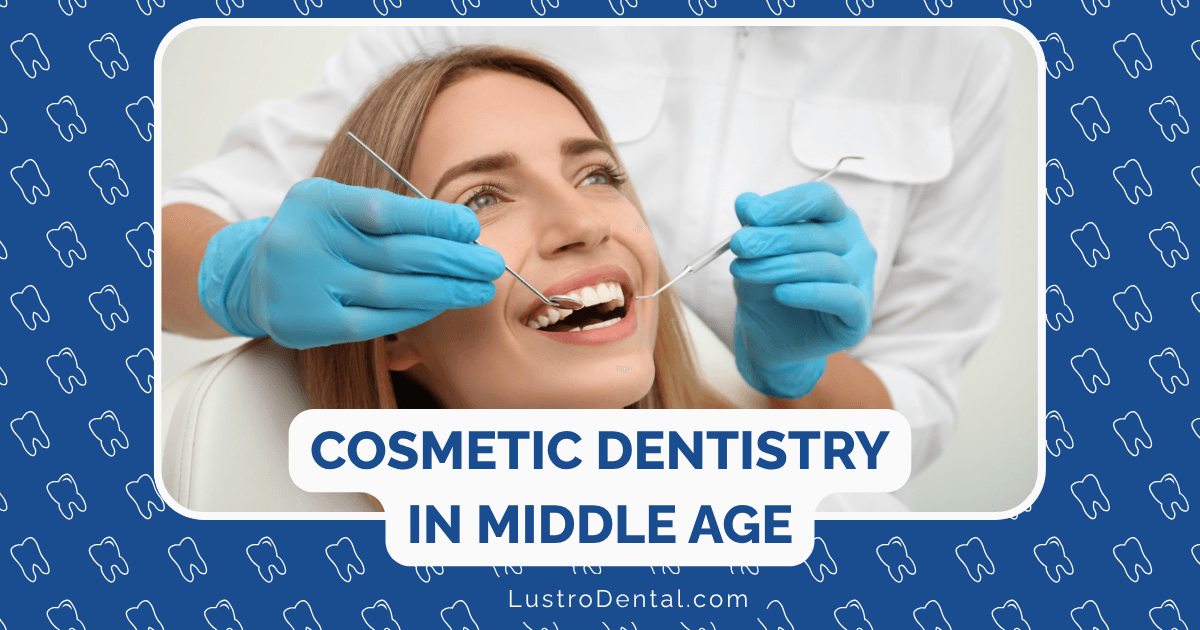
When I hit 45, I found myself staring at my smile in the mirror with a critical eye. The teeth that had served me well for decades were showing their age—slightly yellowed from years of coffee, subtly worn down at the edges, and bearing the evidence of old silver fillings that had darkened over time. I wasn’t looking for a Hollywood smile, just a refreshed version of my own. Sound familiar?
If you’re in your 40s, 50s, or 60s and considering cosmetic dentistry, you’re in good company. According to recent statistics from Impressions Dental, the most common age group seeking cosmetic dental procedures is 40-51 years old. And the good news? Today’s cosmetic dentistry offers more natural-looking options than ever before.
Let’s explore how modern cosmetic dentistry can enhance your smile while honoring the character and authenticity that comes with middle age.
Before diving into specific treatments, it’s worth understanding what makes cosmetic dentistry for middle-aged adults different from treatments for younger patients.
“When a 25-year-old walks into my office wanting cosmetic work, their goals and concerns are very different from someone in their 50s,” explains Dr. Sarah Chen, a cosmetic dentist specializing in adult smile makeovers. “Middle-aged patients typically have more complex dental histories, existing dental work that needs integration, and a desire for results that look natural rather than perfect.”
Common dental issues that emerge or worsen in middle age include:
These issues create unique challenges—but also opportunities for meaningful improvement without looking “overdone.”
Research shows that middle-aged adults seeking cosmetic dentistry have different priorities than younger patients. According to a 2024 study, adults over 40 typically want:
“Most of my middle-aged patients tell me they don’t want to look 20 again—they just want to look like the best version of themselves at their current age,” notes Dr. James Wilson, who specializes in cosmetic dentistry for older adults. “They want teeth that look real, not perfect.”
Traditional veneers required removing significant tooth structure, but today’s ultra-thin veneers can transform your smile while preserving much more of your natural teeth.
What they are: Wafer-thin shells of porcelain (as thin as 0.3mm) that bond to the front surface of teeth.
Best for: Addressing multiple cosmetic concerns simultaneously—discoloration, minor chips, small gaps, and slightly misaligned teeth.
The natural advantage: “The latest generation of ultra-thin veneers allows us to be incredibly conservative with tooth preparation,” explains Dr. Chen. “In some cases, we can even place them with no preparation at all, preserving all your natural enamel.”
Modern veneers are also more translucent and textured, mimicking the natural play of light on tooth enamel. According to Dynamic Smile Design, the new veneer materials allow for customized translucency levels that match your natural teeth perfectly.
Real-life perspective: “At 52, I wanted to address years of coffee stains and some minor chips, but I was terrified of getting that obvious ‘veneer look,'” shares Michael from Boston. “My dentist used ultra-thin veneers on just my front six teeth. They look so natural that even my wife couldn’t tell exactly what had changed—she just thought I looked refreshed.”
Dental bonding has come a long way from the obvious, monochromatic restorations of the past. Today’s materials and techniques allow for incredibly natural results.
What it is: Application of tooth-colored composite resin that’s shaped and polished to match surrounding teeth.
Best for: Repairing chips, building up worn edges, closing small gaps, and covering discoloration on one or a few teeth.
The natural advantage: “Modern composite materials allow us to layer different opacities and translucencies, just like natural teeth,” says Dr. Wilson. “We can even incorporate subtle characterizations like tiny cracks or variations that exist in natural teeth.”
The latest bonding techniques also preserve more of your natural tooth structure than veneers, making them an excellent conservative option.
Real-life perspective: “After decades of grinding my teeth, the edges were flat and chipped,” recalls Jennifer, 48. “My dentist used bonding to restore the natural contours. The results were immediate, and no one could tell I’d had work done. They just thought I looked less tired.”
If you’re like many middle-aged adults, you probably have old metal fillings or crowns that are both visible and aging poorly.
What they are: Ceramic or composite replacements for old metal fillings, crowns, or bridges.
Best for: Updating old dental work with more natural-looking alternatives.
The natural advantage: “Today’s ceramic materials are incredibly lifelike,” explains Dr. Chen. “We can match the translucency, color variations, and light-reflecting properties of natural teeth. Plus, these materials bond directly to the tooth, allowing us to be more conservative in our preparations.”
According to Kelley Mingus Dentistry, advancements in ceramic materials have made these restorations stronger and more stain-resistant than ever before.
Real-life perspective: “I had silver fillings from college that had turned almost black over the decades,” shares Robert, 56. “Having them replaced with tooth-colored materials made a huge difference in how natural my smile looks when I laugh. It’s still my smile, just refreshed.”
Orthodontic treatment isn’t just for teenagers. In fact, adults over 40 represent one of the fastest-growing segments of orthodontic patients.
What they are: Clear, removable aligners (like Invisalign) or behind-the-teeth braces that gradually straighten teeth.
Best for: Correcting tooth crowding, spacing issues, or teeth that have shifted over time.
The natural advantage: “Clear aligners allow us to make subtle improvements to tooth position without the obvious appearance of traditional braces,” notes Dr. Wilson. “For middle-aged patients, even small alignment corrections can have a dramatic effect on the overall appearance of their smile.”
Many adults find that straightening slightly crooked teeth can provide a more youthful appearance without looking artificial.
Real-life perspective: “After my kids finished their orthodontic treatment, I decided it was finally my turn,” says Maria, 54. “I used clear aligners for 14 months to correct crowding that had worsened with age. The changes were subtle but made a big difference in my confidence.”
Tooth loss becomes more common with age, but today’s implant solutions offer incredibly natural-looking replacements.
What they are: Titanium or ceramic posts surgically placed in the jawbone that support crowns, bridges, or dentures.
Best for: Replacing missing teeth with the most natural-looking and functioning alternative.
The natural advantage: “Modern implant crowns are virtually indistinguishable from natural teeth,” says Dr. Chen. “We can customize every aspect—the shape, color, translucency, and even the way the crown emerges from the gumline.”
According to East Chester Dental, the new dental implants are considered one of the best solutions for missing teeth, particularly for adults over 50, as they provide stability and natural appearance that removable options can’t match.
Real-life perspective: “After losing a molar to a failed root canal, I opted for an implant rather than a bridge,” shares Thomas, 59. “The process took several months, but the result is amazing—I literally cannot tell the difference between the implant and my natural teeth when I’m eating or looking in the mirror.”
While younger patients might opt for maximum whitening, middle-aged adults often prefer a more subtle approach.
What it is: Professional whitening calibrated to achieve natural-looking brightness rather than extreme whiteness.
Best for: Removing accumulated stains while maintaining age-appropriate color.
The natural advantage: “We’ve moved away from the ‘toilet bowl white’ trend of the early 2000s,” explains Dr. Wilson. “Today’s approach to whitening for middle-aged patients focuses on removing stains while maintaining some warmth in the color, which looks more natural with mature skin tones.”
According to Shining Smiles Dental, the new whitening technologies cause less sensitivity while achieving more natural results.
Real-life perspective: “I didn’t want blindingly white teeth that would look fake,” says Patricia, 61. “My dentist suggested a moderate whitening approach. The result brightened my smile by several shades but still looks natural with my complexion and age.”
Several technological advances have revolutionized cosmetic dentistry for middle-aged adults:
This technology combines facial analysis, 3D imaging, and AI to create a preview of potential results tailored to your unique features and age. It allows you to “try on” different options virtually before committing to treatment.
“Digital Smile Design has transformed how we approach cosmetic dentistry for middle-aged patients,” notes Dr. Chen. “We can show patients exactly how different options will look with their facial features, ensuring results that enhance their natural appearance rather than creating an artificial look.”
Same-day restorations are now possible thanks to 3D printing technology. This means fewer appointments and more precise results.
“For busy professionals in their 40s and 50s, the time-saving aspect of 3D printing is invaluable,” says Dr. Wilson. “We can create a crown or veneer while you wait, eliminating the need for temporary restorations and multiple visits.”
New dental materials mimic the optical properties of natural teeth more accurately than ever before.
“Today’s ceramics and composites can be layered and customized to match the complex translucency and color variations of natural teeth,” explains Dr. Chen. “This is especially important for middle-aged patients who want results that blend seamlessly with their existing teeth.”
If you’re considering cosmetic dentistry in middle age, here are some questions to help you find the right approach:
Cosmetic dentistry in middle age isn’t about erasing every sign of maturity or creating a perfect but artificial smile. It’s about enhancing what you already have, addressing specific concerns, and giving you the confidence to smile freely.
“The most successful cosmetic cases for middle-aged patients are the ones where friends notice something positive but can’t quite put their finger on what’s changed,” says Dr. Wilson. “That’s the art of natural-looking cosmetic dentistry—improvement without obvious intervention.”
Whether you’re considering a minor refresh or a more comprehensive smile makeover, today’s natural-looking options can help you achieve a smile that looks authentically you—just a bit better.
Have you had cosmetic dental work done in middle age? What was your experience like? Share your story in the comments to help others navigating this decision.