🦷 General Care
✨ Treatments
👶 Family Care
💚 Wellness
💡 Resources

🦷 General Care
✨ Treatments
👶 Family Care
💚 Wellness
💡 Resources

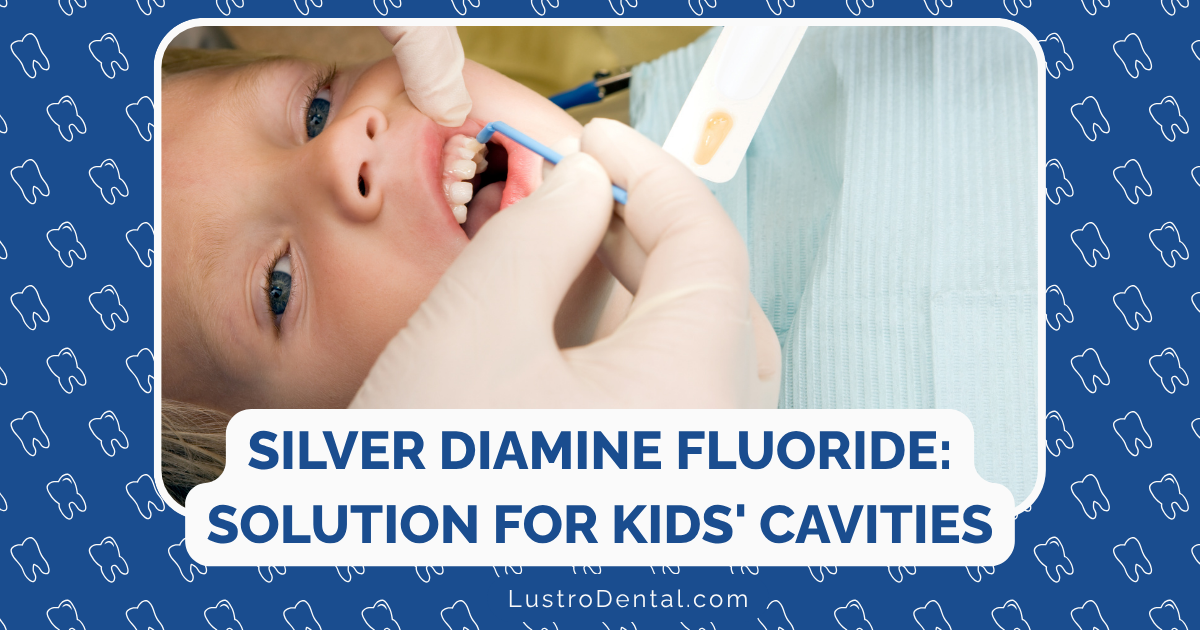
As any parent knows, hearing that your child has cavities can trigger a wave of concern—not just about their dental health, but about the treatment process itself. Traditional cavity treatment involving drilling and filling can be challenging for young children, potentially creating anxiety that follows them into adulthood.
But what if there was a way to treat cavities in children without drills, needles, or the anxiety that often accompanies them? Enter silver diamine fluoride (SDF), a treatment option that’s changing the landscape of pediatric dentistry.
As someone passionate about dental health education, I’ve seen how SDF has transformed the experience of cavity treatment for many children and their families. This non-invasive approach offers a valuable alternative that parents should know about—particularly for young children, those with special healthcare needs, or in situations where traditional treatment might be difficult.
Let’s explore what SDF is, how it works, and whether it might be right for your child.
Silver diamine fluoride is a colorless or blue-tinted liquid that combines two powerful cavity-fighting ingredients:
This powerful combination not only stops (or “arrests”) existing cavities but also helps prevent new ones from forming. SDF has been used extensively in other countries for decades and received FDA clearance in the United States in 2014 (though its use for cavity treatment is technically considered “off-label”).
Dr. Sarah Johnson, a pediatric dentist at Children’s Dental Health Associates, explains: “SDF represents a paradigm shift in how we approach certain cavities in children. Rather than immediately drilling and filling every cavity, we now have the option to arrest the decay process non-invasively in specific situations.”
SDF works through several mechanisms to combat tooth decay:
According to research published in the Journal of Dental Research, SDF can arrest (stop the progression of) approximately 80% of treated cavities. This makes it significantly more effective than other non-invasive treatments like fluoride varnish alone.
One of the most appealing aspects of SDF treatment is its simplicity. The application process typically takes less than two minutes per tooth and involves:
That’s it—no drilling, no numbing injections, and no filling materials. Most children experience no discomfort during the procedure, which is a significant advantage for young or anxious patients.
The American Academy of Pediatric Dentistry notes that SDF treatment may need to be reapplied every 3-6 months until the tooth falls out naturally (for baby teeth) or until more definitive treatment can be provided.
SDF offers several compelling advantages, particularly for pediatric patients:
The most obvious benefit is the absence of drilling, injections, or other potentially frightening aspects of traditional cavity treatment. This can be especially valuable for:
The entire process takes just minutes and doesn’t require extensive preparation or recovery time. This means:
According to the American Dental Association, a single application of SDF can arrest between 47% and 90% of cavities, with the effectiveness increasing with repeated applications. This makes it a reliable option for managing decay.
SDF treatment is typically much less expensive than traditional fillings, with an average cost of $20-$75 per application. This can be particularly important for families with limited financial resources or inadequate dental insurance.
SDF can be an excellent interim solution in situations where:
Dr. Michael Chen, pediatric dentist at Pediatric Dental Associates, notes: “SDF gives us a valuable tool to stabilize the situation until a child is ready for definitive treatment or until the baby tooth falls out naturally. It transforms urgent situations into manageable ones.”
While SDF offers numerous benefits, there is one significant consideration that parents should understand before proceeding: staining.
When SDF reacts with the decayed portion of the tooth, it creates a permanent black or dark brown stain. This is actually a sign that the treatment is working—the silver is reacting with the bacteria and proteins in the decayed area.
This staining:
For many parents, this cosmetic drawback is a reasonable trade-off for a painless, effective treatment—particularly for back teeth that aren’t visible when smiling. However, for highly visible front teeth, the aesthetic impact should be carefully considered.
The American Academy of Pediatrics recommends that dentists show parents before-and-after photos of SDF treatment to ensure they understand the aesthetic outcome before proceeding.
While SDF can be an excellent option for many children with cavities, it’s not the right choice for every situation. SDF may be most appropriate for:
For children under age 3-4 who may struggle to cooperate with traditional treatment, SDF offers a way to manage cavities until they’re older or until the baby teeth fall out naturally.
Children with medical, physical, or cognitive conditions that make traditional dental treatment challenging may particularly benefit from the simplicity of SDF.
For children who have developed fear of dental procedures, SDF can provide a positive, non-threatening experience that helps rebuild trust.
When a child has numerous cavities that would require several appointments to treat conventionally, SDF can stabilize all affected teeth quickly.
Since staining is the primary drawback of SDF, it’s often an excellent choice for molars and other teeth that aren’t visible when smiling.
SDF may not be ideal in these situations:
Due to the staining effect, parents may prefer traditional treatment for highly visible front teeth, especially in older children.
SDF works best on cavities that haven’t penetrated to the innermost part of the tooth. Very deep cavities may require different treatment approaches.
Though rare, children with known allergies to silver should not receive SDF treatment.
SDF arrests decay but doesn’t restore the structure of the tooth. In some cases, a traditional filling may be necessary to restore function or prevent food impaction.
To help parents understand their options, here’s how SDF compares to traditional fillings:
| Aspect | Silver Diamine Fluoride | Traditional Fillings |
| Procedure | Quick application of liquid | Requires drilling and filling |
| Pain | Painless, no anesthesia needed | May require numbing injections |
| Time | 1-2 minutes per tooth | 20-30 minutes per tooth |
| Effectiveness | Arrests 80% of cavities with repeated application | Removes decay and restores tooth structure |
| Aesthetics | Causes black staining of decayed areas | Can be tooth-colored and natural-looking |
| Cost | $20-$75 per application | $150-$300+ per filling |
| Longevity | May need reapplication every 3-6 months | Can last several years to decades |
| Best for | Young children, uncooperative patients, back teeth | Older children, front teeth, structural damage |
If you’re considering SDF treatment for your child, here’s what to expect:
Dr. Lisa Williams, pediatric dentist at American Academy of Pediatric Dentistry, advises: “Even after SDF treatment, maintaining excellent oral hygiene and regular dental visits remains crucial. SDF is a powerful tool, but it works best as part of a comprehensive approach to dental health.”
Parents are often concerned about the safety of any treatment for their children. The good news is that SDF has an excellent safety profile and substantial research supporting its use.
The Journal of the American Dental Association published a systematic review confirming that SDF is effective for arresting cavities in primary (baby) teeth. The review found no significant adverse effects beyond the expected staining.
SDF has been used in countries like Japan, Australia, and Brazil for decades, with millions of applications and no reports of significant adverse events. The FDA granted SDF “breakthrough therapy” designation in 2016, recognizing its significant potential benefits for public health.
The only contraindication is silver allergy, which is quite rare. Minor side effects may include:
SDF represents part of a larger shift in dentistry toward minimally invasive approaches. Rather than the traditional “drill and fill” model, modern dentistry increasingly emphasizes prevention and non-invasive management when possible.
For many children—especially very young ones or those with special healthcare needs—SDF offers a valuable option that can prevent pain and infection while avoiding potentially traumatic experiences at the dental office.
Dr. James Wilson, pediatric dentist and researcher at Children’s Dental Research Institute, notes: “The introduction of SDF into mainstream American dentistry represents one of the most significant advances in pediatric dental care in recent decades. It gives us another tool to address the most common chronic childhood disease—tooth decay—in a way that’s gentler for our young patients.”
Silver diamine fluoride offers a valuable non-drilling option for treating cavities in children, but like any dental treatment, it has both advantages and limitations. The decision to use SDF should be made in consultation with your child’s dentist, taking into account:
By understanding the options available, you can make an informed decision that supports both your child’s dental health and their emotional well-being. For many families, SDF has transformed the experience of cavity treatment from something feared to something easily managed—a significant benefit for children’s long-term relationship with dental care.
Has your child experienced SDF treatment for cavities? What questions do you have about this non-drilling option? Share your thoughts or experiences in the comments below.