🦷 General Care
✨ Treatments
👶 Family Care
💚 Wellness
💡 Resources

🦷 General Care
✨ Treatments
👶 Family Care
💚 Wellness
💡 Resources

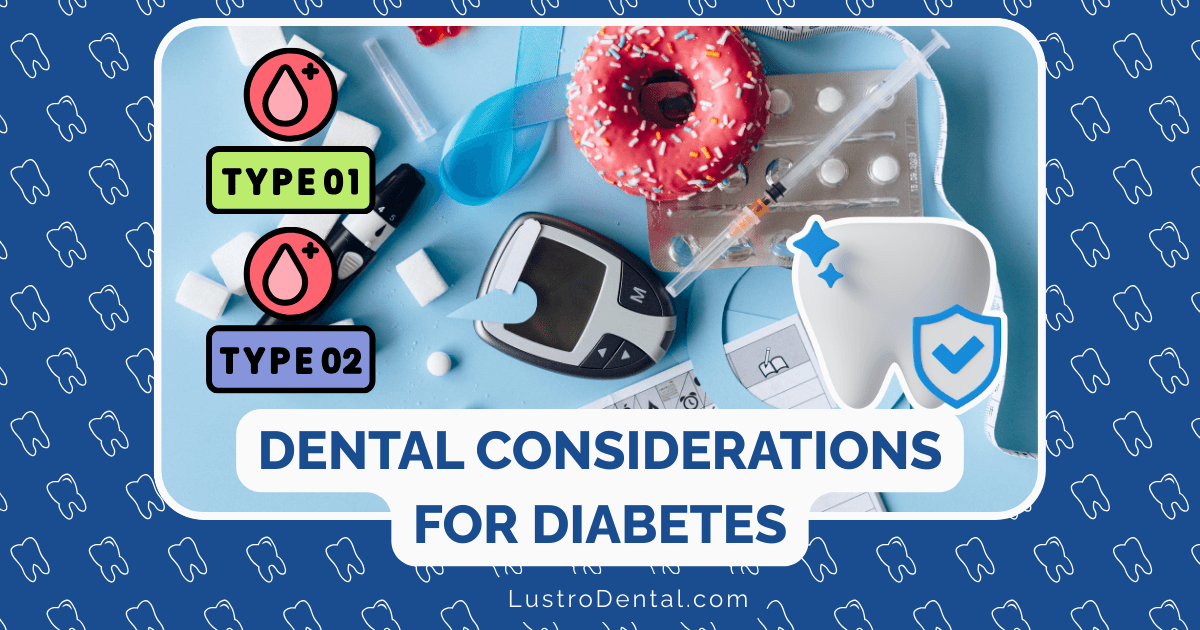
Diabetes and oral health share a complex, bidirectional relationship that requires special attention from both patients and healthcare providers. With over 30 million Americans living with diabetes and many more undiagnosed, understanding the specific dental considerations for both Type 1 and Type 2 diabetes has never been more important.
The American Diabetes Association’s 2025 Standards of Care now includes a dedicated section on dental care, highlighting its critical role in diabetes management. This recognition underscores what many healthcare professionals have long observed: proper dental care is not just about maintaining a healthy smile—it’s an essential component of comprehensive diabetes management.
Before diving into dental considerations, let’s clarify the key differences between Type 1 and Type 2 diabetes, as they influence dental care approaches.
Dr. Sarah Johnson, endocrinologist at Mayo Clinic, explains: “The fundamental difference between Type 1 and Type 2 diabetes lies in their underlying pathophysiology. This affects not only how we manage blood glucose but also how we approach dental care for these patients.”
Both Type 1 and Type 2 diabetes can lead to similar oral health complications, though the risk and severity often correlate with glycemic control rather than diabetes type.
“Periodontal disease is the sixth complication of diabetes,” notes Dr. Michael Chen, periodontist at the University of California. “Patients with diabetes are three times more likely to develop severe gum disease compared to those without diabetes.”
The risk is particularly high when blood glucose is poorly controlled, as hyperglycemia impairs immune function and promotes inflammation. This affects both Type 1 and Type 2 patients, though those with longer disease duration may face greater challenges.
Diabetes can reduce saliva production, leading to dry mouth. This condition is problematic because saliva helps neutralize acids, wash away food particles, and prevent infection.
“Dry mouth isn’t just uncomfortable—it significantly increases the risk for cavities and oral infections,” explains Dr. Elizabeth Wong, dental specialist with expertise in diabetes care. “Patients with Type 1 diabetes may experience this earlier in their disease course due to the often more dramatic blood glucose fluctuations.”
Both Type 1 and Type 2 diabetes can impair wound healing after dental procedures. This is due to:
This consideration is particularly important for surgical procedures like extractions and implant placements.
Patients with diabetes have an increased susceptibility to fungal and bacterial infections in the oral cavity, including:
“Type 1 patients, especially those diagnosed in childhood, may have longer exposure to hyperglycemia over their lifetime, potentially increasing their cumulative risk for these complications,” notes Dr. Johnson.
This painful condition characterized by burning sensations in the mouth occurs more frequently in patients with diabetes, particularly those with peripheral neuropathy.
Patients with Type 1 diabetes require some specific considerations in the dental setting:
“The risk of hypoglycemia during dental procedures is generally higher in Type 1 diabetes patients,” explains Dr. Robert Thompson, dental surgeon specializing in medically complex patients. “This is due to their absolute insulin dependence and often more brittle glucose control.”
Key considerations include:
Dental procedures, especially those requiring fasting or altering normal eating patterns, may necessitate insulin dose adjustments.
According to the 2025 Standards of Care in Diabetes, “Recommendation 4.16 emphasizes the coordination between medical and dental teams to adjust glucose-lowering medications before and after dental procedures.”
For Type 1 patients, this often means:
Type 1 patients are at risk for diabetic ketoacidosis (DKA), which can be triggered by stress, illness, or missed insulin doses.
“For complex or surgical dental procedures, we may recommend checking ketones in addition to blood glucose, especially if the patient has been fasting,” advises Dr. Wong.
Many Type 1 patients now use continuous glucose monitoring (CGM) systems, which can be valuable during dental procedures.
“We encourage patients to keep their CGM sensors active during dental visits,” says Dr. Thompson. “This allows for real-time monitoring and early intervention if glucose levels start trending too low or too high.”
While many considerations overlap with Type 1 diabetes, patients with Type 2 diabetes have some unique needs:
Type 2 diabetes is often managed with a variety of medications, each with different considerations:
The 2025 Standards of Care provides specific guidance on adjusting these medications around dental procedures, emphasizing individualized approaches based on the patient’s overall health status.
Many Type 2 diabetes patients also have obesity, which may require adaptations in the dental setting:
Type 2 diabetes often occurs alongside other conditions that affect dental care:
“The complexity of Type 2 diabetes often lies in managing multiple comorbidities simultaneously,” notes Dr. Chen. “This requires a comprehensive approach to dental care that considers the patient’s entire health profile.”
Dental implants have become a common tooth replacement option, but special considerations apply for Type 2 diabetes patients:
According to a 2025 study in the Journal of Dental Research, “Implant survival rates at 3 years for well-controlled Type 2 diabetes patients approach 95%, compared to 98% in non-diabetic patients, but drop to below 80% in poorly controlled diabetes.”
Proper planning is essential for safe and effective dental care in all diabetes patients:
Before any dental procedure, especially surgical interventions, assessment should include:
For invasive dental procedures:
Dr. Thompson emphasizes, “The 2025 dental care guidelines stress that patients with well-controlled diabetes can safely undergo most dental procedures. However, elective treatments should be postponed for those with HbA1c levels consistently above 9% until better control is achieved.”
Prevention is particularly important for diabetes patients due to their higher risk for oral complications:
The 2025 Standards of Care explicitly recommends that “individuals with diabetes should have a dental exam at least once per year” (Recommendation 4.15).
However, many dental professionals suggest more frequent intervals:
For patients experiencing xerostomia:
Dietary advice should balance diabetes management and oral health:
Dental professionals play a crucial role beyond just treating oral conditions:
“Dentists are in a unique position to identify undiagnosed diabetes,” says Dr. Wong. “Oral manifestations like multiple periodontal abscesses, severe periodontitis, or frequent oral infections should trigger diabetes screening recommendations.”
Some dental offices now offer chairside HbA1c testing or refer patients with suspicious findings for medical evaluation.
The 2025 Standards of Care emphasizes the importance of coordination between dental and medical teams. This includes:
Dental professionals should educate diabetes patients about:
Dental professionals must be prepared to manage diabetes-related emergencies:
Every dental office treating diabetes patients should have:
The field continues to evolve with promising developments on the horizon:
Advances in chairside testing are making it easier to assess:
“The integration of dental care into telehealth platforms is allowing for better coordination between diabetes care providers and dentists,” notes Dr. Chen. “This is particularly valuable for patients in rural areas or those with mobility limitations.”
Research is moving toward more individualized approaches based on:
Emerging treatments show promise for addressing the oral-diabetes connection:
Managing dental health in patients with diabetes—whether Type 1 or Type 2—requires a comprehensive, individualized approach that considers the unique aspects of each condition while addressing their shared complications.
The 2025 Standards of Care’s inclusion of specific dental recommendations represents an important step forward in recognizing oral health as an integral component of diabetes management. By understanding and implementing these considerations, both dental professionals and patients can work together to improve outcomes and quality of life.
As Dr. Johnson concludes, “The mouth is not separate from the rest of the body, and nowhere is this more evident than in diabetes care. When we address oral health as part of comprehensive diabetes management, everyone benefits—the patient, the dental team, and the medical team.”
Are you living with diabetes and have questions about your dental care? Share your experiences or concerns in the comments below!