🦷 General Care
✨ Treatments
👶 Family Care
💚 Wellness
💡 Resources

🦷 General Care
✨ Treatments
👶 Family Care
💚 Wellness
💡 Resources

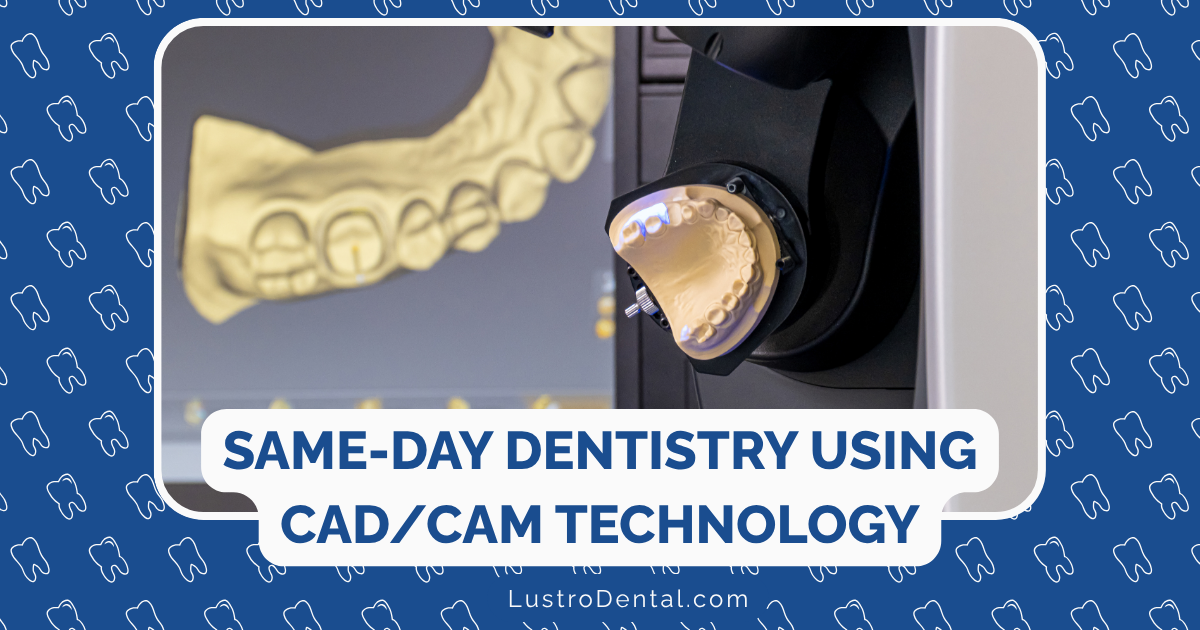
Remember when getting a crown meant at least two dental visits, uncomfortable impressions, temporary restorations that sometimes fell off, and weeks of waiting? If you’ve experienced this traditional process, you’ll appreciate how dramatically dental technology has evolved in recent years. Today, CAD/CAM technology is transforming the patient experience by enabling same-day dental restorations that once required multiple appointments and weeks of laboratory work.
As someone who’s witnessed this technological revolution firsthand, I can tell you that same-day dentistry isn’t just about convenience—it’s about delivering better, more precise care while respecting your time and comfort. Let’s explore how this remarkable technology is changing the face of modern dentistry and why it matters for your oral health.
CAD/CAM stands for Computer-Aided Design and Computer-Aided Manufacturing. In dentistry, this technology allows for the digital design and creation of dental restorations such as crowns, inlays, onlays, veneers, and even bridges—all within a single appointment.
The process involves three main components:
This streamlined digital workflow has revolutionized restorative dentistry by bringing the dental laboratory right into the dental office.
When discussing CAD/CAM dentistry, it’s impossible not to mention CEREC (Chairside Economical Restoration of Esthetic Ceramics), one of the most widely used systems for same-day restorations.
Introduced in the 1980s but continuously refined, CEREC technology has become synonymous with single-visit dentistry. According to Five Parks Dental, the system allows dentists to restore both aesthetics and bite function in just one visit, eliminating the need for temporary restorations and return appointments.
While CEREC is perhaps the best-known system, other CAD/CAM technologies like E4D, Planmeca, and 3Shape TRIOS also offer similar capabilities. What they all share is the ability to transform restorative dental care from a multi-week process to a matter of hours.
If you’re scheduled for a same-day restoration, here’s what you can typically expect during your appointment:
First, your dentist will examine your tooth and prepare it for the restoration, just as they would in a traditional procedure. This involves removing any decay, old filling material, or damaged tooth structure, and shaping the tooth to receive the new restoration.
Instead of biting into a tray of impression material (the “goop” that many patients dread), a small digital scanning wand is used to take highly accurate 3D images of your prepared tooth and surrounding teeth. This process typically takes just a few minutes and is completely comfortable.
According to South Temple Dental, these digital impressions are not only more comfortable but also provide a more accurate representation of oral structures, decreasing the likelihood of ill-fitting restorations.
Once the scan is complete, your dentist uses specialized CAD software to design your restoration. The software creates a detailed 3D model, allowing the dentist to precisely design every aspect of your restoration—from its shape and size to how it fits with adjacent teeth and its opposing teeth when you bite down.
What makes this step particularly valuable is that you can often watch the design process and provide input on the final result. Some practices even allow patients to see a preview of how their new restoration will look in their mouth.
After the design is finalized, the information is sent to an in-office milling machine. This sophisticated device carves your restoration from a solid block of ceramic or composite material that’s been selected to match your natural tooth color.
The milling process typically takes about 15-20 minutes, during which you can relax in the dental chair or waiting room. Some advanced practices are now also incorporating 3D printing technology as an alternative to milling for certain types of restorations.
Once milled, your dentist may make minor adjustments and polish the restoration before permanently bonding it to your prepared tooth. The entire process—from preparation to final placement—usually takes about two hours, depending on the complexity of the restoration and the specific technology being used.
As Ft. Bend Dental notes, most same-day restorations take about two hours from start to finish, and the process is designed to be comfortable, with no need for goopy impressions or multiple numbing shots.
The most obvious benefit is the dramatic reduction in treatment time. Instead of multiple appointments spread over several weeks, you can have your permanent restoration completed in a single visit.
For busy professionals, parents, and anyone with a packed schedule, this time-saving aspect can be invaluable. No need to take multiple days off work or arrange childcare for several appointments.
Digital scanning captures incredibly precise measurements of your teeth—often more accurate than traditional impression materials that can distort or tear. This precision, combined with computer-aided design, typically results in restorations that fit better.
According to Oro Valley Dental Arts, the accuracy of digital impressions leads to better-fitting crowns, reducing the likelihood of needing adjustments later.
With traditional crown procedures, patients must wear a temporary crown for weeks while waiting for the permanent one to be fabricated. These temporaries are often less comfortable, less aesthetic, and can come loose or break.
Same-day CAD/CAM eliminates this step entirely. You leave the office with your final, permanent restoration already in place.
Digital design allows for more conservative preparations in many cases, meaning more of your natural tooth structure can be preserved. This contributes to the long-term health of the tooth and surrounding tissues.
Modern ceramic materials used in CAD/CAM restorations can be remarkably lifelike, mimicking the translucency, color, and light-reflecting properties of natural teeth. The computer-assisted design process also allows for precise matching to your existing teeth.
Cranford Smiles Dental highlights that advanced materials used in CAD/CAM restorations offer not only durability but better aesthetics, creating natural-looking results.
For many patients, fewer appointments mean less dental anxiety. Knowing that your treatment will be completed in a single visit can make the entire experience less stressful.
The digital nature of CAD/CAM technology means your restoration design is stored electronically. If you ever need a replacement in the future, the original design can often be retrieved and reproduced without starting from scratch.
CAD/CAM technology continues to evolve rapidly, with several exciting developments enhancing the capabilities of same-day dentistry:
AI algorithms are now being incorporated into CAD/CAM software to help optimize restoration design. These intelligent systems can analyze thousands of successful restorations to suggest ideal contours, contact points, and occlusal (biting) surfaces.
According to Lifetime Smile DDS, AI-powered software can analyze dental scans and assist in creating personalized treatment plans, further enhancing the precision of same-day restorations.
The materials available for CAD/CAM restorations have expanded dramatically. Today’s ceramic and composite materials offer unprecedented strength, wear resistance, and aesthetic qualities. Some of the latest materials can even be adjusted for translucency and color gradients to match natural teeth perfectly.
While initially limited to single crowns and simple inlays, CAD/CAM technology can now be used for a wider range of restorations, including:
Dentist Clifton NJ notes that CAD/CAM technology now allows for the creation of not just crowns, but bridges and veneers with remarkable precision, often completed in a single visit.
Modern CAD/CAM systems increasingly integrate with other digital dental technologies, creating a comprehensive digital workflow. For example:
Coastland Dental has integrated technologies like iTero scanning and Digital Smile Design alongside CAD/CAM, allowing patients to preview their new smile before treatment begins.
While same-day CAD/CAM restorations offer numerous advantages, they may not be the optimal choice for every clinical situation. Here’s a balanced view of when they shine and when traditional methods might still be preferred:
It’s worth noting that the gap between CAD/CAM and traditional laboratory capabilities continues to narrow as technology advances. Many cases that once required lab fabrication can now be successfully treated with same-day methods.
Many patients wonder if the convenience of same-day restorations comes with a premium price tag. The answer varies by practice, but in general:
According to Dental Implants Boynton Beach, same-day crowns can range from $1,200 to $2,500, comparable to traditional crown costs, and many dental insurance plans partially cover these procedures.
The real economic benefit for patients often comes in the form of time saved—fewer appointments mean less time off work, reduced childcare needs, and fewer trips to the dental office.
For dental practices, CAD/CAM technology represents a significant investment:
However, many practices find the return on investment compelling:
Patient feedback about same-day restorations is overwhelmingly positive. Common themes in testimonials include:
As Bell Dental Studio notes, same-day restorations significantly improve the overall patient experience by streamlining the treatment process.
Looking ahead, several trends are likely to shape the continued evolution of same-day dentistry:
AI and machine learning will continue to automate aspects of the design process, making it faster and more predictable while still allowing for dentist oversight and customization.
New CAD/CAM-compatible materials will offer even better combinations of strength, aesthetics, and biocompatibility. We’re already seeing materials that mimic the graduated translucency of natural teeth and provide exceptional durability.
The range of treatments possible in a single visit will continue to grow. Full-arch rehabilitations and more complex prosthetics will increasingly move into the same-day category.
CAD/CAM systems will become more seamlessly integrated with other digital dental technologies, creating comprehensive digital workflows from diagnosis through treatment and follow-up.
As technology costs decrease over time, more dental practices will be able to offer same-day services, making this convenient option available to more patients.
CAD/CAM technology and same-day dentistry represent one of the most significant advancements in dental care in recent decades. By eliminating the wait for restorations, this technology doesn’t just save time—it transforms the entire patient experience.
For patients, the benefits are clear: greater comfort, fewer appointments, no temporaries, and excellent results. For dental professionals, CAD/CAM technology offers enhanced precision, expanded capabilities, and the satisfaction of providing immediate solutions to patients’ needs.
As this technology continues to evolve, we can expect even more impressive capabilities, making dental care increasingly efficient, precise, and patient-friendly. The days of waiting weeks for a crown are becoming a thing of the past, and that’s something both patients and dental professionals can smile about.
Have you experienced same-day dental restorations? How did they compare to traditional methods? Share your experience in the comments below!