🦷 General Care
✨ Treatments
👶 Family Care
💚 Wellness
💡 Resources

🦷 General Care
✨ Treatments
👶 Family Care
💚 Wellness
💡 Resources

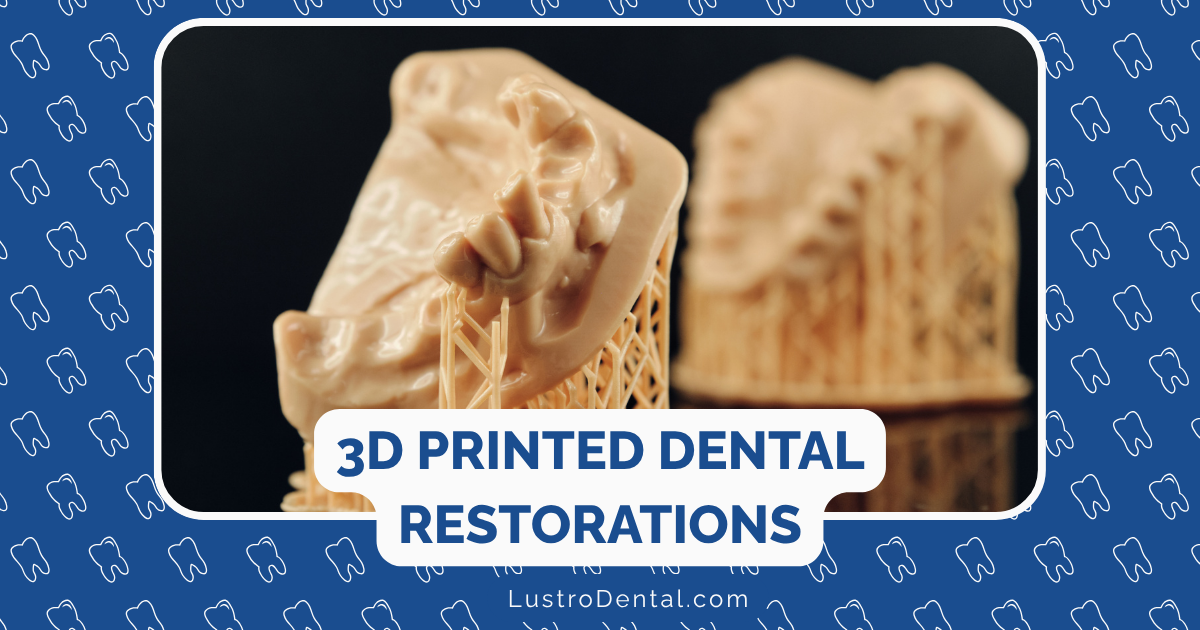
Have you ever wondered what happens between the moment your dentist scans your teeth and when they place your new crown, bridge, or veneer? The journey of a modern dental restoration is a fascinating blend of digital technology, materials science, and clinical expertise that has revolutionized how we restore teeth. As someone who’s witnessed this transformation firsthand, I can tell you that today’s 3D printed dental restorations represent one of the most significant advances in dental care in decades.
In this article, we’ll follow the remarkable journey of a 3D printed dental restoration—from the initial digital scan to the moment you walk out of the dental office with your new smile. Along the way, we’ll explore how this technology is making dental care faster, more precise, and often more affordable than ever before.
Before diving into the 3D printing process, it’s worth understanding how dramatically things have changed:
Traditional Restoration Process:
Digital 3D Printed Restoration Process:
According to AMFG, the dental 3D printing market is predicted to hit $50.1 billion by 2033, growing at a CAGR of 18.96% in 2025. This explosive growth reflects the transformative impact of this technology on dental care.
The journey begins with a digital impression of your teeth:
How it works:
Digital Dental Studio notes that intraoral scanning captures precise 3D images of a patient’s teeth, providing a level of detail that traditional impressions often miss.
Several types of digital scanning technologies are used in modern dentistry:
According to iFun3D, intraoral scanning is fast and accurate for capturing the shape and dimensions of teeth, while CBCT scans provide detailed three-dimensional views for complex cases.
Once captured, the scan data undergoes initial processing:
This digital model serves as the foundation for designing your custom restoration.
With the digital model complete, your dentist or a dental technician designs your restoration using specialized CAD software:
Design considerations:
Institute of Digital Dentistry explains that CAD software like exocad allows dentists to design crown restorations with consideration for bite alignment, adjacent teeth, and aesthetics before exporting the design as an STL file.
Based on your specific needs, the appropriate material is selected:
Common materials for 3D printed restorations:
According to 3DPrint.com, significant advancements in dental-specific materials like BEGO™ VarseoSmile® TriniQ® Resin and Formlabs’ Premium Teeth Resin have expanded capabilities in producing implant crowns and natural-looking denture teeth.
Before proceeding to printing, the design undergoes verification:
This digital verification process helps prevent issues before the physical restoration is created.
With the design finalized, preparation for printing begins:
Setup process:
Dental Proto3000 describes how this stage includes inserting a resin tank, a resin cartridge, and the printer’s build platform, followed by selecting the correct file from the printer’s job queue.
Several 3D printing technologies are used for dental restorations:
Advanced Dental Export notes that high-speed printing technologies like CLIP and DLP significantly reduce production times for dental restorations.
During printing, your restoration takes physical form:
How it works:
According to Institute of Digital Dentistry, printing a dental crown using a SprintRay Pro 55S takes approximately 17 minutes to complete.
Once printing is complete, the restoration undergoes initial processing:
Cleaning steps:
Formlabs Dental recommends washing printed parts in isopropyl alcohol (≥99%) to remove uncured resin, followed by air drying for at least 30 minutes.
The cleaned restoration then undergoes curing to achieve final hardness and properties:
Curing process:
Institute of Digital Dentistry notes that curing a printed crown under UV lights takes approximately 9 minutes with the SprintRay Pro Cure 2.
The final steps before placement involve detailed finishing:
Finishing process:
According to Phrozen Dental, post-processing includes removing the model from the building plate, cleaning it in an ultrasonic cleaner, drying it, and post-curing to ensure proper hardening.
Before final placement, your restoration undergoes a careful evaluation:
Try-in process:
Minor adjustments can be made chairside to ensure perfect fit and function.
With adjustments complete, the restoration is permanently placed:
Placement process:
Formlabs Dental notes that finished restorations can be attached using conventional temporary cements for up to 12 months.
Before you leave, your dentist performs final checks:
And with that, your journey from digital scan to new smile is complete!
One of the most significant advantages is the dramatic reduction in treatment time:
AMFG highlights that same-day dentistry eliminates the need for multiple visits and external lab fabrication, allowing patients to receive restorations within a single appointment.
Digital workflows improve accuracy throughout the process:
iFun3D notes that 3D printed crowns offer micron-level precision, resulting in a superior fit and minimizing the need for chairside adjustments.
3D printing enables superior aesthetic outcomes:
The digital workflow often translates to cost benefits:
3DPrint.com reports that materials for 3D printing in dentistry can cost 10 to 30 times less than traditional milling blocks, making the process more cost-effective.
The field continues to evolve rapidly:
Advanced Dental Export mentions that bioprinting is being explored for developing 3D-printed bone grafts and biocompatible implants that integrate with the patient’s anatomy.
The range of 3D printed dental applications continues to grow:
3D printing is increasingly part of a comprehensive digital ecosystem:
The journey of a 3D printed dental restoration represents more than just technological advancement—it’s a fundamental transformation of the dental experience. From the comfort of digital impressions to the convenience of same-day treatment, this revolution is making dental care more accessible, efficient, and effective.
As we look toward the future, the integration of 3D printing with other digital technologies promises even more remarkable possibilities. The days of multiple appointments, uncomfortable impressions, and long waits for dental restorations are rapidly becoming a thing of the past.
Whether you need a simple crown or a complete smile makeover, the journey from scan to smile has never been more streamlined or predictable. And that’s something worth smiling about.
Have you experienced a 3D printed dental restoration? How did it compare to traditional methods? Share your experience in the comments below!