🦷 General Care
✨ Treatments
👶 Family Care
💚 Wellness
💡 Resources

🦷 General Care
✨ Treatments
👶 Family Care
💚 Wellness
💡 Resources

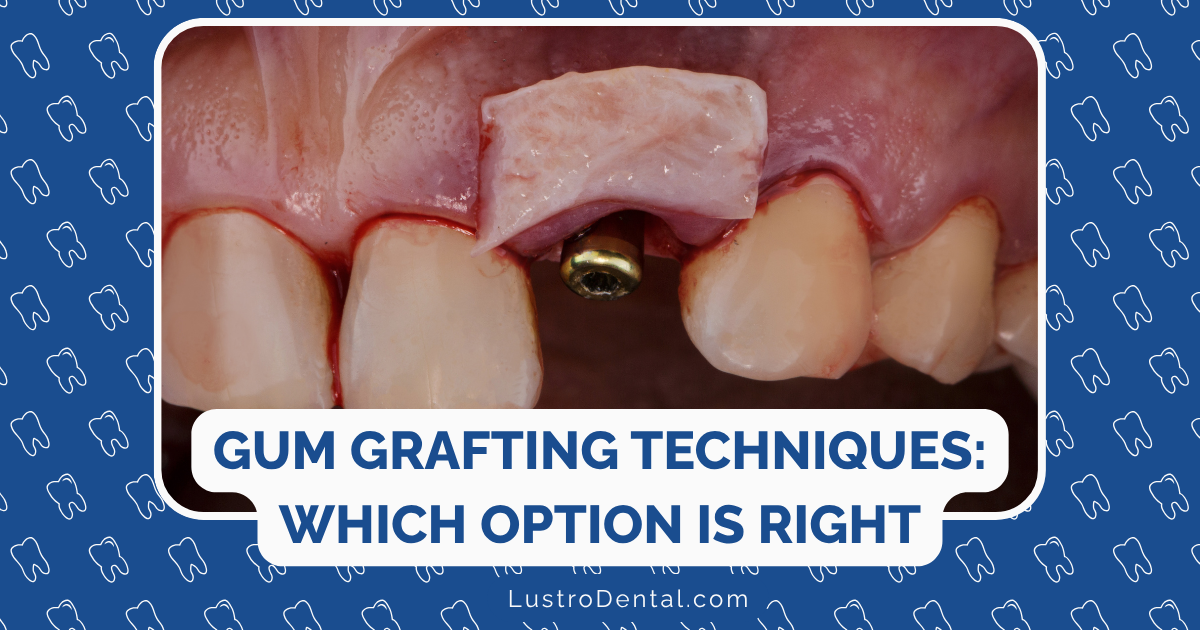
When Michael first noticed the sensitivity in his lower front teeth, he assumed he just needed a special toothpaste. But as the roots became more visible and the sensitivity worsened, he realized something more significant was happening. “My dentist told me I had gum recession and suggested I see a periodontist about gum grafting,” Michael explained during his consultation. “But I’m confused about what that actually involves and what my options are.”
Michael’s experience is common. Gum recession—where the gum tissue pulls away from the teeth, exposing more of the tooth structure and eventually the roots—affects nearly half of adults over 30. While often dismissed as merely a cosmetic concern, exposed roots can lead to sensitivity, increased risk of decay, and eventually tooth loss if left untreated.
Fortunately, modern dentistry offers several effective techniques to address this issue. In this comprehensive guide, we’ll explore the various gum grafting options available to cover exposed roots, helping you understand which approach might be best for your specific situation.
Before diving into treatment options, it’s important to understand why gum recession occurs in the first place.
Dr. Sarah Johnson, a board-certified periodontist with the American Academy of Periodontology, explains: “Understanding the underlying cause is crucial for long-term success. We need to address not just the recession itself, but also what caused it in the first place.”
Exposed roots aren’t just a cosmetic concern—they can lead to serious oral health issues:
According to research published in the Journal of Periodontology, treating recession not only improves aesthetics but also reduces sensitivity in over 80% of cases and helps prevent further attachment loss.
Several well-established techniques have proven effective for covering exposed roots. Each has specific indications, advantages, and considerations.
The Procedure: This is the most commonly used technique for root coverage and is considered the gold standard by many periodontists.
Best For:
Success Rate: Studies published in the International Journal of Periodontics & Restorative Dentistry show that connective tissue grafts achieve approximately 80-90% root coverage in appropriate cases, with excellent long-term stability.
Patient Experience: Michael, whom we mentioned earlier, underwent a connective tissue graft for his lower front teeth. “The procedure itself wasn’t as bad as I feared,” he shared. “I was completely numb during the surgery. The discomfort afterward was manageable with over-the-counter pain relievers, though the roof of my mouth was sore for about a week.”
The Procedure:
Best For:
Success Rate: While excellent for creating durable, attached gingiva, free gingival grafts typically achieve less root coverage (approximately 60-70%) than connective tissue grafts. They also tend to result in a less aesthetic “patch-like” appearance due to color differences between the palatal tissue and surrounding gums.
Patient Experience: “I had a free gingival graft on my lower gums,” explains Jennifer, another patient. “The recovery was similar to what Michael described, but I noticed the new tissue looked whiter than my regular gums at first. My periodontist assured me it would blend better over time, and it has, though there’s still a slight color difference if you look closely.”
The Procedure: Unlike the previous techniques that require harvesting tissue from the palate, pedicle grafts use existing gum tissue adjacent to the recession:
Types of Pedicle Grafts:
Best For:
Success Rate: When properly selected, pedicle grafts can achieve 70-90% root coverage with excellent aesthetic results since the tissue color and texture match perfectly.
Patient Experience: David, who had a laterally positioned flap to treat recession on an upper canine, reports: “The recovery was easier than I expected since there was no second surgical site. The area was sore for a few days, but nothing major. I’m really happy with how natural it looks.”
Periodontal treatment continues to evolve, with newer techniques focusing on minimizing invasiveness while maximizing results.
Developed by Dr. John Chao, this scalpel-free, suture-free procedure has gained popularity for its minimally invasive approach.
The Procedure:
Best For:
Success Rate: Research published in the International Journal of Periodontics & Restorative Dentistry shows promising results, with studies reporting 85-95% root coverage that remains stable over time.
Patient Experience: “After researching my options, I chose the pinhole technique for treating recession on several upper teeth,” shares Rebecca. “The procedure was quick—about an hour for five teeth—and recovery was remarkably easy. I had some swelling for a couple of days but minimal pain. The best part was not having any cuts or stitches in my palate.”
This technique uses processed donor tissue (usually human or porcine) instead of harvesting the patient’s own tissue.
The Procedure:
Best For:
Success Rate: Studies show results comparable to connective tissue grafts, with approximately 75-85% root coverage in appropriate cases.
Patient Experience: James, who needed extensive grafting on multiple teeth, chose this option: “My periodontist recommended using ADM because I needed too much tissue to take from my palate. The recovery was comfortable since I only had one surgical site. The results have been excellent, and I’d definitely choose this option again.”
This technique uses the patient’s own blood products to enhance healing and results.
The Procedure:
Best For:
Success Rate: Early research suggests that PRF-enhanced grafting may improve both the percentage of root coverage and the quality of healing, though more studies are needed.
Patient Experience: “My periodontist recommended adding PRF to my connective tissue graft,” explains Sophia. “The only difference for me was having a blood draw before the procedure. It’s hard to compare, but my healing seemed to go very smoothly, and I achieved complete coverage of my exposed roots.”
The “best” grafting technique varies depending on several factors. Your periodontist will consider:
Dr. Robert Wilson of the American Academy of Periodontology advises: “The consultation is critical. A thorough examination, including measurements of recession, tissue thickness, and assessment of contributing factors, allows us to recommend the most appropriate technique for each individual case.”
Understanding the typical recovery timeline helps patients prepare appropriately.
According to a survey published in the Journal of Clinical Periodontology, over 85% of patients report that recovery from gum grafting was easier than they anticipated, with most returning to normal activities within 3-5 days.
The success of any gum grafting procedure depends not only on the surgical technique but also on addressing the original causes of recession and proper maintenance.
Dr. Lisa Rodriguez, a periodontist specializing in reconstructive procedures, emphasizes: “The long-term success of gum grafting depends heavily on the patient’s commitment to addressing the factors that caused the recession initially. With proper maintenance, results can last a lifetime.”
Returning to Michael’s story, he ultimately chose a connective tissue graft for his lower front teeth. “After discussing all the options with my periodontist, I felt the connective tissue graft offered the best balance of predictability and aesthetics for my situation,” he explains.
His journey included:
“Six months later, you can hardly tell I had anything done,” Michael shares. “The sensitivity is completely gone, and my gums look natural. Most importantly, my periodontist says the recession has been successfully addressed, protecting my teeth for the long term.”
Gum recession and exposed roots are common but treatable conditions. With multiple effective techniques available, patients and their dental professionals can choose the approach that best suits their specific situation.
The key takeaways to remember:
If you’re noticing signs of gum recession—longer-looking teeth, sensitivity, or visible root surfaces—consult with a periodontist to discuss your options. With modern techniques and proper care, a healthier, more comfortable smile is within reach.
Have you experienced gum grafting? We’d love to hear about your experience in the comments below.