🦷 General Care
✨ Treatments
👶 Family Care
💚 Wellness
💡 Resources

🦷 General Care
✨ Treatments
👶 Family Care
💚 Wellness
💡 Resources

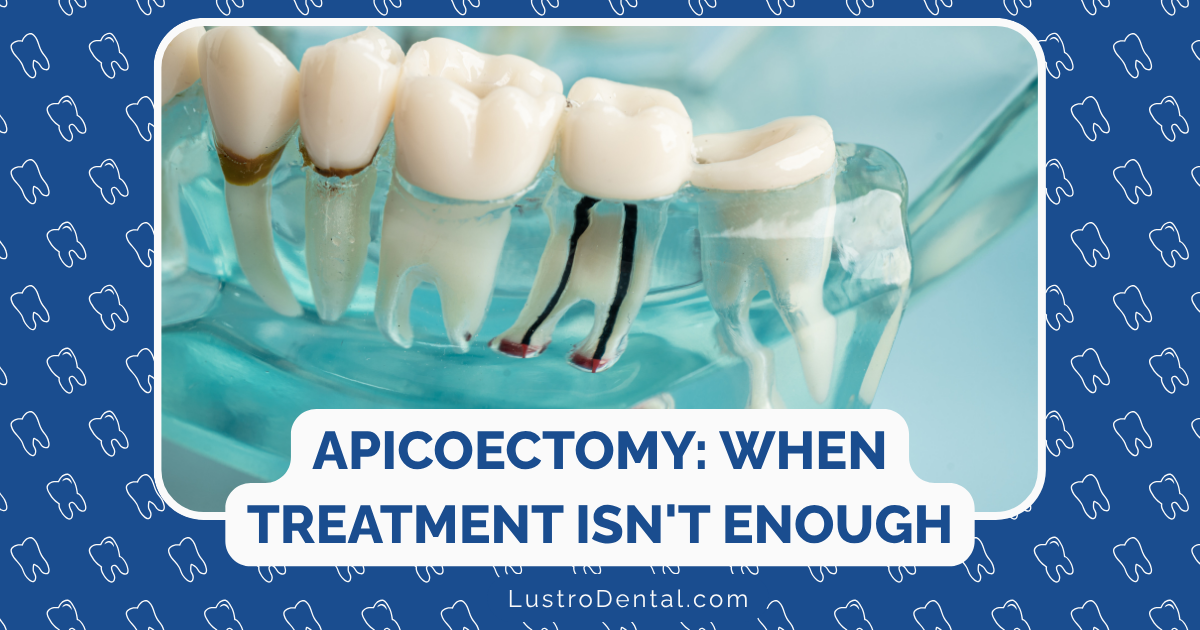
When a root canal procedure doesn’t resolve your dental issues, it can be frustrating and concerning. You’ve already invested time, money, and endured treatment, only to find that symptoms persist or new problems develop. In these situations, an apicoectomy—a specialized endodontic surgical procedure—may become necessary.
As someone who’s guided many patients through this journey, I understand the questions and concerns that arise when considering this next step in treatment. In this article, I’ll explain what an apicoectomy is, when it becomes necessary, what to expect during the procedure, and the outcomes you can anticipate.
An apicoectomy (also called root-end surgery or root-end resection) is a minor surgical procedure that focuses on the tip (apex) of a tooth’s root. During the procedure, an endodontist:
Dr. Sarah Johnson, endodontist at Olympic View Dental, explains: “Think of an apicoectomy as addressing the problem from the other direction. Instead of accessing the root canal through the crown as in traditional root canal therapy, we approach it through the gum tissue to directly treat the root tip where infection often persists.”
An apicoectomy isn’t the first line of treatment for tooth infections. It’s typically considered only after other options have been explored. Here are the most common scenarios where an apicoectomy becomes necessary:
The most common reason for an apicoectomy is when a tooth that has undergone root canal therapy continues to show signs of infection. This might be evident through:
Some teeth have anatomical features that make complete cleaning and filling through conventional root canal treatment challenging:
Dr. Michael Chen, researcher at Journal of Oral Research and Review, notes: “Up to 15% of teeth have anatomical variations that can complicate endodontic treatment. These variations may only become apparent when conventional treatment fails to resolve the infection.”
Sometimes physical barriers prevent complete cleaning and filling of the canal system:
In some cases, nonsurgical retreatment (redoing the root canal) might be technically difficult or unlikely to succeed:
According to Rochester Endodontics, “While retreatment is often the first choice when a root canal fails, there are situations where an apicoectomy offers a more predictable path to saving the tooth.”
Modern apicoectomy procedures, especially those using microsurgical techniques, are precise and relatively comfortable. Here’s what typically happens:
The entire procedure typically takes 30-90 minutes, depending on the tooth location and case complexity.
Modern apicoectomies use advanced technology that significantly improves outcomes:
A controlled clinical trial comparing traditional and microsurgical approaches found that modern techniques had a probability of success more than 5 times higher than traditional methods.
Recovery from an apicoectomy is typically straightforward:
Dr. Lisa Wong of Endodontics of NYC advises: “Most patients are surprised by how quickly they recover from an apicoectomy. The majority return to work or school the next day with minimal discomfort that’s easily managed with over-the-counter pain relievers.”
Modern apicoectomy procedures have excellent success rates:
A 2020 study cited by Healthline found that about 97% of cases experienced excellent results following apical surgery up to 5 years later, with good results reported in more than 75% of cases after 10 to 13 years.
When facing a failed root canal, several options exist:
Dr. Robert Wilson, endodontist at Avon Oral and Maxillofacial Surgery, emphasizes: “The decision between these options should be based on careful diagnosis, the specific reason for the initial failure, and the overall restorability of the tooth. Each case requires individualized assessment.”
Consider these factors when discussing treatment options with your endodontist:
An apicoectomy represents an important treatment option in the endodontist’s toolkit for saving natural teeth when conventional root canal therapy hasn’t achieved the desired outcome. With modern microsurgical techniques, this procedure offers high success rates, relatively quick recovery, and the opportunity to preserve your natural tooth for many more years.
If you’re experiencing persistent issues after root canal treatment, consult with an endodontist to determine if an apicoectomy might be appropriate for your situation. The specialized training, equipment, and expertise of an endodontist are crucial for achieving the best possible outcome with this procedure.
Remember, preserving your natural teeth whenever possible is generally preferable to extraction and replacement, both from functional and economic perspectives. An apicoectomy might be the solution that allows you to keep your natural tooth for years to come.
Have you undergone an apicoectomy or are you considering one? Share your experience or questions in the comments below!