🦷 General Care
✨ Treatments
👶 Family Care
💚 Wellness
💡 Resources

🦷 General Care
✨ Treatments
👶 Family Care
💚 Wellness
💡 Resources

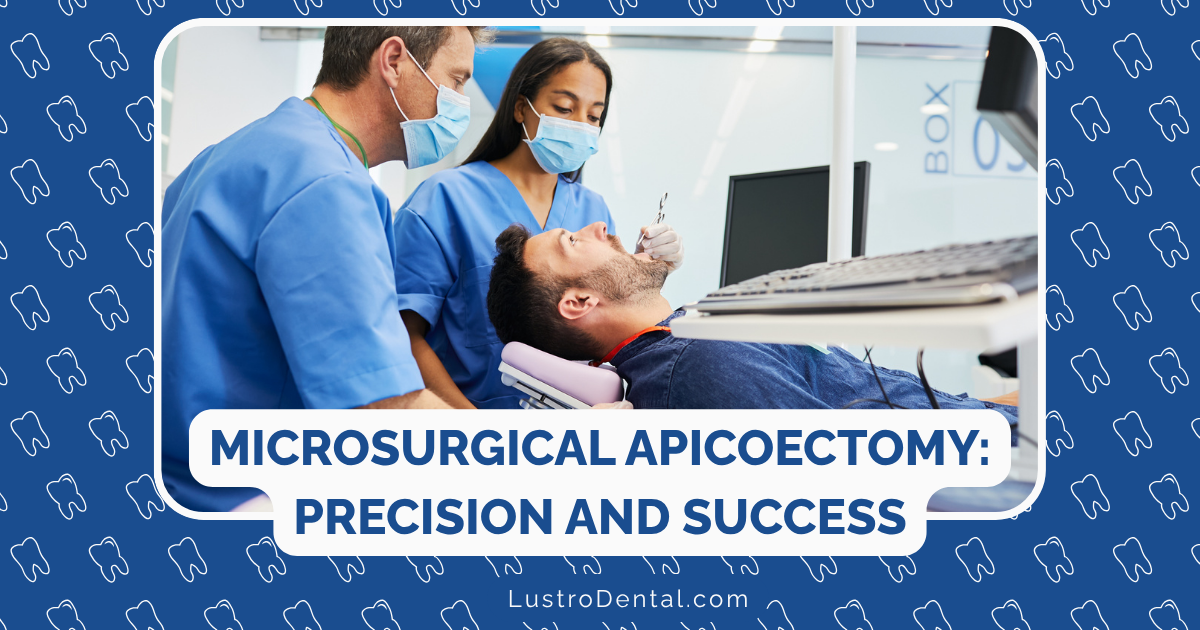
When your endodontist mentions you might need an apicoectomy, it’s natural to feel a bit anxious. After all, any procedure with “surgery” in its description can sound intimidating. But here’s something that might ease your mind: the apicoectomy of today is dramatically different from what it was even 15 years ago.
As someone who’s passionate about dental health education, I’ve witnessed firsthand how modern microsurgical techniques have transformed this procedure from something patients dreaded to a precise, minimally invasive treatment with remarkable success rates.
Let’s explore how these advancements are helping patients save teeth that might otherwise be lost, with less discomfort and better long-term outcomes than ever before.
To appreciate how far we’ve come, it helps to understand where we started. Traditional apicoectomy (also called root-end surgery) has been performed for decades as a way to save teeth when conventional root canal treatment fails or isn’t possible.
In traditional apicoectomy procedures, dentists would:
While this approach saved many teeth, it had limitations. The success rates varied widely—from as low as 44% to around 90% in the best cases, according to a comprehensive review published in the Journal of Endodontics.
Dr. Sarah Johnson, Director of Endodontic Research at University Dental Institute, explains: “Without magnification, endodontists were essentially working blind when it came to the intricate anatomy of root tips. We couldn’t see microfractures, additional canals, or isthmus areas, which often led to persistent infection.”
Enter the era of microsurgery. Beginning in the 1990s but truly taking hold in the early 2000s, endodontic microsurgery has completely transformed the apicoectomy procedure.
The modern approach includes:
The results? Modern apicoectomy procedures now boast success rates exceeding 90%—with some studies reporting rates as high as 96% when using MTA as the root-end filling material.
What exactly makes modern apicoectomy so much more effective? Let’s break down the key technological advancements that have revolutionized this procedure.
Perhaps the most transformative addition to endodontic surgery has been the surgical operating microscope (SOM). This isn’t just a minor improvement—it’s a complete paradigm shift in how the procedure is performed.
The SOM provides:
Dr. Michael Chen of Advanced Endodontic Specialists notes, “The microscope doesn’t just help us see better—it fundamentally changes what’s possible. We can identify and treat anatomical complexities that we couldn’t even detect before.”
Traditional apicoectomy relied on dental drills (burs) to prepare the root end. Modern microsurgery uses specialized ultrasonic tips that offer remarkable advantages:
The KiS (Kim Surgical) ultrasonic tips, developed specifically for endodontic microsurgery, feature zirconium nitride coating for enhanced durability and strategically placed irrigation ports to improve visibility during the procedure.
Modern apicoectomy begins long before the actual procedure, with advanced imaging techniques that provide crucial information for planning:
A 2023 study in the International Journal of Endodontics found that CBCT imaging reveals up to 38% more periapical lesions than conventional radiographs, leading to more accurate diagnosis and treatment planning.
The materials used to seal the root end have evolved dramatically, with significant implications for healing and long-term success:
Now considered the gold standard for root-end filling, MTA offers:
The newest generation of root-end filling materials includes bioceramics, which offer:
Modern apicoectomy is a carefully choreographed procedure that typically includes these steps:
The proof of microsurgery’s superiority isn’t just anecdotal—it’s backed by robust research. A comprehensive meta-analysis published in the Journal of Endodontics compared traditional apicoectomy (called conventional root-end surgery or CRS) with endodontic microsurgery (EMS).
The results were striking:
This difference was statistically significant, with the relative risk of success for EMS being 1.07 times that of CRS. The difference was even more pronounced for molar teeth, which are typically the most challenging to treat.
Another landmark study conducted over 5 years found that teeth treated with modern microsurgical techniques and MTA showed a 96% healing rate compared to just 52% for those treated with conventional methods.
While improved success rates are impressive, they only tell part of the story. Modern apicoectomy offers numerous benefits for patients:
The minimally invasive nature of microsurgery means:
Research indicates that:
Perhaps most importantly:
Dr. Lisa Wong, endodontist at University Dental Center, shares: “I’ve had patients come in expecting to lose a tooth, only to find that with microsurgery, we can save it with a 90%+ success rate. The relief and gratitude they express is why I love what I do.”
While the advancements in endodontic microsurgery are remarkable, this procedure isn’t for everyone. It’s typically recommended in specific situations:
Factors that influence the decision include:
The field continues to evolve, with exciting developments on the horizon:
Some endodontists are beginning to use augmented reality systems that overlay CBCT data onto the surgical field, providing real-time guidance during procedures.
Research is exploring the use of growth factors and bioactive materials that not only seal the root end but actively promote regeneration of lost tissues.
While still in early stages, robotic assistance for certain aspects of microsurgery may further enhance precision and reduce operator fatigue.
Not all endodontists have embraced microsurgical techniques to the same degree. If you’re considering an apicoectomy, it’s worth asking about:
The American Association of Endodontists maintains a directory of specialists, many of whom have advanced training in microsurgical techniques.
The transformation of apicoectomy from a somewhat unpredictable procedure to a highly precise microsurgical technique represents one of the most significant advances in modern endodontics. With success rates now exceeding 90%, patients can approach this treatment with confidence that was unimaginable just a generation ago.
If you’re facing challenges with a previously treated tooth, don’t assume extraction is your only option. Modern endodontic microsurgery might just be the solution that saves your natural smile.
Have you had experience with modern apicoectomy? Are you considering the procedure? Share your questions or experiences in the comments below.