🦷 General Care
✨ Treatments
👶 Family Care
💚 Wellness
💡 Resources

🦷 General Care
✨ Treatments
👶 Family Care
💚 Wellness
💡 Resources

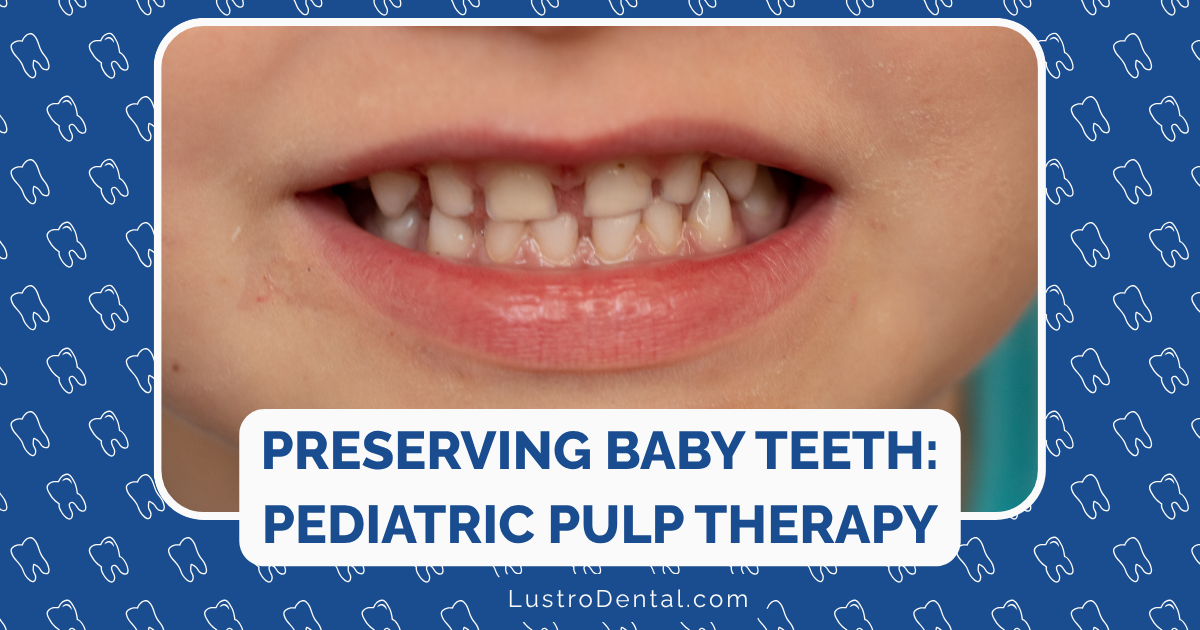
As a parent, hearing that your child needs any dental procedure beyond a routine cleaning can be concerning. When a dentist recommends pulp therapy for your child’s baby tooth, you might wonder if it’s really necessary. After all, aren’t those teeth going to fall out eventually?
Having guided many families through this decision, I can assure you that this question is completely natural. Understanding what pulp therapy is, why it might be recommended for primary teeth, and what to expect can help you make informed decisions about your child’s dental health.
Let’s start with the basics. Inside each tooth—whether baby or permanent—is a soft tissue called pulp. This pulp contains nerves, blood vessels, and connective tissue that nourish the tooth and keep it vital. Think of it as the living core of the tooth.
Pulp therapy (sometimes called a “baby root canal”) is a dental procedure designed to treat, restore, and save a primary tooth that has extensive decay or infection in the pulp. The goal is to maintain the integrity and health of the tooth until it naturally falls out and is replaced by a permanent tooth.
Dr. Sarah Johnson, a pediatric dentist at Children’s Dental Health Associates, explains: “Pulp therapy for primary teeth serves a critical purpose—it allows us to save a tooth that would otherwise need to be extracted, maintaining the space and function until the permanent tooth is ready to emerge.”
This is perhaps the most common question parents ask. If these teeth will eventually fall out anyway, why go through a procedure to save them?
The truth is that primary teeth serve several crucial functions:
Baby teeth hold space for permanent teeth. If a primary tooth is lost too early, adjacent teeth can shift into the empty space, potentially causing alignment problems when permanent teeth try to emerge.
Healthy teeth allow children to chew properly, which is essential for good nutrition and overall health.
Primary teeth play a vital role in speech development. Missing front teeth can affect a child’s ability to form certain sounds correctly.
Visible missing or damaged teeth can affect a child’s self-confidence and social interactions.
Untreated infections in baby teeth can spread to developing permanent teeth below them or even to other parts of the body.
Dr. Michael Chen, pediatric dentist at American Academy of Pediatric Dentistry, notes: “We now understand that primary teeth are far more than just placeholders. They’re essential for a child’s development in multiple ways, which is why preserving them whenever possible is the standard of care in modern pediatric dentistry.”
How do you know if your child might need pulp therapy? Here are common indicators:
If your child complains of spontaneous tooth pain or pain that wakes them at night, this could indicate pulp involvement.
Unusual sensitivity to hot or cold foods and drinks that lingers after the stimulus is removed may suggest pulp inflammation.
Swelling around a tooth or gums, or the presence of a “gum boil” (a small pimple-like bump on the gums), often indicates infection that has spread from the pulp.
A tooth that has turned grayish or yellowish compared to surrounding teeth may have damaged pulp.
If your child experiences pain when chewing or when pressure is applied to a specific tooth, this could indicate pulp problems.
It’s important to note that some children may not report symptoms even when there is significant pulp involvement. This is why regular dental check-ups are crucial for catching problems early.
There are several approaches to pulp therapy for baby teeth, depending on the extent of pulp involvement:
When decay is deep but hasn’t yet reached the pulp, the dentist may remove most of the decay and place a protective material over the remaining thin layer of dentin to prevent pulp exposure. This is the most conservative approach.
If there’s a very small exposure of the pulp during decay removal, the dentist might place a medicament directly on the exposed area to promote healing and formation of reparative dentin.
This is the most common type of pulp therapy for primary teeth. It’s performed when decay or trauma has affected the crown portion of the pulp but the root pulp remains healthy.
During a pulpotomy:
When infection has spread throughout the pulp, including the root canals, a pulpectomy is performed:
A pulpectomy is essentially a complete root canal for a baby tooth, with the key difference being that the filling material must be resorbable to allow for normal shedding of the tooth later.
If your child needs pulp therapy, here’s what typically happens:
The entire procedure usually takes 30-45 minutes per tooth, though this can vary based on the specific treatment and your child’s cooperation.
Dr. Lisa Williams, pediatric dentist at Pediatric Dental Association, reassures parents: “Most children tolerate pulp therapy surprisingly well. With today’s techniques for pain management and behavior guidance, we can make the experience much more comfortable than parents might expect.”
Most children recover quickly from pulp therapy. Here’s what you might notice:
The good news is that pulp therapy for primary teeth has high success rates. According to research published in the Journal of Dentistry for Children, pulpotomies have success rates of 80-90% when properly performed.
Successful pulp therapy allows the primary tooth to remain functional until it’s naturally ready to exfoliate (fall out), at which point the filling material will resorb along with the roots of the baby tooth, making way for the permanent tooth.
While preserving primary teeth is preferable, there are situations where extraction might be recommended instead of pulp therapy:
If extraction is necessary, your dentist will discuss space maintenance options to prevent adjacent teeth from drifting into the empty space.
Of course, the best approach is to prevent the need for pulp therapy altogether. Here are key preventive strategies:
If pulp therapy has been recommended for your child, consider asking these questions:
While pulp therapy for primary teeth might seem like a lot of effort for teeth that are temporary, the procedure represents an important investment in your child’s overall dental health and development.
By preserving baby teeth until they’re naturally ready to fall out, you’re helping ensure proper spacing for permanent teeth, maintaining your child’s ability to speak and eat comfortably, and preventing potential infection and pain.
With modern techniques and materials, pulp therapy can be performed comfortably and effectively, giving your child the best foundation for a lifetime of good oral health.
Has your child undergone pulp therapy for a primary tooth? What was your experience like? Share your thoughts or questions in the comments below.