🦷 General Care
✨ Treatments
👶 Family Care
💚 Wellness
💡 Resources

🦷 General Care
✨ Treatments
👶 Family Care
💚 Wellness
💡 Resources

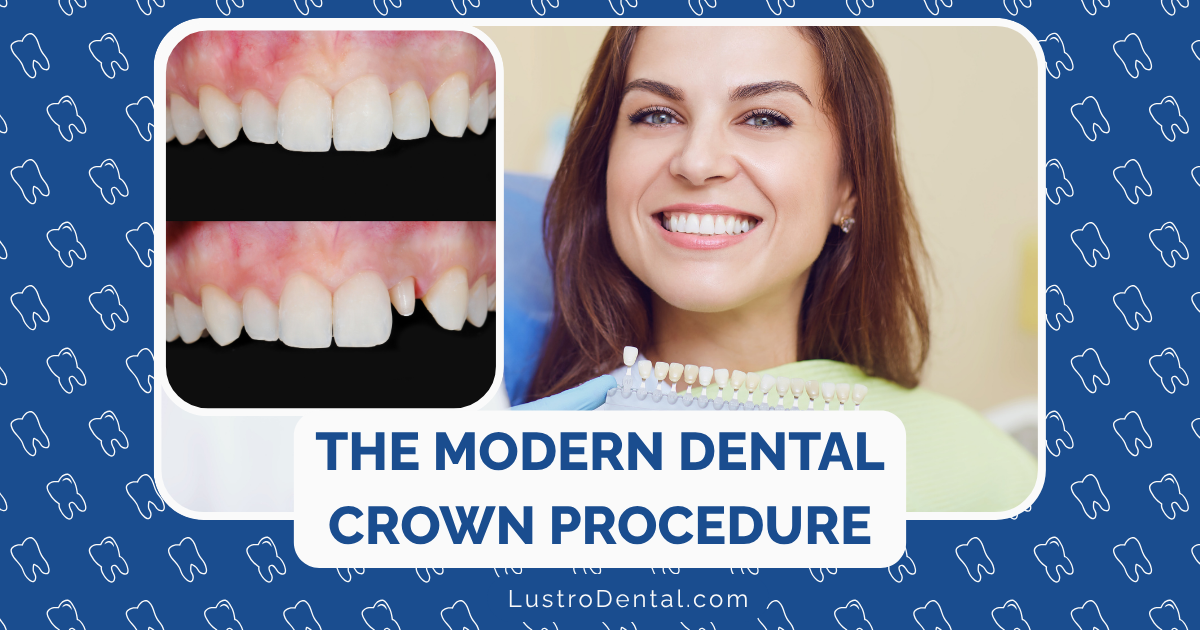
If you’ve been told you need a dental crown, you might be picturing multiple appointments, messy impressions that make you gag, temporary crowns that fall off at inconvenient times, and a weeks-long wait for your permanent restoration. While that was once the standard experience, modern dental techniques have transformed the crown procedure into something far more convenient and comfortable.
As someone who’s guided many patients through this process, I understand the questions and concerns you might have. This guide will walk you through what to expect with today’s crown procedures, highlighting how technological advances have improved the experience from start to finish.
Before diving into the procedure itself, let’s clarify what today’s dental crowns are all about:
A dental crown is a tooth-shaped “cap” placed over a damaged or weakened tooth to restore its shape, size, strength, and appearance. Crowns fully encase the visible portion of your tooth above the gumline.
According to the American Dental Association, crowns are recommended when:
Today’s crowns are typically made from:
Dr. Sarah Johnson, a prosthodontist at the American College of Prosthodontists, explains: “The evolution of dental materials has been remarkable. Today’s zirconia and lithium disilicate crowns offer strength comparable to traditional metal crowns but with aesthetics that make them virtually indistinguishable from natural teeth.”
To appreciate how far crown procedures have come, let’s compare the traditional approach with today’s modern techniques:
First Appointment:
Waiting Period: 2-3 weeks while the lab fabricates your crown
Second Appointment:
Single Appointment:
Total time: Approximately 2 hours from start to finish
Dr. Michael Chen of Digital Dentistry Today notes: “The shift to same-day crowns represents one of the most significant advances in restorative dentistry. Patients are amazed that we can deliver a permanent, high-quality restoration in just one visit.”
Whether you’re having a traditional or same-day crown, these steps will help ensure a smooth experience:
Let’s explore what happens during a crown procedure using today’s advanced techniques:
Your dentist will begin with a thorough examination of the tooth needing the crown, often including:
This information helps determine the best approach for your specific situation.
Modern dentistry emphasizes shared decision-making. Your dentist will discuss:
Once you’re comfortable and the area is numb:
Modern preparation techniques are typically more conservative than traditional approaches, preserving more of your natural tooth structure.
According to research published in the Journal of Prosthetic Dentistry, digital design workflows allow for 15-30% more conservative preparations compared to traditional methods.
Instead of traditional putty impressions that can be uncomfortable and induce gagging, modern practices use digital scanning technology:
Dr. Lisa Rodriguez, a technology-focused dentist, explains: “Digital impressions are not only more comfortable for patients but actually more accurate than traditional methods. The precision translates to better-fitting crowns with fewer adjustments needed.”
If you’re receiving a same-day crown, you’ll witness the design process in real-time:
For same-day crowns:
For traditional crowns:
Once your crown is ready:
Modern crown procedures typically involve minimal recovery time:
Today’s crown procedures offer significant benefits over traditional approaches:
Same-day crowns eliminate the need for multiple appointments and temporary crowns, saving you time and hassle. According to a 2024 patient satisfaction survey, 94% of patients preferred the single-visit approach over traditional two-visit procedures.
Digital impressions eliminate the discomfort associated with traditional impression materials. For many patients—especially those with strong gag reflexes—this improvement alone makes the modern approach worth it.
Digital design allows for more precise and minimal tooth reduction, preserving more of your natural tooth structure. This conservative approach supports better long-term tooth health.
Modern materials and fabrication techniques create crowns that are virtually indistinguishable from natural teeth. The digital workflow allows for precise color matching and natural contours.
Temporary crowns can be problematic—they may fall off, feel uncomfortable, or look unnatural. Same-day procedures eliminate this interim step entirely.
Despite the advances in crown technology, some concerns may remain:
Modern dental anesthetics are highly effective, making the procedure itself virtually painless. For anxious patients, additional options may include:
Same-day crowns may have a slightly higher fee than traditional crowns in some practices, but when you factor in the saved time and elimination of temporary crowns, many patients find the value compelling.
According to the American Dental Association’s 2025 Survey of Dental Fees, the national average cost for a crown ranges from $1,000 to $1,500 depending on material and location. Most dental insurance plans cover about 50-70% of this cost after deductibles.
Some patients wonder if same-day crowns are as durable as laboratory-fabricated ones. Research published in the Journal of the American Dental Association shows that CAD/CAM crowns have comparable longevity to traditional crowns, with 5-year success rates exceeding 95% for both.
Your experience may vary slightly depending on the type of crown you’re receiving:
For highly visible front teeth, additional steps may include:
For back teeth that handle significant chewing forces:
If your tooth has had root canal treatment:
Hearing from others who have experienced modern crown procedures can be reassuring:
“I was amazed by how different this crown experience was compared to one I had five years ago. No goopy impressions, no temporary crown, and I was in and out in about two hours with a permanent crown that feels completely natural.” — Michael, 42
“As someone with a strong gag reflex, the digital scanner was a game-changer. I could actually breathe normally during the impressions, and the whole process was so much more comfortable.” — Sarah, 35
“I was surprised that I could watch my crown being designed on the screen. It made me feel involved in the process and confident about what was happening.” — David, 58
To ensure you’re fully prepared, consider asking your dentist these questions:
Dental crown procedures have evolved dramatically, transforming what was once a lengthy, multi-appointment process into a streamlined, comfortable experience. Today’s digital workflows and advanced materials not only save you time but often result in better-fitting, more natural-looking, and longer-lasting restorations.
If you need a crown, discussing these modern options with your dentist can help ensure you receive the most appropriate treatment for your specific needs. With proper care, your new crown can provide years of functional and aesthetic benefits, supporting your oral health and confidence in your smile.
Remember that while technology has improved the process, the skill and experience of your dental team remain crucial factors in the success of your crown. Choosing a dentist who stays current with advanced techniques and materials will help ensure the best possible outcome.
Have you experienced a modern crown procedure? We’d love to hear about your experience in the comments below!