🦷 General Care
✨ Treatments
👶 Family Care
💚 Wellness
💡 Resources

🦷 General Care
✨ Treatments
👶 Family Care
💚 Wellness
💡 Resources

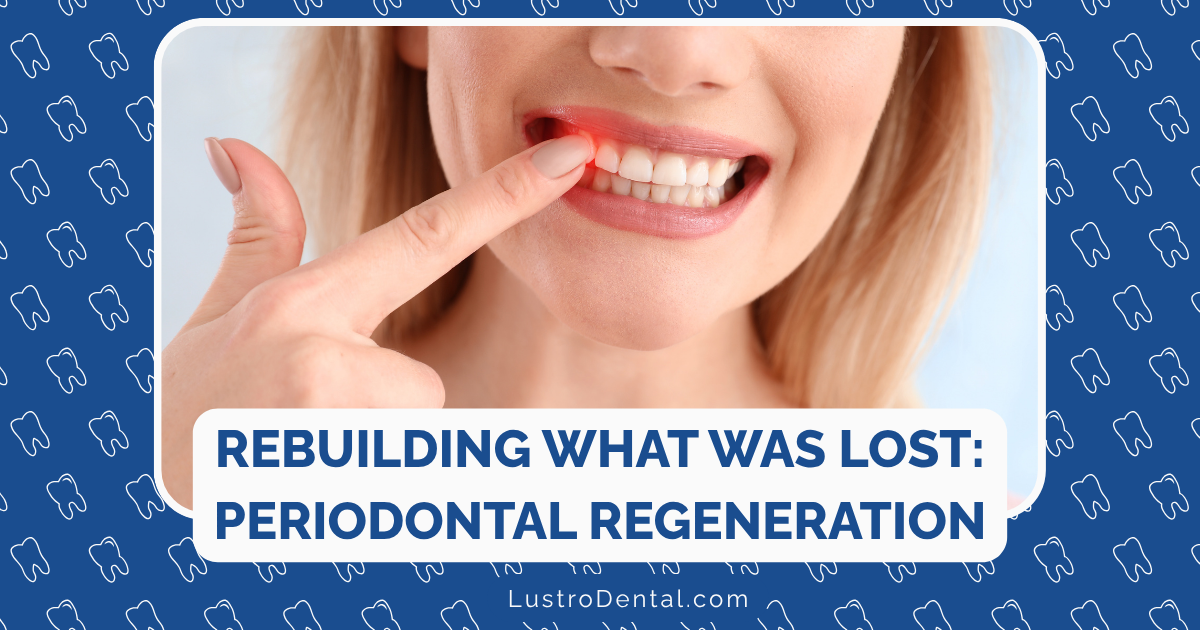
Periodontitis doesn’t just affect your gums—it systematically destroys the entire supporting structure of your teeth, including the periodontal ligament, cementum, and alveolar bone. For decades, the conventional wisdom was that once these tissues were lost, they were gone forever. The best patients could hope for was to halt the progression of disease and maintain what remained.
Today, that narrative has fundamentally changed. Modern periodontal regenerative techniques don’t just stop the disease—they can actually reverse much of the damage, rebuilding the complex architecture that supports your teeth.
As someone who’s dedicated years to dental health education, I’m excited to share these remarkable advances that are giving patients new hope. This comprehensive guide will explore the cutting-edge techniques that are transforming periodontal treatment outcomes and helping patients keep their natural teeth for decades longer than previously possible.
Before diving into regenerative techniques, it’s important to understand exactly what tissues are damaged by periodontitis and need to be regenerated:
This specialized connective tissue consists of thousands of collagen fibers that connect your tooth to the surrounding bone. The PDL acts as a shock absorber during chewing and provides sensory feedback. In periodontitis, these fibers are destroyed, leading to tooth mobility.
This mineralized layer covers the tooth root and serves as the attachment point for periodontal ligament fibers. Periodontitis can cause cementum destruction, making reattachment of the periodontal ligament impossible without regeneration.
This is the bone that forms the socket around your tooth. Periodontitis progressively destroys this bone, creating “pockets” around the teeth and eventually leading to tooth loss if untreated.
While not strictly part of the attachment apparatus, healthy gingival (gum) tissue creates a seal around the tooth that prevents bacteria from accessing deeper structures.
Dr. Sarah Chen, Director of Periodontal Research at the University of California, explains: “True periodontal regeneration means recreating all of these tissues in their proper architectural relationship. It’s not enough to just grow bone—we need the periodontal ligament to reattach to both the bone and the cementum in a functional way.”
Successful periodontal regeneration relies on four fundamental biological principles, according to research published in the Journal of Clinical Periodontology:
With these principles in mind, let’s explore the major techniques being used to regenerate periodontal tissues.
Guided Tissue Regeneration represents one of the earliest and still most widely used approaches to periodontal regeneration.
The fundamental concept behind GTR is elegantly simple: different tissues grow at different rates. Gum tissue grows much faster than bone, cementum, and periodontal ligament. Without intervention, the gum tissue will fill in the defect first, preventing the slower-growing periodontal tissues from regenerating.
GTR uses a barrier membrane to temporarily separate the gum tissue from the root surface and bone defect, creating a protected space where the slower-growing periodontal tissues can regenerate.
Dr. Robert Williams, periodontist at Northwestern University, explains: “Think of the membrane as creating a private room where only the cells we want—those that can form new bone, cementum, and periodontal ligament—are invited. The fast-growing epithelial cells are kept out until the regeneration is well underway.”
According to a 2024 review in the Journal of Biomaterials, GTR membranes fall into two main categories:
A systematic review by Nibali et al. referenced in the Journal of Periodontology found that the survival rates of molars with furcation involvement treated with GTR ranged from 83.3% to 100% over a follow-up period of 5 to 12 years—impressive results for teeth that might otherwise have been extracted.
While GTR creates the space for regeneration, bone grafting materials provide the scaffold and sometimes the biological signals needed for new bone formation.
Modern periodontal regeneration often combines multiple graft materials to leverage their complementary properties. For instance, a slowly resorbing xenograft might be mixed with a more bioactive allograft to provide both immediate growth factor release and long-term space maintenance.
A 2025 study in the Journal of Pharmaceutical and Biomedical Sciences found that using deproteinized bovine bone mineral (DBBM) with either 10% collagen or a collagen membrane resulted in significant bone gain (around 5mm) and a 92.33% 5-year survival rate for treated teeth.
While membranes and grafts provide the space and scaffold for regeneration, growth factors and biologic agents provide the signals that stimulate and guide the regenerative process.
EMD (commercially available as Emdogain®) contains proteins derived from developing pig tooth buds that mimic the natural proteins involved in tooth development.
Dr. Lisa Johnson, periodontist at Boston University, notes: “EMD essentially recreates the developmental environment that existed when your teeth were first forming. It’s like turning back the biological clock to allow the tissues to redevelop in their natural sequence.”
These autologous (from the patient’s own blood) preparations concentrate platelets and the growth factors they contain.
According to a 2024 review in the International Journal of Biomaterials, PRF offers several advantages:
Advanced PRF (A-PRF) protocols use lower centrifugation speeds to preserve more white blood cells and growth factors, potentially enhancing regenerative outcomes.
These are laboratory-produced versions of natural human growth factors:
A limitation noted in a 2025 Science Direct review is that these recombinant factors often require high doses, raising cost and safety concerns.
Perhaps the most exciting frontier in periodontal regeneration involves stem cells—undifferentiated cells that can develop into various specialized cell types.
According to a comprehensive 2024 review in PMC, several types of stem cells show promise for periodontal regeneration:
A 2025 clinical trial published in Nature Scientific Reports demonstrated that the transplantation of adipose-derived mesenchymal stem cells (ADMSCs) showed promising results for periodontal regeneration, though the field is still largely in the experimental stage.
Dr. Michael Rodriguez, stem cell researcher at Harvard School of Dental Medicine, explains: “The real power of stem cell approaches is their ability to not just provide a physical scaffold, but to actively participate in and orchestrate the regenerative process. They can respond to the local environment, secrete appropriate factors, and even differentiate into the needed cell types.”
The success of regenerative procedures depends not just on the materials used, but on the surgical technique employed. Recent advances have focused on minimally invasive approaches that maximize wound stability and primary closure.
Developed by Cortellini and Tonetti, MIST uses small incisions and specialized instruments to access periodontal defects while minimizing trauma to the surrounding tissues.
According to a 2025 Springer review, the modified minimally invasive surgical technique (m-MIST) with papilla preservation flaps achieves primary closure rates of 95% when combined with enamel matrix derivatives.
Using operating microscopes and microsurgical instruments allows for:
These approaches have significantly improved outcomes by enhancing wound stability and reducing the incidence of membrane exposure—a common complication that can compromise regenerative results.
Modern periodontal regeneration rarely relies on a single technique or material. Instead, combination approaches leverage the strengths of multiple modalities.
This classic combination provides both the scaffold (bone graft) and the protected space (membrane) needed for optimal regeneration.
Combining the signaling properties of EMD with the structural support of a bone graft has shown synergistic effects in multiple studies.
The growth factors in PRF can enhance the regenerative potential of bone graft materials, while the fibrin network improves handling properties and stabilizes the graft.
This triad—often referred to as the tissue engineering triad—combines cells, scaffolds, and signals for comprehensive regeneration.
A 2025 study in Nature demonstrated that combination therapies tailored to specific defect morphologies yield the best outcomes, with contained defects (those surrounded by bony walls) showing more predictable results than non-contained defects.
Not all periodontal defects are equally amenable to regenerative approaches. Careful case selection is critical for predictable outcomes.
Before undertaking regenerative procedures, a thorough assessment should include:
Dr. Jennifer Lee, Clinical Professor of Periodontology at UCLA, emphasizes: “Regenerative procedures are technique-sensitive and patient-sensitive. The most advanced materials won’t compensate for poor case selection or inadequate home care. The biological principles must be respected.”
While laboratory studies and controlled clinical trials provide valuable data, what matters most to patients is real-world outcomes. What can you realistically expect from periodontal regeneration?
A 10-year randomized controlled trial cited in the Journal of Periodontology found that periodontal regeneration achieved:
The 2025 JPBS study reported radiographic bone gain of approximately 5mm using modern bone graft materials, representing substantial reconstruction of lost alveolar bone.
Perhaps most importantly, a 30-year study published in PMC found that the majority of patients with stages III and IV periodontitis (the most severe forms) could be successfully treated with conventional periodontal treatment, including regenerative approaches when indicated. Among 103 patients followed for 30 years, most were classified as “low-loss” patients, losing only 1.05 teeth on average.
Beyond the clinical metrics, patients report high satisfaction with regenerative procedures due to:
The success of periodontal regeneration doesn’t end with surgery. Long-term outcomes depend heavily on post-treatment care and maintenance.
The JPBS study emphasized that “strict supportive periodontal therapy and oral hygiene are crucial for maintaining successful results in periodontal regeneration.”
This typically includes:
Dr. Robert Chen, Director of the Periodontal Maintenance Program at University of Pennsylvania, notes: “Regeneration gives us a second chance, but it doesn’t make the teeth immune to future disease. The biology that made the patient susceptible to periodontitis in the first place hasn’t changed, so ongoing maintenance is absolutely critical.”
The field continues to evolve rapidly, with several exciting developments on the horizon:
This technology allows for the precise deposition of cells, growth factors, and scaffold materials in complex, customized structures that mimic natural periodontal architecture.
Delivering genes that encode for growth factors or anti-inflammatory molecules directly to periodontal tissues could provide more sustained and physiological regenerative signals.
A concept highlighted in a 2025 Science Direct review, this approach aims to recapitulate the developmental processes that formed the periodontal tissues originally, potentially allowing more complete and functional regeneration.
Rather than focusing solely on growth factors, emerging strategies target the immune response to create an environment more conducive to regeneration rather than inflammation.
The evolution of periodontal regenerative techniques represents one of the most significant advances in dentistry over the past few decades. What was once considered impossible—the regrowth of lost periodontal tissues—is now a clinical reality for many patients.
While challenges remain, particularly for complex cases and non-contained defects, the combination of advanced surgical techniques, innovative biomaterials, growth factors, and emerging stem cell therapies offers unprecedented opportunities to rebuild what periodontitis has destroyed.
For patients facing the prospect of tooth loss due to periodontal disease, these regenerative approaches offer hope—not just for keeping their teeth, but for restoring them to health with a strong foundation that can last for decades.
As Dr. Sarah Chen summarizes: “We’re no longer just managing disease—we’re rebuilding what was lost. That’s a fundamental paradigm shift that has transformed how we approach periodontal therapy and what we can offer our patients.”
If you’re dealing with periodontitis, talk to your periodontist about whether regenerative approaches might be appropriate for your specific situation. The journey to rebuilding periodontal health is complex and highly individualized, but with modern regenerative techniques, the possibility of restoration—not just maintenance—is greater than ever before.