🦷 General Care
✨ Treatments
👶 Family Care
💚 Wellness
💡 Resources

🦷 General Care
✨ Treatments
👶 Family Care
💚 Wellness
💡 Resources

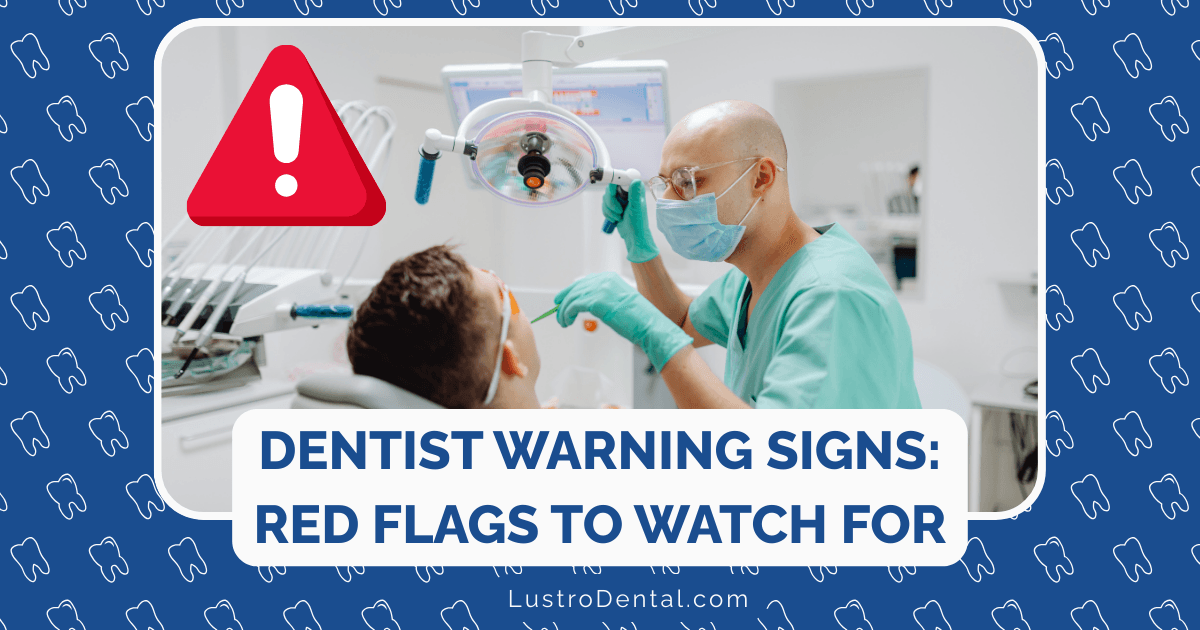
Finding the right dentist is about more than convenience or a friendly smile. Your oral health—and by extension, your overall health—depends on receiving quality dental care from a competent, ethical practitioner.
But how do you separate the excellent from the questionable? According to the National Practitioner Data Bank, there were nearly 2,500 reports of dental malpractice in the United States in 2023 alone. Many more instances of substandard care likely went unreported.
This guide will help you identify the dentist warning signs that should make you think twice before settling into that dental chair.
Every legitimate dentist should be properly licensed by their state’s dental board. If you can’t easily verify their credentials, that’s an immediate red flag.
How to check: Most state dental boards have online verification systems. For example, the American Dental Association provides links to all state dental boards where you can verify licensure and check for disciplinary actions.
Dr. Michael Roberts, a dental compliance expert, warns: “A dentist who can’t or won’t provide clear information about their education, licensing, or continuing education should raise immediate concerns.”
While a few negative reviews are normal for any business, patterns of complaints about specific issues deserve attention.
Watch for patterns like:
A study published in the Journal of Medical Internet Research found that online reviews of healthcare providers often highlight important quality indicators that formal metrics miss.
While not mandatory, membership in professional organizations like the American Dental Association (ADA) or Academy of General Dentistry (AGD) indicates a commitment to ethical standards and continuing education.
Quality dental care begins with thorough assessment and communication. According to Ask the Dentist, a new patient appointment should last at least 75-90 minutes to allow for proper examination and discussion.
Red flags include:
A trustworthy dentist will show you your X-rays and explain what they’re seeing. If your dentist takes X-rays but doesn’t share them with you or vaguely references “problems” without showing you the evidence, be wary.
Dr. Jennifer Thompson, a dental ethics educator, notes: “Patients have a right to see and understand their diagnostic images. A dentist who won’t share these is either hiding something or doesn’t respect patient autonomy.”
Dental care rarely has only one possible approach. If your dentist presents only a single treatment option—especially an expensive one—without discussing alternatives, that’s concerning.
Questions to ask:
A good dentist welcomes questions and takes time to answer them clearly. If your dentist seems annoyed by questions or gives dismissive, vague answers, consider it a warning sign.
Be cautious if a new dentist immediately identifies numerous problems requiring extensive treatment, especially if your previous dentist never mentioned these issues.
According to the Coalition Against Insurance Fraud, some unethical dentists engage in “creative diagnosis”—finding problems that don’t exist or exaggerating minor issues to justify unnecessary procedures.
Unless you’re in pain or have an emergency, major dental work shouldn’t be presented as needing immediate attention. Pressure to undergo non-emergency procedures the same day as diagnosis often indicates questionable motives.
The American Dental Association provides guidelines on appropriate frequency for dental X-rays. For most adults with good oral health, bitewing X-rays are recommended every 18-36 months. Full-mouth X-rays are typically needed only every 3-5 years.
If your dentist wants to take full X-rays at every visit without clear justification, this could indicate unnecessary radiation exposure and potential billing fraud.
While the latest technology isn’t always necessary, extremely outdated equipment may compromise care quality. Modern dentistry has made significant advances in materials, techniques, and patient comfort.
Watch for:
Infection control is non-negotiable in dentistry. According to the Centers for Disease Control and Prevention, dental professionals should:
If you notice staff not changing gloves between patients, unclean surroundings, or other hygiene issues, leave immediately.
Transparent pricing is essential in healthcare. If your dentist can’t or won’t provide clear information about costs before treatment, proceed with caution.
While payment plans can be helpful for necessary care, aggressive pushing of financing options—especially for cosmetic or elective procedures—may indicate a focus on profit over patient needs.
Some unethical dentists engage in questionable insurance practices. Be wary if your dentist:
Dr. Lisa Chen, a former dental insurance auditor, warns: “If a dentist suggests altering dates of service or procedure codes ‘to help with insurance,’ they’re likely committing fraud—and putting you at risk as well.”
Extremely low-priced services, particularly those advertised as “limited time offers,” often come with hidden costs or serve as bait for upselling more expensive treatments.
A good dentist educates without shaming. If your dentist makes you feel embarrassed or guilty about your oral health, rather than offering constructive guidance, this indicates poor professional conduct.
While dental assistants and hygienists are vital team members, the dentist should personally handle diagnosis, treatment planning, and key procedures. If you rarely see the actual dentist, this could indicate assembly-line dentistry focused on volume over quality.
Any ethical healthcare provider respects a patient’s right to seek a second opinion. If your dentist seems offended or dismissive when you mention wanting another perspective, consider it a serious red flag.
Unprofessional comments, inappropriate jokes, or any behavior that makes you uncomfortable has no place in healthcare. Trust your instincts if something feels wrong in the dentist-patient interaction.
According to the Journal of the American Dental Association, seeking a second opinion is particularly important when:
If you encounter unethical or dangerous practices, reporting helps protect other patients. Complaints can typically be filed with:
Finding a trustworthy dentist takes effort, but your oral health is worth it. By recognizing these red flags early, you can avoid substandard care, unnecessary procedures, and potential harm.
Remember that most dentists are ethical professionals dedicated to patient care. These warning signs aren’t meant to make you suspicious of all dental providers but to help you distinguish excellent practitioners from those who fall short of professional standards.
Your relationship with your dentist should be built on trust, respect, and open communication. If something doesn’t feel right, it’s always appropriate to ask questions, seek clarification, or find another provider who better meets your needs.
Have you encountered any of these red flags with dental providers? Share your experience in the comments below to help others recognize warning signs.