🦷 General Care
✨ Treatments
👶 Family Care
💚 Wellness
💡 Resources

🦷 General Care
✨ Treatments
👶 Family Care
💚 Wellness
💡 Resources

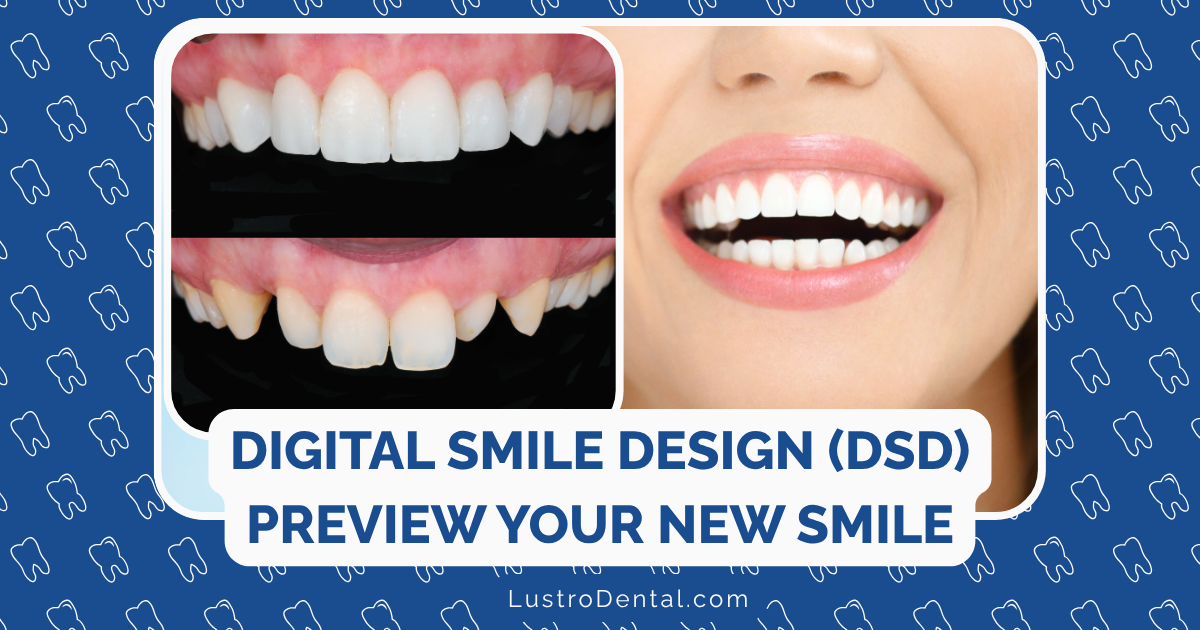
Have you ever wished you could see exactly how your smile would look after dental treatment—before committing to the procedure? For many people, the uncertainty of cosmetic dental outcomes has been a significant barrier to pursuing the smile they’ve always wanted. Fortunately, a revolutionary approach called Digital Smile Design (DSD) is changing this dynamic, allowing patients to preview and even help shape their new smile before any treatment begins.
As someone who has witnessed countless smile transformations, I can tell you that this technology has fundamentally changed how we approach cosmetic dentistry. It’s no longer about hoping for the best—it’s about knowing what to expect and actively participating in designing your dream smile.
Digital Smile Design is a comprehensive, multi-faceted approach to dental treatment planning that uses digital technology to analyze your facial and dental characteristics, visualize potential outcomes, and create a precise roadmap for your smile transformation.
Unlike traditional cosmetic dentistry methods that relied heavily on the dentist’s subjective judgment and verbal descriptions of outcomes, DSD provides a visual, objective, and measurable framework for designing your ideal smile.
According to the Central Park Dentist, DSD combines digital imaging, software simulations, and precise treatment planning to create a truly personalized smile that complements your unique facial features and personality.
The DSD process typically follows these key steps:
The journey begins with collecting detailed digital records of your current smile and facial features:
This multi-dimensional approach captures not just your teeth, but how they relate to your lips, gums, facial proportions, and overall appearance.
Once your digital records are collected, specialized software is used to:
During this phase, your dentist will consider factors like:
According to NYC Smile Design, advanced technology like Mod-jaw can even capture the real-time movement of your jaw and teeth, ensuring that your new smile will function as beautifully as it looks.
Here’s where the magic happens. Using the digital design, your dentist creates a virtual preview of your new smile. This might include:
This preview gives you a remarkably accurate representation of your potential results, allowing you to see how your new smile will look in proportion to your face, when you speak, and when you smile.
Unlike traditional approaches where the dentist makes most decisions, DSD encourages your active participation:
As FY Smile points out, this collaborative approach improves patient engagement and overall treatment outcomes by ensuring your preferences are incorporated into the final design.
In many cases, your dentist can create a temporary physical version of your new smile that you can actually try on:
This step provides an additional layer of confidence before proceeding with final treatment.
Once you’ve approved the design, your dentist creates a detailed treatment plan that might include:
The digital design serves as a precise blueprint for the dental laboratory, ensuring that your final restorations match exactly what you previewed and approved.
The advantages of DSD extend far beyond just seeing your results in advance. Here’s why this approach has become the gold standard in cosmetic dentistry:
Perhaps the most obvious benefit is eliminating the uncertainty of traditional cosmetic dental procedures:
According to Shelby Dental Care Center, this preview capability significantly enhances patient decision-making by aligning expectations with actual results.
DSD moves beyond the “one-size-fits-all” approach to create smiles that are uniquely yours:
This personalization ensures that your new smile looks natural and enhances your overall appearance rather than looking artificial or generic.
The visual nature of DSD dramatically improves communication between you and your dental team:
As Susan J. Curley DDS notes, this enhanced communication leads to greater transparency in the treatment process and helps build trust between patient and dentist.
With DSD, the guesswork is removed from cosmetic dental procedures:
This predictability benefits both patients and dentists by ensuring that everyone’s expectations are aligned from the beginning.
For complex cases requiring multiple specialists, DSD serves as a central communication tool:
According to research published on PubMed Central, this interdisciplinary collaboration is one of the key advantages of integrating DSD into restorative dentistry.
The psychological advantages of previewing your new smile shouldn’t be underestimated:
Many patients report that seeing their potential new smile is an emotional experience that helps them commit to treatment with enthusiasm rather than apprehension.
The field of Digital Smile Design continues to evolve rapidly, with several exciting innovations enhancing the experience:
AI is revolutionizing how smile designs are created and evaluated:
According to Institute of Digital Dentistry, AI has become a fundamental component of modern digital dentistry, with AI-powered systems now able to generate sophisticated designs in minutes.
AR technology is taking smile previews to the next level:
Oval Clinic reports that AR is now being used for guided surgeries, allowing dentists to superimpose digital models onto a patient’s mouth for precise treatment planning and execution.
Advances in 3D printing are improving the physical mock-up phase of DSD:
According to Digital Smile Design’s learning hub, chairside 3D printing is becoming mainstream, with accelerated print times due to AI-driven algorithms optimizing print parameters.
Cloud technology is enhancing the collaborative aspects of DSD:
This connectivity ensures that everyone involved in your treatment is literally on the same page, working from identical digital records and designs.
DSD can be applied to virtually any cosmetic or restorative dental treatment:
While DSD offers numerous benefits, it’s particularly valuable for certain patients:
It’s important to understand some considerations about DSD:
According to the research published on PubMed Central, potential challenges include technical limitations, learning curves for practitioners, and managing patient expectations.
If you’re considering a smile transformation using DSD, here are some questions to ask your dentist:
Looking ahead, several emerging trends will likely shape the future of DSD:
The next frontier is integrating smile design with other facial aesthetic treatments:
Artificial intelligence will continue to enhance the personalization of smile designs:
VR technology will make the preview experience even more realistic:
New materials will improve both the mock-up and final restoration phases:
Digital Smile Design represents a fundamental shift in cosmetic dentistry—from dentist-directed to collaborative, from uncertain outcomes to predictable results, and from standard approaches to truly personalized care.
By allowing you to preview your results before treatment begins, DSD eliminates much of the anxiety and uncertainty traditionally associated with cosmetic dental procedures. More importantly, it empowers you to actively participate in designing your smile, ensuring that the final result aligns with your personal vision and expectations.
As technology continues to advance, the gap between preview and reality will become increasingly narrow, making the DSD experience even more valuable and reassuring for patients seeking smile transformations.
If you’ve been considering cosmetic dental treatment but have hesitated due to uncertainty about the outcome, Digital Smile Design might be the solution you’ve been waiting for—a chance to see your new smile before saying “yes” to treatment.
Have you experienced Digital Smile Design in your dental treatment? What was your experience like seeing your new smile before treatment began? Share your thoughts in the comments below!