🦷 General Care
✨ Treatments
👶 Family Care
💚 Wellness
💡 Resources

🦷 General Care
✨ Treatments
👶 Family Care
💚 Wellness
💡 Resources

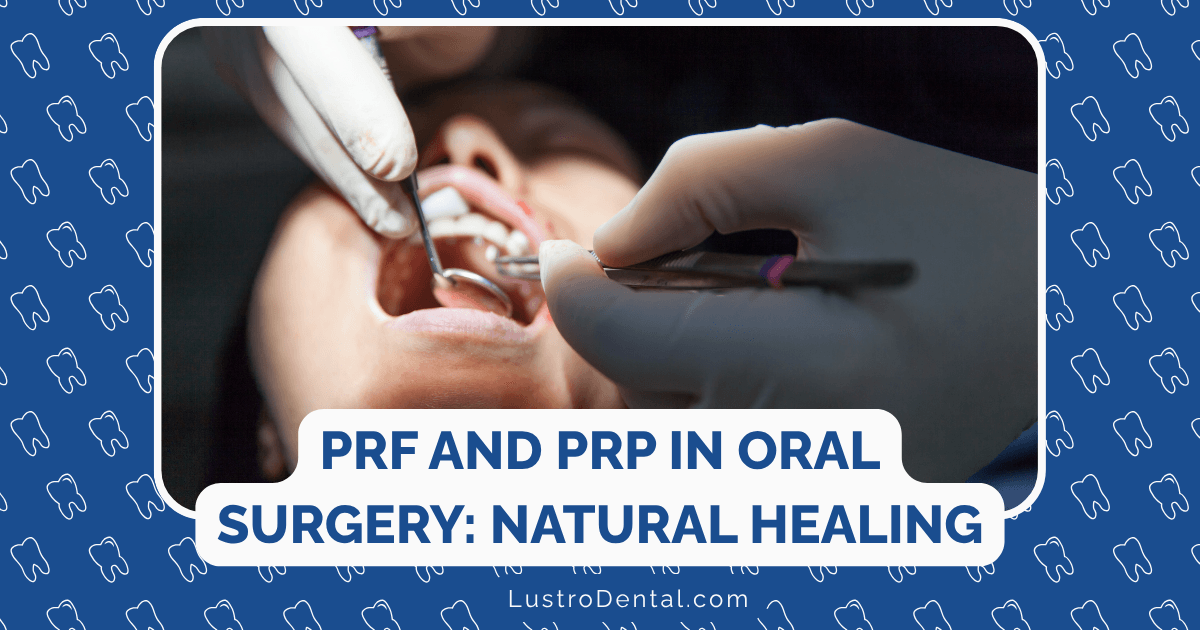
When Lisa came in for her dental implant consultation, she was concerned about the healing process. She’d heard stories about lengthy recovery times and potential complications. “Is there anything that can help me heal faster?” she asked. This question is one I hear frequently in my practice, and fortunately, modern dentistry offers some remarkable solutions.
Enter PRF and PRP—revolutionary approaches that harness your body’s own healing mechanisms to accelerate recovery and improve outcomes after oral surgery. These techniques have transformed how we approach procedures ranging from wisdom tooth extractions to complex bone grafting.
In this article, we’ll explore how these natural healing enhancers work, their benefits, and what you can expect if your dentist recommends them for your procedure.
PRF (Platelet-Rich Fibrin) and PRP (Platelet-Rich Plasma) are both concentrated blood products derived from your own blood. Though similar, they have distinct properties and applications.
PRP is a concentration of platelets in plasma obtained by drawing a small amount of your blood and processing it in a centrifuge. This process separates the blood components, allowing us to isolate and concentrate the platelets—cell fragments that play a crucial role in clotting and healing.
What makes PRP special is its rich concentration of growth factors—natural proteins that:
According to research published in the Journal of Oral and Maxillofacial Surgery, PRP contains 3-5 times the normal concentration of platelets found in whole blood, creating a powerful healing cocktail.
PRF represents the next generation of platelet concentrates. Unlike PRP, PRF doesn’t use anticoagulants or additives. Your blood is centrifuged at a lower speed, creating a fibrin matrix rich in platelets, leukocytes (white blood cells), and growth factors.
The key differences that make PRF unique:
Dr. Sarah Johnson, a researcher at the National Institute of Dental and Craniofacial Research, explains: “PRF’s sustained release of growth factors mimics the natural healing process more closely than earlier technologies. The fibrin matrix provides both structural support and a delivery system for these healing factors.”
To understand why PRF and PRP are so effective, we need to look at the key growth factors they contain and how these proteins accelerate healing:
A study published in the International Journal of Oral and Maxillofacial Surgery found that these growth factors work synergistically, creating a healing response greater than any single factor could produce alone.
Many patients are curious about what the PRF or PRP process involves. Here’s what you can expect if your dentist recommends these treatments:
The process begins with a simple blood draw, similar to a routine blood test. Typically, only 10-60ml of blood is needed (about 1-4 tablespoons), depending on the extent of your procedure.
Your blood is placed in a specialized centrifuge, which spins the blood at precise speeds to separate its components.
Depending on your procedure, the PRF or PRP is applied in different ways:
The entire process takes place during your surgical appointment, adding only about 10-15 minutes to your procedure time.
These regenerative techniques have proven particularly valuable in several dental and oral surgery procedures:
When a tooth is removed, PRF can be placed in the socket to:
PRF and PRP can significantly enhance implant success by:
When rebuilding bone for implant placement or other purposes:
When bone is added to the sinus floor for upper jaw implants:
For procedures addressing gum disease and its effects:
Dr. Robert Chen of the American Academy of Periodontology notes: “The applications of PRF and PRP continue to expand as we gather more clinical evidence. We’re seeing particular benefits in complex cases where healing might otherwise be compromised.”
While both PRP and PRF offer significant benefits, research is increasingly pointing to some advantages of PRF for many dental applications:
A comparative study published in the Journal of Oral Implantology found that PRF showed superior results for soft tissue healing and bone regeneration after third molar extractions compared to PRP.
However, PRP still has valuable applications, particularly when a liquid form is needed for injection or mixing with certain graft materials.
The evidence supporting PRF and PRP use in oral surgery is substantial and growing:
A randomized controlled trial published in the Journal of Oral and Maxillofacial Surgery found that extraction sites treated with PRF showed:
Research in the International Journal of Implant Dentistry demonstrated:
Multiple studies have shown:
Returning to Lisa from our introduction, she opted to have PRF used during her implant placement and bone grafting procedure. Here’s what she reported:
“I was nervous about having an implant, especially after hearing about long recovery times from friends. But my experience with PRF was remarkably different. The swelling was minimal—just two days of noticeable puffiness compared to the week my friend experienced. I only needed pain medication for the first day, and by day three, I felt almost normal.
When I returned for my follow-up, my dentist was impressed with how quickly the tissue had healed. Six months later, when it was time to place the crown, the imaging showed excellent bone formation around my implant. The entire process was so much smoother than I expected.”
Lisa’s experience aligns with what clinical studies have shown—PRF can significantly improve the patient experience during recovery while enhancing long-term outcomes.
While the benefits are clear, these techniques aren’t automatically used in every case. Several factors determine whether PRF or PRP would be beneficial for your specific situation:
Dr. James Wilson of Mayo Clinic advises: “A thorough medical history is essential before recommending PRF or PRP. While these techniques are appropriate for most patients, individualized assessment ensures the best approach for each case.”
PRF and PRP represent a significant advancement in how we approach healing after oral surgery. By harnessing and concentrating the body’s own regenerative mechanisms, we can create more predictable results and improve the patient experience.
As Dr. Rodriguez of the American Academy of Implant Dentistry states: “These techniques bridge the gap between conventional surgery and true regenerative medicine. They allow us to not just repair tissues but to actively enhance and accelerate the healing process.”
If you’re facing an upcoming oral surgery procedure, ask your dental professional whether PRF or PRP might be appropriate for your case. The investment in enhanced healing could make a significant difference in your recovery experience and long-term outcome.
Have you experienced a procedure with PRF or PRP? We’d love to hear about your experience in the comments below.
The only discomfort typically associated with PRF/PRP is the initial blood draw, which feels similar to having blood taken for lab tests—a brief pinch followed by minimal sensation.
Since PRF and PRP use your own blood, there is no risk of disease transmission or rejection—a significant advantage over other regenerative materials.
Coverage varies by provider. Some dental insurance plans cover a portion of the cost when used for certain procedures, while others consider it an enhancement. Our office can help you determine potential coverage before your procedure.
The additional cost typically ranges from $200-$500 depending on the extent of application and whether multiple preparations are needed. Many patients find this investment worthwhile given the improved healing and reduced recovery time.
While research strongly supports their benefits, no technique can guarantee perfect results for every patient. Your overall health, adherence to post-operative instructions, and the specific details of your case all influence outcomes.