🦷 General Care
✨ Treatments
👶 Family Care
💚 Wellness
💡 Resources

🦷 General Care
✨ Treatments
👶 Family Care
💚 Wellness
💡 Resources

We’ve all seen them—those picture-perfect smiles that seem to radiate harmony and balance. While you might attribute such beauty to straight, white teeth alone, there’s actually a fascinating mathematical principle at work behind truly stunning smiles: the golden ratio. This ancient mathematical concept, found throughout nature and fine art, plays a crucial role in dental aesthetics, particularly in the often-overlooked relationship between gums and teeth.
As a dental health advocate, I find that understanding these principles helps patients make more informed decisions about cosmetic procedures and appreciate the artistry involved in modern dentistry. Let’s explore how the science of proportion creates beautiful smiles and why the gum-to-tooth relationship matters more than you might think.
The golden ratio (approximately 1.618:1) has fascinated mathematicians, artists, and scientists for centuries. From the spiral of a nautilus shell to the proportions of the human face, this mathematical relationship appears repeatedly in structures we instinctively find beautiful.
In 1973, Dr. Richard Lombardi first applied this concept to dentistry in the Journal of Prosthetic Dentistry, suggesting that the visible width of each tooth from the front view should be approximately 62% of the width of the adjacent tooth. This creates a harmonious progression from central incisors to canines that our eyes find naturally pleasing.
The golden ratio in dentistry isn’t just about tooth-to-tooth relationships, though. It extends to:
Understanding these relationships gives cosmetic dentists a scientific framework for creating smiles that don’t just look “fixed” but appear naturally beautiful.
Before we dive into gum aesthetics, let’s establish the ideal tooth proportions that serve as the foundation for a harmonious smile:
Research published in the Journal of Prosthetic Dentistry indicates that the most aesthetically pleasing central incisors (your two front teeth) have a width that is approximately 75-80% of their height. In other words, these teeth should be slightly rectangular, being taller than they are wide.
When teeth are too square (width equals height) or too narrow (width significantly less than height), they can appear unnatural, regardless of how white or straight they may be.
According to the golden proportion concept, when viewed from the front:
This creates a pleasing visual progression from the midline outward. While not every natural smile perfectly follows these proportions, they serve as an important reference point for cosmetic dentistry.
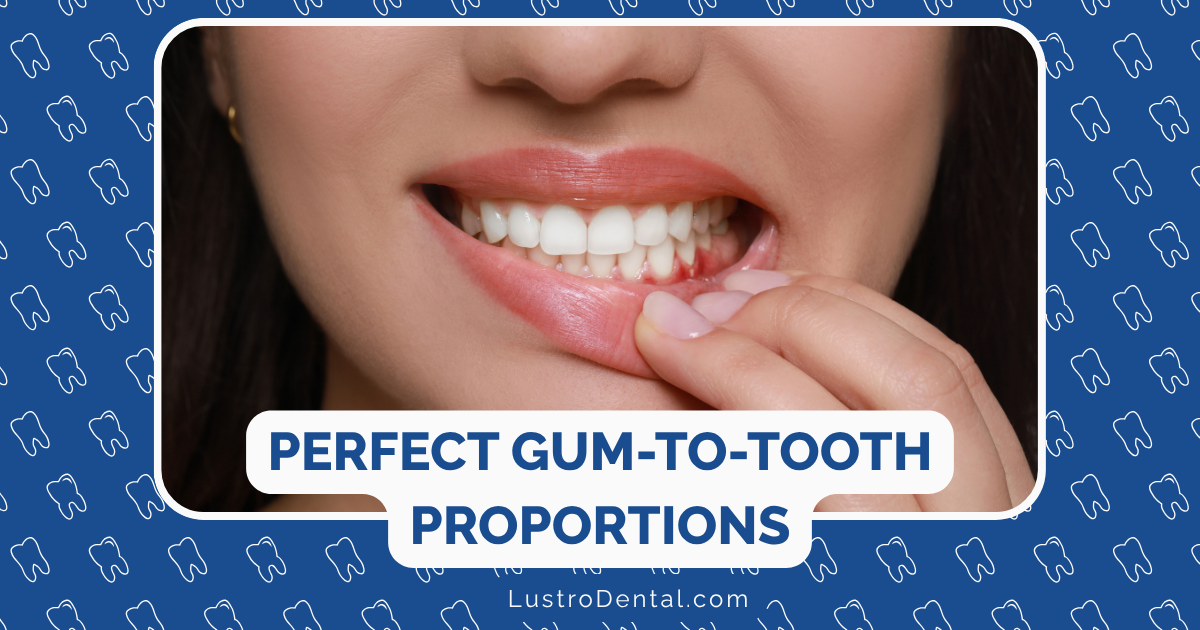
Now, let’s focus on what many consider the unsung hero of beautiful smiles: gum tissue. The relationship between gums and teeth dramatically impacts smile aesthetics, yet it’s often overlooked in discussions about smile makeovers.
Research from the American Academy of Periodontology suggests these guidelines for optimal gum aesthetics:
The gingival aesthetic line is formed by connecting the gingival zeniths of the central incisor, lateral incisor, and canine. In an aesthetically pleasing smile, this line forms a specific angle relative to the horizontal plane, typically between 84-86 degrees.
This subtle angulation creates visual interest and harmony that contributes significantly to smile beauty. When this line is flat or irregular, the smile can appear artificial or imbalanced.
Understanding these mathematical relationships is one thing; applying them in real-world dentistry is another. Here’s how dental professionals use these principles to create beautiful smiles:
Modern dentists often use digital smile design software that applies golden ratio principles automatically. By uploading photos of a patient’s face and current smile, the software can generate a preview of ideal proportions tailored to that individual’s unique features.
Dr. Christian Coachman, the pioneer of Digital Smile Design, explains: “We’re not just designing teeth; we’re designing harmony between teeth, gums, lips, and the entire face. The golden ratio helps us create that harmony in a predictable way.”
When gum tissue doesn’t follow ideal aesthetic lines, gum contouring (also called gingival sculpting) can reshape the gum line. Using lasers or traditional surgical techniques, dentists can:
This procedure is often performed before placing veneers or crowns to establish the proper foundation for the final restorations.
Sometimes, teeth appear too short not because they actually are, but because they’re partially covered by excess gum tissue. Crown lengthening surgically removes this excess tissue and sometimes a small amount of bone to expose more of the tooth structure.
This procedure can transform the appearance of “small teeth” without actually changing the teeth themselves, simply by restoring proper gum-to-tooth proportions.
The small triangles of gum tissue between teeth (papillae) are crucial for aesthetic smiles. When these are missing, “black triangles” appear that age the smile significantly.
Techniques to rebuild these include:
While these mathematical principles provide excellent guidelines, it’s important to note that they’re not rigid rules. True artistry in cosmetic dentistry comes from knowing when to follow the golden ratio strictly and when to deviate for natural-looking results.
Dr. Stephen Snow introduced the concept of “golden percentage” as an alternative to the strict golden proportion, suggesting that central incisors should occupy 25% of the visual width from canine to canine, laterals 15%, and canines 10%. This approach allows for more flexibility while maintaining aesthetic harmony.
Several factors influence what proportions will look most natural for a specific individual:
A skilled cosmetic dentist considers all these factors rather than applying a one-size-fits-all approach.
The effects of achieving proper gum-to-tooth proportions go far beyond aesthetics. Research published in the Journal of Esthetic and Restorative Dentistry demonstrates that smiles with ideal proportions are perceived as:
This perception affects not just how others see us but how we see ourselves. Patients who undergo smile makeovers that address both tooth and gum aesthetics report significant improvements in self-confidence and social comfort.
Sarah, a patient who underwent comprehensive smile design including gum recontouring, shared: “I never realized how much my uneven gum line affected my smile. After treatment, I not only smile more confidently, but my teeth actually look larger and more balanced, even though we didn’t change their size at all.”
If you’re curious about how your own smile measures up to these ideal proportions, here are some questions to consider:
If you answered yes to any of these questions, you might benefit from a consultation with a cosmetic dentist who specializes in comprehensive smile design.
Not all dentists have the same level of training in aesthetic principles. If you’re considering treatment to improve your smile proportions, look for a dentist who:
The golden ratio in dentistry represents the perfect marriage of art and science. By understanding and applying these mathematical principles to both teeth and gums, dental professionals can create smiles that appear naturally beautiful rather than artificially perfect.
The next time you admire someone’s stunning smile, remember that it’s not just about white, straight teeth. The subtle relationship between gums and teeth, guided by ancient mathematical principles, plays a crucial role in creating that harmony and balance that we instinctively recognize as beautiful.
Whether you’re considering cosmetic dental work or simply appreciating the science behind beautiful smiles, understanding these principles gives you a deeper appreciation for the complexity and artistry involved in modern aesthetic dentistry.
Have you had cosmetic dental work that addressed gum aesthetics? Share your experience in the comments below.