🦷 General Care
✨ Treatments
👶 Family Care
💚 Wellness
💡 Resources

🦷 General Care
✨ Treatments
👶 Family Care
💚 Wellness
💡 Resources

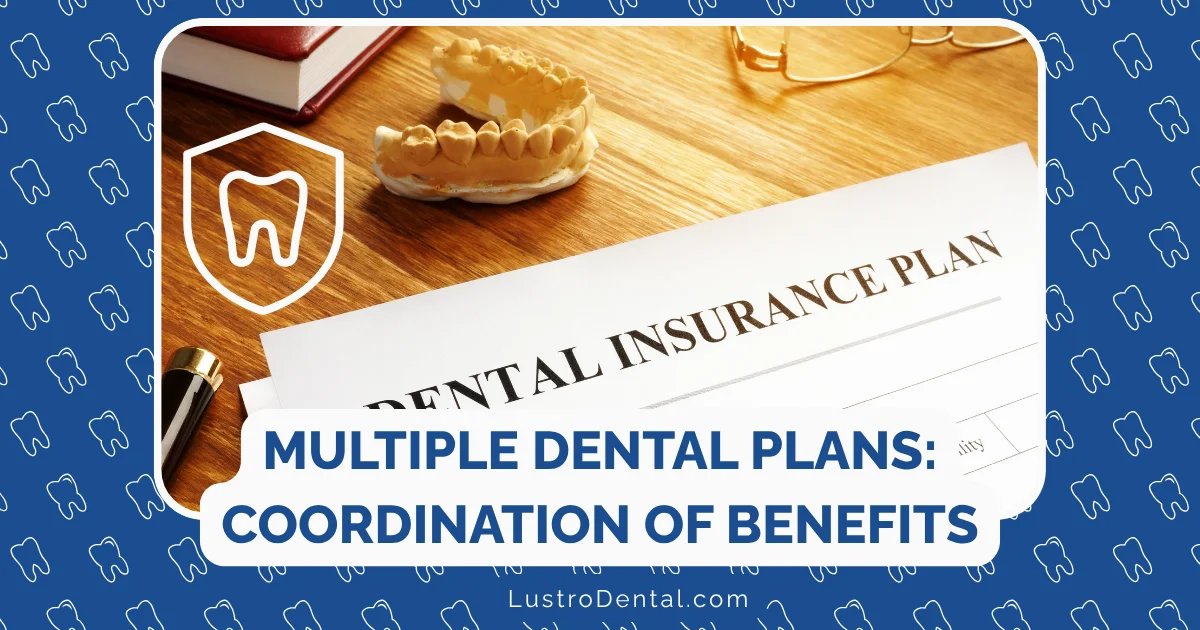
You’ve got dental insurance through your job. Your spouse has a plan through their employer too. And they’ve added you as a dependent. Congratulations—you now have dual dental coverage! But before you start dreaming about double the benefits and zero out-of-pocket costs, let’s talk about what actually happens when you have multiple dental policies.
The process that determines how your two (or more) dental insurance plans work together is called Coordination of Benefits, or COB. And despite what many people think, having two dental insurance policies doesn’t mean you get double the benefits—it means you need to understand some complex rules.
Coordination of Benefits is the insurance industry’s way of ensuring that the total amount paid by all your insurance plans doesn’t exceed 100% of the cost of services. According to Delta Dental, one of America’s largest dental insurers, COB prevents what the industry calls “double-dipping.”
In other words, COB determines:
Before diving into the rules, let’s bust some common myths:
Myth #1: Having two dental plans means you’ll never pay anything out-of-pocket. Reality: While dual coverage can reduce your costs, you may still have out-of-pocket expenses, especially for major procedures or if both plans have similar exclusions.
Myth #2: You’ll get double the annual maximum. Reality: You won’t receive more than 100% of the actual cost of treatment. However, you might effectively increase your overall coverage by having a secondary plan pick up where the primary leaves off.
Myth #3: Coordination of benefits is automatic. Reality: You need to inform both insurance companies about your dual coverage and provide the necessary information for COB to work properly.
Determining which insurance plan is primary (pays first) follows a hierarchy of rules. According to the National Association of Dental Plans, these rules are surprisingly standardized across most insurers:
The plan that covers you as an employee/subscriber is primary over a plan that covers you as a dependent.
Example: Your plan through your employer pays first. Your coverage under your spouse’s plan pays second.
If you have coverage as an active employee and also as a retired employee or through COBRA, the active employment plan is primary.
Example: If you’re covered by your current employer’s plan and also have coverage through a retiree plan from a previous employer, your current employer’s plan pays first.
For children covered under both parents’ plans, the plan of the parent whose birthday comes first in the calendar year is primary. Note: This is about the month and day only, not the year of birth.
Example: If Mom’s birthday is April 15 and Dad’s is October 30, Mom’s plan is primary for the children, regardless of which parent is older.
For children of divorced or separated parents, the determination follows this order:
However, this can be overridden by a court decree.
If none of the above rules determines the primary plan, the plan that has covered the person longer is primary.
Let’s break down what happens when you have a dental procedure with dual coverage:
According to MetLife Dental, one of the largest dental insurers in the U.S., the secondary plan will never pay more than it would if it were the only plan in effect.
Primary Plan Coverage: 100% for preventive care Secondary Plan Coverage: 100% for preventive care
What Happens:
Result: No benefit from dual coverage for fully covered preventive services.
Primary Plan Coverage: 80% after $50 deductible Secondary Plan Coverage: 80% after $50 deductible
What Happens:
Result: Dual coverage eliminated your out-of-pocket expense.
Primary Plan Coverage: 50% with $1,000 annual maximum (which you’ve partially used, leaving $600) Secondary Plan Coverage: 50% with $1,500 annual maximum
What Happens:
Result: Dual coverage provided 100% coverage for a major procedure that would otherwise have cost you $600 out-of-pocket.
While having two dental insurance policies can provide financial benefits, there are some downsides to consider:
You (or your family) are paying two premiums. According to a study by the American Dental Association, the average dental insurance premium is about $360-$600 per year for an individual. If you’re paying for a second policy but rarely using it, you might be wasting money.
Coordinating benefits between two insurance companies can be time-consuming and frustrating. Claims may be delayed while the two companies determine who pays what.
If you request a predetermination of benefits (a cost estimate before treatment), the process becomes more complex with dual coverage, as the secondary insurer can’t provide an accurate estimate until the primary has processed the claim.
If you do have multiple dental policies, here’s how to maximize your benefits:
Make sure both insurers know about the other coverage. Provide all policy information to both companies and to your dental provider.
If you need expensive dental work, consider timing it to maximize your benefits. For example, if you’re close to maxing out your primary plan’s annual limit, schedule the procedure for when your secondary coverage can pick up more of the cost.
While COB rules are fairly standardized, there can be variations. Request the COB provisions in writing from both insurers.
Maintain copies of all claims, explanations of benefits, and correspondence with both insurance companies. This documentation will be invaluable if disputes arise.
The answer depends on your specific situation. According to Consumer Reports, dual coverage makes the most sense when:
Coordination of benefits for dental insurance is complex but can provide significant financial advantages if you understand how it works. While dual coverage won’t double your benefits, it can reduce your out-of-pocket expenses, especially for major dental procedures.
Before adding or maintaining a second dental insurance policy, do the math. Calculate the additional premium cost against the potential savings based on your anticipated dental needs.
Remember, the goal isn’t to have the most insurance—it’s to have the right insurance that provides the best coverage for your specific dental health needs at the most reasonable cost.
Have you navigated the world of dual dental coverage? Share your experiences and tips in the comments below!